How 'fast' politics has left the NSW government staring into the electoral abyss
- Written by: Andy Marks, Pro Vice-Chancellor, Strategy, Government and Alliances, Western Sydney University
The 1973 Watergate Committee hearings[1] ran for 51 days. The televised revelations drew a huge audience. The pressure built with slow, devastating intensity, devouring then US President Richard Nixon’s agenda, eventually leaving him no option but to fall on his sword.
While not quite a Watergate moment, it is hard to see how the current NSW parliamentary inquiry[2] into the appointment of the New York trade commissioner will end. Approaching day 49 of proceedings, the inquiry has already prompted the resignation of NSW Liberal deputy leader Stuart Ayres, with more fallout a distinct possibility.
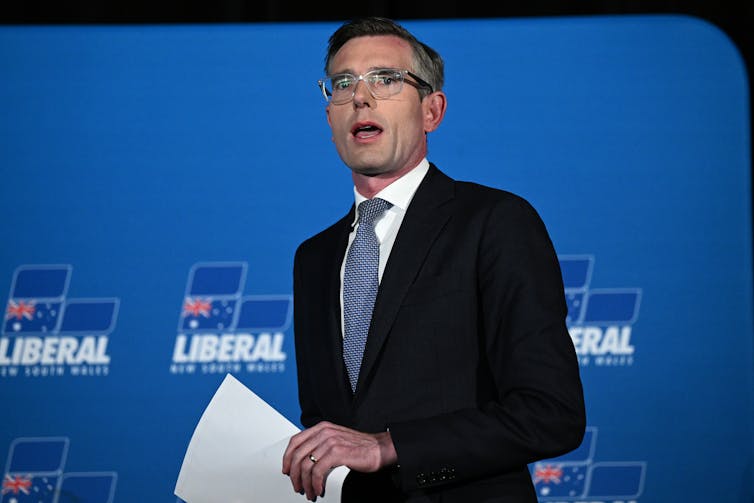
Internal Liberal-National Coalition critics of Dominic Perrottet’s management of the issue are reportedly “furious[3]”. Their wrath centres on two issues. First, the premier’s inability to anticipate public reaction to the appointment. Second, his incapacity to put an end to the controversy.
The latter point is telling, as it goes to heart of the most prized skill in modern politics: tempo.
Regaining control of political tempo is possibly Perrottet’s only chance of securing another term for his 12-year-old government at the March 2023 election against a reinvigorated Labor opposition. Finding your rhythm, let alone dictating it, is not as easy as it sounds. Trust me. In a former life I was a drummer[4] of mild renown.
Political tempo is an interesting phenomenon. Elected officials do everything they can to control it, but it is a dark and fleeting art. In Australian politics of old, slowing down the media and parliamentary agenda was a virtue; a marker of reasoned, deliberative and informed leadership.
Read more: NSW government slides further into trouble as Perrottet struggles for clear air[5]
Asked on an airport tarmac in 1965 by a clamouring media pack whether Labor would back then Prime Minister Robert Menzies’s commitment of Australian troops to Vietnam, Labor leader Arthur Calwell calmly refused to answer.
Days later, on the floor of parliament, he articulated Labor’s prescient rejection[6] of the decision. It was a moment that restored his party’s moral compass and set a tempo towards eventual electoral victory eight years later under Whitlam.
The art of slow politics has been lost. In recent decades, controlling the daily media agenda has become the goal. The timing of press releases, the staging of doorstop interviews, speaking points, three-word slogans and zingers have become the hallmark of fast politics. Perrottet, like other contemporary leaders, is compelled to move, and accordingly be judged, at this speed.
A protracted inquiry is kryptonite to fast politics.
With no end in sight to the upper house inquiry, the NSW Coalition is contending with daily, relatively unpredictable attacks on its integrity. This comes in the wake of the electoral defeat of its federal colleagues, largely over questions of integrity and trust.
The premier has attempted to counter this perception by initiating his own inquiry – by former public service commissioner Graeme Head – to “ensure the utmost independence and public confidence in the process[7]”. Public confidence is indeed the critical factor.
But the concurrent upper house inquiry has no patience for slow politics. It makes its own case for the public’s confidence. It marches on, drowning out the premier’s internal inquiry, with a cavalcade of political and “private citizen” appearances setting their own tempo, making their own claims, and marking out their own versions of events.
In this scenario, the premier’s attempts at process and transparency are countered by the unpredictable and meandering events of hearings he can neither predict nor counter.
The political agenda has been lost, and tempo – of any discernible rhythm – seems impossible to restore.
Read more: View from The Hill: Barilaro keeps Nationals in the tent; koalas stay in limbo[8]
It is a dire position for any government to find itself in, particularly at this late stage of the electoral cycle. It may be that an abandonment of prior positions is the only option. A reset.
To a degree, the NSW Labor opposition has beaten the Coalition on the reset front. Opposition Leader Chris Minns has vowed to “abolish[9]” the controversial trade postings should Labor win office. It is not too late for the premier to make the same commitment.
Matching Labor’s political tempo on this issue would seem anathema to many Coalition strategists, and their Labor counterparts. Careers in modern politics have been forged through steadfast political differentiation, conflict, and dogged combat.
The federal poll tells us voters might be tiring of political cacophony. Truly “new” politics in NSW might just be found in synchronicity.
References
- ^ Watergate Committee hearings (www.levin-center.org)
- ^ NSW parliamentary inquiry (www.parliament.nsw.gov.au)
- ^ furious (amp.smh.com.au)
- ^ I was a drummer (en.m.wikipedia.org)
- ^ NSW government slides further into trouble as Perrottet struggles for clear air (theconversation.com)
- ^ Labor’s prescient rejection (www.thesaturdaypaper.com.au)
- ^ ensure the utmost independence and public confidence in the process (amp.abc.net.au)
- ^ View from The Hill: Barilaro keeps Nationals in the tent; koalas stay in limbo (theconversation.com)
- ^ abolish (www.smh.com.au)