Sore throats suck. Do throat lozenges help at all?
- Written by: David King, Senior Lecturer in General Practice, The University of Queensland
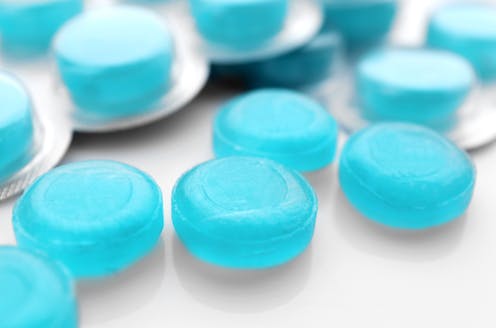
It’s hard to get through a winter without suffering sore throat, but luckily they normally get better within a few days[1].
Sore throat is a common symptom of COVID and its newer variants[2]. And of course, many sore throats are caused by viral colds or flu, so they can be treated at home.
The most common treatment is probably throat lozenges – but do they really work any better than sucking on a hard lolly?
Why does my throat hurt so much?
A sore throat can fall anywhere between slight discomfort to a sensation of “swallowing razor blades”. Occasionally it hurts so much to swallow that people dribble saliva from their mouths, rather than swallowing it.
Bacteria and viruses can invade the thin moist skin (mucosa) lining the throat. This kills many lining cells and triggers inflammation[3], which appears as redness, swelling and increased secretions.
Infections in the nose also cause thick mucus to travel down the back of the throat and cause further irritation. This is referred to as “post-nasal drip”. A blocked nose causes reliance on mouth breathing, which tends to dehydrate the already inflamed throat. Ouch.

Read more: When RAT-testing for COVID, should you also swab your throat?[5]
What do lozenges do?
Lozenges are a solid medication intended to be dissolved or disintegrated slowly in the mouth. They consist of one or more active ingredients and are flavoured and sweetened to make them pleasant tasting. Hard lozenges[6] are generally formed using sucrose or other sugars similar to the process for hard candy confections.
There are many active ingredients added to lozenges, including antiseptics; pain relievers; menthol and eucalyptus oil; cough suppressants such as dextromethorphan[7] and soothing compounds. “Cough drops” and sore throat lozenges are almost identical[8] but may contain different proportions of these ingredients.
Different brands of lozenges advertise a confusing choice of formulations. It is more common now to see brands with “triple action” ingredients that promise to be anaesthetic (to numb pain), antiseptic (to kill germs) and anti-inflammatory (to reduce redness).
Unfortunately, clinical trials directly comparing the benefit of different medication types for most common conditions (head to head trials) are rarely undertaken. This is likely due to the added complexity of such trials compared with placebo controlled trials, and medication research often being funded by the pharmaceutical manufacturer[9] of the products. So, we have to rely on indirect comparisons instead.
The traditional approach to treating sore throat is to assume lozenges or gargling with antiseptics will reduce sore throat by treating the infection causing it.
However, a limited number of trials of antiseptic lozenges (such as Strepsils and Betadine lozenges) produced only a small reduction[10] in sore throat pain (a difference of one unit in a ten-point pain scale compared with placebo). So they do seem to provide a small degree of relief[11], and continue to be sold.
More and more brands are including other medications beyond antiseptics in their range of throat lozenges
 A sore throat can make swallowing painful.
Shutterstock[12]
A sore throat can make swallowing painful.
Shutterstock[12]
Read more: Health Check: do cough medicines work?[13]
Checking the effects
There are some other explanations for the apparent effectiveness of any treatment for a self-limiting infection. How do we know if the symptom or infection would have lasted longer if we hadn’t used that treatment? To tell, we’d need a control group who didn’t receive the treatment, and a large sample size to overcome the role of chance causing the difference.
Relief might come from something other than the active ingredient. After all, sucking on a sweet, hard lozenge could soothe a dry throat by increasing saliva release. To test this effect, we’d need a true placebo medication – identical in every respect apart from the active ingredient.
Several well-designed and well-conducted controlled clinical trials show some active ingredients provide significantly better pain relief than placebo lozenges. These medications fall into two main groups: local anaesthetics (such as benzocaine) and anti-inflammatory agents (flurbiprofen).
A study[14] comparing benzocaine lozenges, (now offered in many brands of lozenges) to placebo lozenges found quicker pain relief (20 minutes for benzocaine compared to more than 45 minutes for the placebo). More study participants felt relief using the medication, though very few reported complete pain relief.
A systematic research review[15] found nine studies that supported the benefit of flurbiprofen lozenges (available in Australia in Strepfen Intensive lozenges) for a range of sore throat conditions. In one of the reviewed studies[16], flurbiprofen produced greater reductions in sore throat pain (47%) as well as difficulty swallowing (66%) and swollen throat (40%) over the first 24 hours compared with placebo.
One of the common sore throat treatments sold in Australia is Difflam, which contains the anti-inflammatory medication benzydamine. One clinical trial[17] found a greater than two point reduction in the ten point pain scale by day three in those using Benzydamine versus placebo.
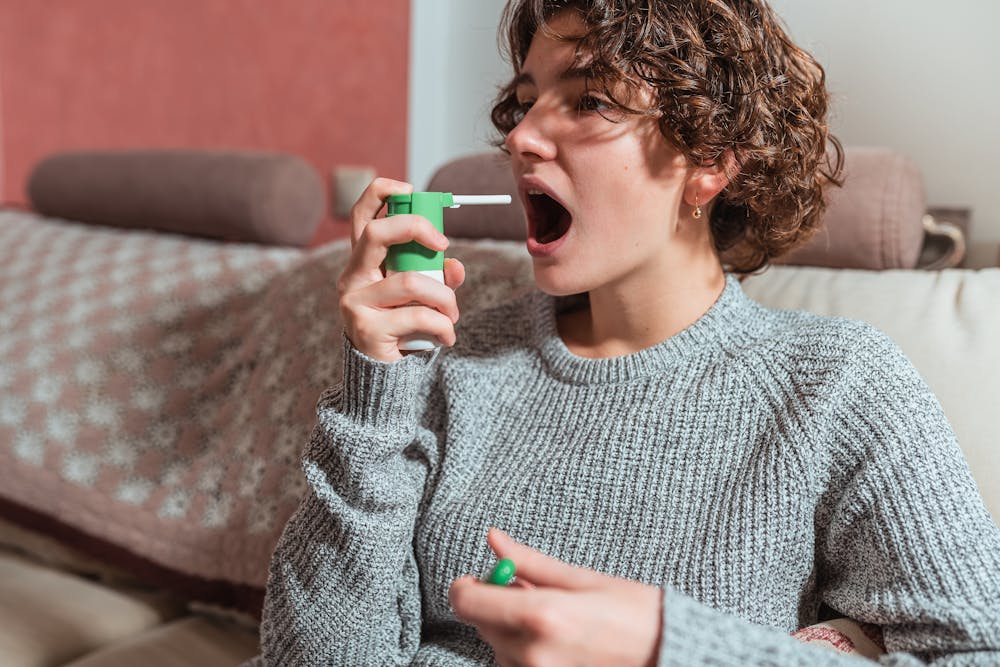 Some people prefer throat sprays.
Shutterstock[18]
Some people prefer throat sprays.
Shutterstock[18]
Are lozenges better than sore throat sprays?
A study[19] using radioactive labelled medication demonstrated more prolonged and complete delivery of medication in the mouth for lozenges compared to spray and gargle. This seems to be the basis for the claim that sprays are less effective than lozenges.
However, drawing conclusions from such evidence is less accurate than a study that directly compares the effectiveness of the various modes of delivery on actual pain. One study[20] compared flurbiprofen and found similar pain relief benefit between lozenges and spray.
So the choice of delivery method can be based on personal preference, including the taste of the product.
The takeaway
Sore throat lozenges and sprays provide some additional relief for the pain of sore throat, particularly those with anti-inflammatory or local anaesthetic ingredients. They are often combined with an antiseptic agent, which may or may not add any significant benefit.
Used as directed, these agents seem safe and have negligible adverse effects. They are also affordable and readily available.
But this shouldn’t stop us using other treatments we know also soothe sore throats, such as a small spoonful of honey[21].
Read more: How to actually fix a lost voice, according to science (hint: lemon and honey doesn't work)[22]
References
- ^ few days (www.safetyandquality.gov.au)
- ^ newer variants (www.bmj.com)
- ^ inflammation (www.ncbi.nlm.nih.gov)
- ^ Shutterstock (image.shutterstock.com)
- ^ When RAT-testing for COVID, should you also swab your throat? (theconversation.com)
- ^ lozenges (www.sciencedirect.com)
- ^ dextromethorphan (medlineplus.gov)
- ^ almost identical (quantumhealth.com)
- ^ funded by the pharmaceutical manufacturer (doi.org)
- ^ small reduction (doi.org)
- ^ a small degree of relief (www.compoundchem.com)
- ^ Shutterstock (image.shutterstock.com)
- ^ Health Check: do cough medicines work? (theconversation.com)
- ^ study (doi.org)
- ^ research review (pubmed.ncbi.nlm.nih.gov)
- ^ one of the reviewed studies (doi.org)
- ^ clinical trial (www.academia.edu)
- ^ Shutterstock (image.shutterstock.com)
- ^ study (pubmed.ncbi.nlm.nih.gov)
- ^ study (pubmed.ncbi.nlm.nih.gov)
- ^ spoonful of honey (www.researchgate.net)
- ^ How to actually fix a lost voice, according to science (hint: lemon and honey doesn't work) (theconversation.com)
Read more https://theconversation.com/sore-throats-suck-do-throat-lozenges-help-at-all-184454