Australia's finally acknowledged climate change is a national security threat. Here are 5 mistakes to avoid
- Written by: Robert Glasser, Honorary Professor, Institute for Climate, Energy & Disaster Solutions, Australian National University
The climate policies of the former Morrison government were widely panned – largely for a weak commitment to cutting emissions and a slow transition to renewable energy. But amid all the shortcomings, arguably the biggest was the Coalition’s neglect of security threats posed by climate change.
The Albanese government has moved to address this gap. It has launched an urgent review[1] of climate and security risk led by intelligence chief Andrew Shearer, working closely with Defence. The review team now faces a daunting task.
Climate change[2] is a pressing and accelerating threat to global security. It will disrupt trade, displace populations, cause food and energy shortages and drive conflict between nations.
Southeast Asia, on our northern doorstep, is particularly at risk[3]. It’s a global hotspot of overlapping climate hazards such as intensifying cyclones, sea level rise and extreme heat.
What’s more, the region is heavily populated – 275 million people live in Indonesia alone – and its social safety nets cannot support all those displaced by disasters.
The government review is a crucial first step in preparing Australia for the dangers ahead. But to be successful, it must avoid these five pitfalls.
1. Narrow definition of national security
Climate change will no doubt challenge our defence force, threatening military infrastructure and readiness. It will also exacerbate tensions in military hotspots such as the South China Sea[4], where sea level rise and ocean warming will amplify disputes over maritime boundaries and fisheries.
But the most pressing regional security threats will come from climate change disruptions to social systems. In particular, disruptions to food, water and energy will displace large populations, undermine the legitimacy of governments and cause other social upheaval.
The issues go far beyond traditional national security portfolios such as Defence, Foreign Affairs, Home Affairs and intelligence agencies. A wide range of government departments must be involved in addressing these risks.
Read more: Seriously ugly: here's how Australia will look if the world heats by 3°C this century[5]
2. Focusing too much on overseas threats
The risk assessment should consider the need to both respond to climate harms within Australia while being prepared to meet overseas threats, such as military instability abroad. This will primarily require personnel to deal with both tasks.
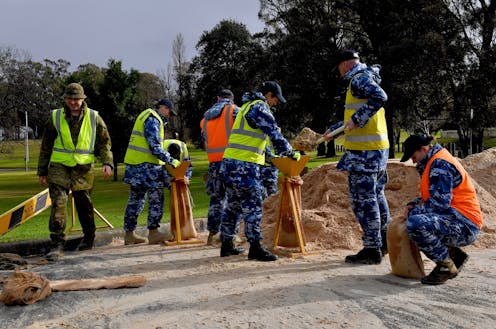
During the election campaign, Labor mooted[6] a new civilian national disaster response force. This force would free Defence to meet intensifying military threats abroad.
A review too heavily focused on overseas threats would miss the need for such measures.
3. Taking a siloed view
Most analysis of climate damage tends to focus on individual, rather than system-wide, impacts.
For example, a study might examine how rising temperatures will reduce food production, but not the compounding effects of hazards happening at the same time such as floods, drought and increased pests.
It’s difficult to analyse how hazards can trigger cascades of disruptions across society. But unless the review grapples with this reality, it will fundamentally misjudge the scale of the challenge.
4. Underestimating the urgency
It’s easy to assume the pace of climate impacts we’ve experienced in the recent past is what to expect in future. But in fact, these impacts are now increasing rapidly.
Extreme heat events, for example, have mushroomed[7] 90-fold over the past decade, relative to the previous 30 years. Severe one-in-100-year flood events will soon become annual events[8] in many parts of the world.
These changes are already visible in Southeast Asia where sea levels are rising at the fastest pace globally. Some 75 million Indonesians are now exposed[9] to high flood risk.
So the risk assessment must avoid miscalculating how soon major disruptions to society will be felt.
5. Oversimplifying
Labor wants the review completed urgently (although it will be updated regularly[10]). With time pressures, some shortcuts will be needed. But the assessment team should avoid oversimplifying the process.
It would be unfortunate, for example, if the review involved a series of common questions presented to government departments, with the answers collated to form the final report. This was essentially the approach of the Biden administration[11] in the US. The result was a patchy assessment with little whole-of-government integration.
Ideally, the process should begin with consultation across government to identify the key objectives – many of which will fall within the mandates of multiple government department, such as:
- securing our borders
- ensuring energy security
- tackling transnational organised crime
- countering terrorism and violent extremism.
Read more: Climate change poses a 'direct threat' to Australia's national security. It must be a political priority[12]
The objectives would be the reference points for the review, and relevant government agencies would work together to identify the risks and responses.
For example, China’s regional trajectory cannot be understood separately from the risks posed by climate change. Australia must develop a deep and nuanced understanding of how climate change may affect Australian efforts to compete (or cooperate) with China in the region. The review should lay the groundwork for this.
Getting it right
Climate threats exist all at once in every direction: domestically, regionally, and internationally. This is the core challenge the review must tackle.
It will take exceptionally good judgement and execution to ensure that the risk assessment avoids becoming a platitude or, at the other extreme, mired in complexity.
Our national security, and the safety and well-being of all Australians, depends on getting it right.
Read more: Indonesia's capital Jakarta is sinking. Here's how to stop this[13]
References
- ^ review (www.theguardian.com)
- ^ Climate change (ad-aspi.s3.ap-southeast-2.amazonaws.com)
- ^ at risk (ad-aspi.s3.ap-southeast-2.amazonaws.com)
- ^ South China Sea (thediplomat.com)
- ^ Seriously ugly: here's how Australia will look if the world heats by 3°C this century (theconversation.com)
- ^ mooted (www.afr.com)
- ^ mushroomed (www.nature.com)
- ^ annual events (www.abc.net.au)
- ^ exposed (www.nature.com)
- ^ regularly (keystone-alp.s3-ap-southeast-2.amazonaws.com)
- ^ Biden administration (www.aspistrategist.org.au)
- ^ Climate change poses a 'direct threat' to Australia's national security. It must be a political priority (theconversation.com)
- ^ Indonesia's capital Jakarta is sinking. Here's how to stop this (theconversation.com)