Part-time work holds women back from executive positions and accentuates gender pay gap: new data
Written by: Michelle Grattan, Professorial Fellow, University of Canberra
Most women are not working full-time during most of their working lives, which holds them back from management positions and accentuates the pay gap with men, according to data released on Monday.
Men on average out-earn women across all working age groups.
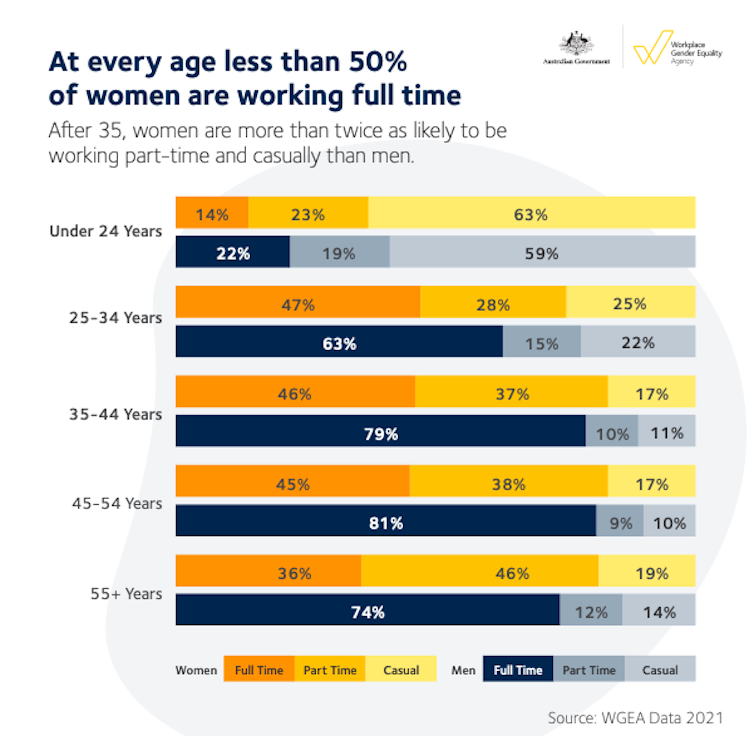
At every age group less than 50% of women were full time in 2021, according to the Wages and Ages: Mapping the Gender Pay Gap by Age data series. This has been issued by the Workplace Gender Equality Agency, a federal government body. The data comes from private sector employers with 100 or more employees.
The divergence in working patterns between men and women starts from age 35, when men are mainly working full time and women mainly working part time or casually. After 35 women are more than twice as likely to work part time and casually than men.
Men over age 55 are twice as likely to be in management as women. Of those women in management at the same age, two thirds are in lower ranks. Men also earn more than women across each generation in the workplace, according to the data. The gap is greatest at 55-64 where men out-earn women by almost one third (31.9%). This is more than $40,000 on average a year. Even those women in senior executive and CEO jobs aged 55 and above face a big pay gap – they are earning about $93,000 annually less on average than male counterparts. The agency says “that in 2021 at no age were more than 50% of women working full time, yet higher paid management opportunities were almost exclusively reserved for full-time workers. In all age groups, more than 90% of managers were working full-time.”
On average, companies with more part-time managers have more women at executive levels. WGEA director Mary Wooldridge said if the trends in the data continued, millennial women now working would earn only 70% of men’s earnings by the time they were 45. “Millennial women in the workforce 35 and under are currently reaching management at equal rates as men,” Wooldridge said. “We have a generation of Australian women who are highly educated, and over the last decade have been outnumbering men in higher education enrolments and completion. "If organisations want to unlock the potential that these women can provide after the age of 35, there needs to be a shift in workplace structures surrounding them. Creative workplaces will reap the talent rewards today and in the future.” She said “too many employers are missing a huge talent pool by not encouraging and enabling women to work additional hours or in the managerial ranks”. She highlighted the importance of gender-neutral parental leave. childcare subsidies and support, and flexible work policies. “Leading employers are creating or redesigning roles to support part-time management and job-sharing structures,” Wooldridge said.