When RAT-testing for COVID, should you also swab your throat?
- Written by: Thea van de Mortel, Professor, Nursing and Deputy Head (Learning & Teaching), School of Nursing and Midwifery, Griffith University
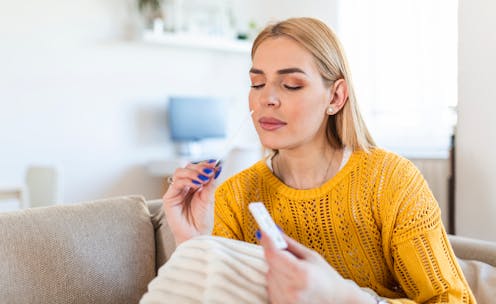
We’re now pretty used to swabbing our nose to test for COVID when we have a scratchy throat or new cough. But should we also be using our rapid antigen test (RAT) to swab our throat, as some social media sources suggest?
As people with an Omicron infection often get a sore throat early on, they reason that Omicron is found first in the throat. So swabbing the throat and nose together, some social media sources say, is more likely to accurately detect an infection.
A sore throat is more common[1] with Omicron than Delta. However this doesn’t mean you should use your nasal RAT to swab your throat for Omicron. It’s best to follow the instructions on the packet.
Remind me, what are the different types of RATs?
There are several different ways to test for COVID using a RAT.
Oral samples can include saliva (spit into a tube), saliva from a tongue or cheek swab, or a throat swab (tonsil area).
Nasal samples can be collected from the front (anterior), middle or back (nasopharyngeal) of the nose.
There are also many different brands of RAT. Their ability to detect a positive case varies depending on the brand, the variant[2], whether the person has symptoms[3], and their viral load[4] at the time of the test.
Read more: Taking your first rapid antigen test? 7 tips for an accurate result[5]
What do studies say about RATs for the nose vs throat?
It’s complicated. The time lag between researchers conducting a study and its publication means studies that compare sampling methods were largely conducted before Omicron, or before the widespread use of RATs.
A systematic review[6] of 23 pre-Omicron studies found nasal and throat samples tested together were more sensitive (meaning they accurately detected a positive case) than nasal samples alone: 97% vs 86%.
However, these were swabs taken independently (with two separate swabs – one for the nose and one for the throat) and then combined at the point of testing the sample, rather than taking a combined nasal/throat swab (where the nose is swabbed then the throat is swabbed with the same swab, or vice versa). They also used PCRs rather than RATs.
A study[7] conducted during the Omicron wave tested 49 people with PCR-confirmed COVID who had both nasal and throat swabs. It found 86% of positive cases were picked up by nasal swabs on a RAT compared with 47% detected by throat swabs, and 89% by both methods.
This suggests Omicron is not more easily detected in the throat. Adding a throat swab did not pick up many extra cases (3%).
However, a preprint study[9], which is yet to be peer-reviewed (checked by independent scientists), reports conflicting results.
In this study, individual nasal and throat swabs both detected 64.5% of infections. But some nasal samples tested positive when the throat swab was negative and vice versa. Doing both tests individually picked up around 89% of positive cases.
When individual nasal swabs were compared to a combined nasal/throat swab, the nasal swabs picked up around 68% of the cases, while the combined swab picked up around 82%.
In summary, of the two recent studies that include an Omicron sample, the published study found that nasal swabs were much more effective than throat swabs at detecting COVID. And if the results of both tests were combined, only 3% of extra cases would be detected.
The preprint (unpublished) study reports conflicting results, suggesting a combined nasal/throat swab would pick up an extra 14% of cases.
Read more: Just how accurate are rapid antigen tests? Two testing experts explain the latest data[10]
Does Omicron appear first or at higher levels in the throat?
A survey found those with Omicron were 9% more likely to report a sore throat[11] than those with Delta, whereas the latter were more likely to report a runny nose and sneezing.
However, when comparing saliva from a throat swab to a deep nasal swab in a study of 624 people, researchers found[12] more virus (known as viral load) in the deep nasal swabs than in saliva tests. A test is more likely to detect a positive case when the viral load is higher.
The researchers found more virus in the nasal swab regardless of the day the specimen was collected, which suggests the virus doesn’t appear earlier in the throat.
Detection of COVID in saliva from the throat was 4% less likely in Omicron compared to Delta cases, which suggests Omicron doesn’t increase the viral load of saliva in the throat either.
However, it’s important to note, the nasal swabs we take at home are unlikely to go as deep as those in this study, which could affect the results.
Other things to consider
The type of swab also differs, depending on whether it is designed for a nasal or oral test, and may not always be appropriate to sample a different area, because of differences in swab shape and flexibility.
The pH (a measure of acidity) also differs in the throat and the nose, and altered pH can affect COVID test function[14], and therefore could potentially affect the result.
So what should you do?
The website of Australia’s regulator, the Therapeutic Goods Administration, recommends[15] performing either a nasal or oral test, as the instructions direct.
Likewise, the US Food and Drug Administration[16] recommends RAT instructions are followed to the letter.
While the UK’s National Health Service (Britain) website refers to swabbing both the throat and nose, this is using a RAT kit that is made[17] to do both.
As there is currently no clear evidence that Omicron appears in the throat earlier or at higher levels, and RATs are designed and tested for the specific area being sampled, it makes sense to continue to follow the test instructions.
If you wish to swab both areas, it’s best to use two separate tests designed for those areas.
Read more: Can you use rapid antigen tests in children under 2 years old?[18]
References
- ^ more common (onlinelibrary.wiley.com)
- ^ the variant (link.springer.com)
- ^ symptoms (www.acpjournals.org)
- ^ viral load (www.acpjournals.org)
- ^ Taking your first rapid antigen test? 7 tips for an accurate result (theconversation.com)
- ^ systematic review (www.thelancet.com)
- ^ study (www.acpjournals.org)
- ^ Shutterstock (www.shutterstock.com)
- ^ a preprint study (onlinelibrary.wiley.com)
- ^ Just how accurate are rapid antigen tests? Two testing experts explain the latest data (theconversation.com)
- ^ sore throat (onlinelibrary.wiley.com)
- ^ researchers found (onlinelibrary.wiley.com)
- ^ Shutterstock (www.shutterstock.com)
- ^ altered pH can affect COVID test function (www.sciencedirect.com)
- ^ recommends (www.tga.gov.au)
- ^ US Food and Drug Administration (twitter.com)
- ^ made (www.gov.uk)
- ^ Can you use rapid antigen tests in children under 2 years old? (theconversation.com)
Read more https://theconversation.com/when-rat-testing-for-covid-should-you-also-swab-your-throat-184732