For many Australians, Anzac Day has been defined by a pilgrimage to Gallipoli. Can we mark the day differently?
- Written by: Brad West, Senior Lecturer in Sociology, University of South Australia
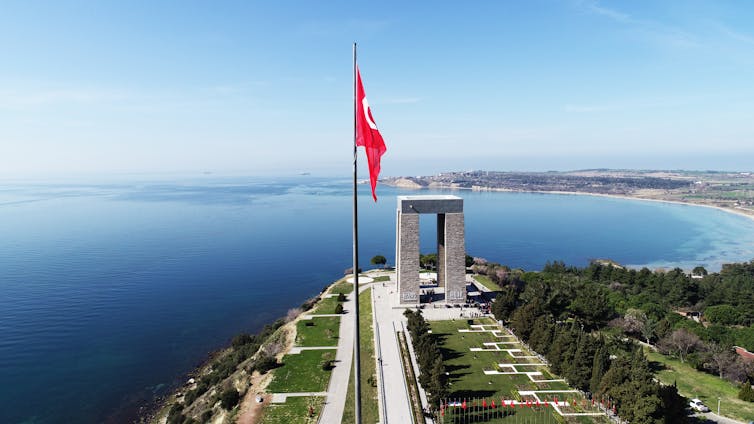
After years of pandemic disruptions, crowds will once again be free to attend[1] Anzac Day dawn services and veteran marches on April 25 this year.
But what will public participation be like this Anzac Day? And with the decline of Anzac pilgrimages – especially to Gallipoli – can we find a new, compelling and inclusive ways to commemorate Anzac Day?
Read more: The forgotten Australian veterans who opposed National Service and the Vietnam War[2]
The Gallipoli pilgrimage
In my recently published book, Finding Gallipoli[3], I argue Australia’s historical commemoration of war has been shaped by the symbolic representations and experience of travel.
During the first world war, travel was an important way of comprehending the conflict. Travel was often romanticised for the purposes of recruitment, while soldier diaries reveal many saw themselves as tourists on foreign battlefields.
Australian historian Richard White[4] suggests such sentiment afforded frontline troops a degree of detachment from the horrors of war.
Many soldiers also derived comfort from the belief that if they died in battle, their graves could become a site of pilgrimage through travel.
Yet Australians rarely engaged in this pilgrimage practice until the late 20th century. This is, in part, explained by the Returned and Services League’s[5] (RSL) view, which saw popular travel accounts[6] “sanctifying” Gallipoli battle sites as commercial and crass.
A shift in the 1990s
According to Australian historian Graeme Davison, the number of spectators[7] at Anzac Day parades across Australia throughout the 1980s was low, if not declining. Increases only appeared in the first half of the 1990s.
This increased attendance at Anzac Days is often associated with a phase of new nationalism spearheaded by Peter Weir’s 1981 film, Gallipoli, starring Mel Gibson.
In my book, however, I argue it was not popular cultural projections that made the difference. A bigger factor was the Hawke Labor government’s decision to make pilgrimage the main commemorative activity for the 75th anniversary of the Gallipoli campaign.
Also central was the influence of young Australians, especially backpackers[8], who became carriers and custodians of the Anzac tradition. As contemporary travellers at Gallipoli, this group was interested in the Turkish perspective, and this encouraged a more inclusive historical portrayal of the battle.
This marked a shift from older descendants of Australian service men and women – as well as ex-service groups like the RSL – being seen as the sole champions of the Anzac spirit.
Read more: How Anzac Day came to occupy a sacred place in Australians' hearts[9]
Change in Turkey
The Gallipoli pilgrimage was only possible due to a fundamental shift[10] in how Turkey engaged with its wartime past.
Turkish pro-republican politicians had largely avoided commemorative engagements[11] of the first world war following the formation of modern Turkey in 1923.
However, the establishment of a national park at Gallipoli and mounting Kurdish separatist sentiment across the country[12] saw Turkish authorities in the 1980s and 1990s embrace pilgrimage[13] to Gallipoli as a way to renew their secular republic.
Since the election of the Justice and Development Party (AKP) in 2002, Gallipoli has become a site for reimagining Turkish national identity – away from secularism and toward an identity more rooted in Ottoman history and Islam.
The Gallipoli battlefields have grown increasingly inaccessible to Australian travellers over time. That’s due to Turkey’s renewed interest in the pilgrimage tradition, diplomatic tensions[14] over the 90th anniversary of the conflict in 2005 and increased recognition of the Armenian Genocide[15] in Australia.
Australia’s controversial Senate inquiry[16] into the damaging impact of roadworks on key battle sites along the Gallipoli peninsula also heightened friction between the two nations.
Read more: In remembering Anzac Day, what do we forget?[17]
The search for an alternative to travel
In such a fraught political climate, we have witnessed the search for alternative, compelling ways to commemorate Anzac Day. But the options are not promising.
As part of efforts to direct attention away from Gallipoli[18], then-prime minister Tony Abbott unveiled plans to spend A$100 million[19] in 2015 on a Australian National Memorial in Viller-Bretonneux.
However, the monument and its connected museum’s carefully constructed portrayals of the conflict didn’t have the immersive quality of Gallipoli travel experiences. Nor did it have the exposure to “foreign” understandings of history that we find at Gallipoli.
Commemorating in Australia
In Australia, commemorations have often focused on the Australian War Memorial in Canberra. But this site is not without controversy either: an expensive renovation of the Australian War Memorial has been heavily criticised[20], particularly in the context of a mental health crisis among veterans.
Critics have questioned the memorial’s plans to display heavy military technology, such as planes, helicopters and armoured vehicles, given its funding ties[21] to global arms manufacturers.
Could a different day serve the purpose of remembering Australia’s recent wartime efforts? In July last year, Defence Minister Peter Dutton announced plans for a special Commemorative Day[22] recognising the “service and sacrifice of Defence personnel and their families” who have helped prevent terrorist attacks on Australian soil.
However, this proposed day of remembrance has already provoked controversy[23] for largely overlooking the diversity of people who were vital to Australia’s involvement[24] in Afghanistan. This included Afghan interpreters, but also Australian personnel other than soldiers, such as development advisers.
In finding new ways to commemorate Anzac Day, we should learn a lesson from the rise of the Gallipoli pilgrimage. To be meaningful, military history now needs to acknowledge the contributions of all parties and sides, while the experience of remembrance itself has to be memorable.
Lest we forget.
Read more: The hard sell: has the Anzac industry passed its use-by date?[25]
References
- ^ free to attend (thenewdaily.com.au)
- ^ The forgotten Australian veterans who opposed National Service and the Vietnam War (theconversation.com)
- ^ Finding Gallipoli (www.amazon.com.au)
- ^ Richard White (www.tandfonline.com)
- ^ Returned and Services League’s (onlinelibrary.wiley.com)
- ^ popular travel accounts (www.tandfonline.com)
- ^ number of spectators (research.monash.edu)
- ^ backpackers (journals.sagepub.com)
- ^ How Anzac Day came to occupy a sacred place in Australians' hearts (theconversation.com)
- ^ fundamental shift (www.tandfonline.com)
- ^ avoided commemorative engagements (theconversation.com)
- ^ Kurdish separatist sentiment across the country (www.crisisgroup.org)
- ^ embrace pilgrimage (www.awm.gov.au)
- ^ diplomatic tensions (www.abc.net.au)
- ^ recognition of the Armenian Genocide (www.abc.net.au)
- ^ Senate inquiry (www.aph.gov.au)
- ^ In remembering Anzac Day, what do we forget? (theconversation.com)
- ^ attention away from Gallipoli (www.theguardian.com)
- ^ to spend A$100 million (www.abc.net.au)
- ^ heavily criticised (honesthistory.net.au)
- ^ funding ties (www.theguardian.com)
- ^ special Commemorative Day (www.minister.defence.gov.au)
- ^ provoked controversy (www.theguardian.com)
- ^ involvement (www.theguardian.com)
- ^ The hard sell: has the Anzac industry passed its use-by date? (theconversation.com)