What is toe jam? From harmless gunk to a feast for bugs
- Written by: Caroline Robinson, Associate Professor Podiatry, Charles Sturt University
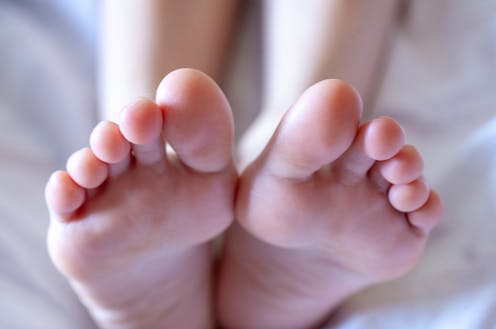
Toe jam[1] can be a source of fascination, disgust or barely noticed. It can be a sign you need to wash your feet or rethink your choice of footwear. It can also lead to major health issues.
Toe jam, the gunk and debris between your toes, has even made it to a Beatles song.
But it was unlikely John Lennon was thinking about foot hygiene when he wrote the lyrics to the second verse of Come Together[2]:
Yes, The Beatles really mentioned toe jam in Come Together (YouTube).He wear no shoeshine, he got toe-jam football
He got monkey finger, he shoot Coca-Cola
He say, ‘I know you, you know me’
One thing I can tell you is you got to be free.
What is toe jam, actually?
Toe jam isn’t a medical term. There is no formal medical term to describe the dead skin cells, sweat, sock lint and dirt that combine in the small and often cramped spaces between our toes.
Toe jam can have the consistency of soft cheese or cake crumbs. It can smell or be odourless. And its colour can range from white to grey-brown.
You’re more likely to create toe jam if you wear closed-in shoes when it’s hot, or gumboots that don’t allow sweat to evaporate.
Poor foot hygiene will certainly make it more likely you’ll develop toe jam. That’s because sweaty debris accumulates in between the toes if you don’t pay attention to cleaning these areas in the shower or bath.
Toe jam may also be more likely if your feet sweat a lot for other reasons. For instance, we know sweaty feet[3] can be a problem for children and adolescents, who have more active sweat glands. And some people have a serious medical condition called hyperhidrosis[4], where they sweat excessively.
Read more: Anhidrosis: why some people – apparently like Prince Andrew – just can't sweat[5]
Is toe jam like athlete’s foot?
The collection of sweat and dead skin between toes provides bacteria living naturally on our skin the chance to thrive.
These bacteria, which include ones in the genus Brevibacterium, feed on sweat, releasing molecules that give the characteristic “cheesy” smell of sweaty feet[6]. Brevibacterium is also used to ripen some cheeses.

This warm and damp environment is also a perfect site for tinea pedis[8], a fungal skin infection you might know as athlete’s foot.
Signs of tinea might be soggy white skin between your toes, which can be itchy, and red areas, a sign of skin damage. Damaged skin[9] between toes might develop small fluid-filled blisters and may also bleed if the weak skin is torn.
So while toe jam isn’t the same as tinea, it might provide the perfect conditions for the fungus to grow.
Read more: Why do feet stink by the end of the day?[10]
How serious is toe jam?
Generally, toe jam is a minor health problem. You can manage it[11] with good foot hygiene. And if you develop tinea, you can use a short course of an anti-fungal treatment you can buy from a pharmacy (see below).
It is quite a different prospect, however, for a person living with a chronic disease such as diabetes, someone who has poor vision (so can’t see toe jam or its complications developing), or who may be unable to reach their feet due to limited mobility.
Diabetes not well controlled with diet and exercise, or drugs, increases the risk[12] of a person having reduced blood flow (peripheral arterial disease) and reduced feeling in their feet (sensory neuropathy).
Broken skin between the toes caused by tinea can become infected rapidly, increasing the risk[13] of:
infection spreading to the foot and leg (cellulitis)
infection of the bone (osteomyelitis)
gangrene (dead tissue caused by lack of blood flow)
amputation of a toe, part of the foot or leg.
So early identification of tinea in a vulnerable person is especially important to prevent complications.
Read more: Life on Us: a close-up look at the bugs that call us home[14]
4 ways to avoid problems
Here are our four tips to avoid problems with toe jam, including developing tinea and its complications:
wash the spaces between your toes and dry them carefully after a shower or bath, and after swimming. Gyms and swimming pools are a common place to pick up a fungal infection on your feet so it’s a good idea to wear thongs to reduce the risk of tinea
if possible, avoid wearing footwear that doesn’t allow sweat to evaporate (such as closed-in shoes made of synthetic material and gumboots). Going barefoot, when there is no risk of injury, will also allow sweat to evaporate
treat sweaty feet by using an anti-perspirant[15] containing aluminium chloride. More severe cases of hyperhidrosis may be managed using drugs, such as Botox[16] injections to the feet. Fungal infections (tinea[17]) should be treated using over-the-counter antifungal creams such a terbinafine or clotrimazole. Resistant infections might require a course of prescribed antifungal medicines
pay attention to signs[18] indicating an infection is spreading from the foot. These could be pain and swelling in the toes, or red streaks along the foot and up the leg. This requires an urgent visit to a podiatrist or doctor.
Footnote
Lennon mentions a “walrus gumboot” in verse three of Come Together. The final line of verse two says “you got to be free”. The cover of The Beatles album Abbey Road shows Paul McCartney walking barefoot (second from the left).
 Maybe The Beatles were onto something.
Imma Gambardella/Shutterstock[19]
Maybe The Beatles were onto something.
Imma Gambardella/Shutterstock[19]
Maybe the Beatles did know a thing or two about toe jam and foot health.
Read more: Beatles: Abbey Road at 50 is a marker of how pop music grew up in the 1960s[20]
References
- ^ Toe jam (www.healthline.com)
- ^ Come Together (genius.com)
- ^ sweaty feet (www.racgp.org.au)
- ^ hyperhidrosis (www.sweathelp.org)
- ^ Anhidrosis: why some people – apparently like Prince Andrew – just can't sweat (theconversation.com)
- ^ smell of sweaty feet (theconversation.com)
- ^ Shutterstock (www.shutterstock.com)
- ^ tinea pedis (www.healthdirect.gov.au)
- ^ Damaged skin (dermnetnz.org)
- ^ Why do feet stink by the end of the day? (theconversation.com)
- ^ manage it (www.racgp.org.au)
- ^ risk (www.diabetesfeetaustralia.org)
- ^ increasing the risk (www.ncbi.nlm.nih.gov)
- ^ Life on Us: a close-up look at the bugs that call us home (theconversation.com)
- ^ anti-perspirant (www.racgp.org.au)
- ^ Botox (www.dermcoll.edu.au)
- ^ tinea (dermnetnz.org)
- ^ signs (www.healthline.com)
- ^ Imma Gambardella/Shutterstock (www.shutterstock.com)
- ^ Beatles: Abbey Road at 50 is a marker of how pop music grew up in the 1960s (theconversation.com)
Read more https://theconversation.com/what-is-toe-jam-from-harmless-gunk-to-a-feast-for-bugs-177454