Australia plans to be a big green hydrogen exporter to Asian markets – but they don’t need it
- Written by: Andrew Blakers, Professor of Engineering, Australian National University
In its latest budget[1], the federal government has promised hundreds of millions of dollars to expand Australia’s green hydrogen capabilities.
Green hydrogen is made by electrolysis of water, powered by solar and wind electricity, and it’s key to the government’s “technology not taxes” approach to meeting its climate target of net-zero emissions by 2050.
The government aims to create a major green hydrogen export industry, particularly to Japan[2], for which Australia signed an export deal in January. But as our latest research[3] suggests, the likely scale may well be overstated.
We show Japan has more than enough solar and wind energy to be self-sufficient in energy, and does not need to import either fossil fuels or Australian green hydrogen. Indeed, Australia as a “renewable energy superpower” is far from a sure thing.
Japan has plenty of sun and wind
“Green” hydrogen could be used to generate electricity and also to form chemicals such as ammonia[4] and synthetic jet fuel.
In the federal budget, hydrogen fuel is among the low-emissions technologies that will share[5] over A$1 billion. This includes[6] $300 million for producing clean hydrogen, along with liquefied natural gas, in Darwin.
Read more: Poor policy and short-sightedness: how the budget treats climate change and energy in the wake of disasters[7]
Australia plans to be a top-three exporter of hydrogen[8] to Asian markets by 2030. The idea is that green hydrogen will help replace Australia’s declining coal and gas exports as countries make good on their promises to bring national greenhouse gas emissions down to zero.
Underlying much of this discussion is the notion that crowded jurisdictions such as Japan and Europe have insufficient solar and wind resources of their own, which is wrong.
Our recent study[9] investigated the future role of renewable energy in Japan, and we modelled a hypothetical scenario where Japan had a 100% renewable electricity system.
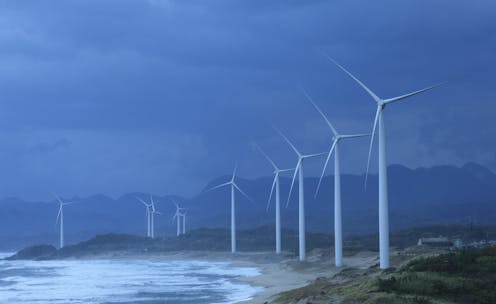
We found Japan has 14 times more solar and offshore wind energy potential than needed to supply all its current electricity demand.
Electrifying nearly everything – transport, heating, industry and aviation – doubles or triples demand for electricity[10], but this still leaves Japan with five to seven times more solar and offshore wind energy potential than it needs.
After building enough solar and wind farms, Japan can get rid of fossil fuel imports without increasing energy costs. This removes three quarters of its greenhouse gas emissions and eliminates the security risks of depending on foreign energy suppliers.
Japanese energy is cheaper, too
Our study comprised an hourly energy balance model, using representative demand data and 40 years of historical hourly solar and wind meteorological data.
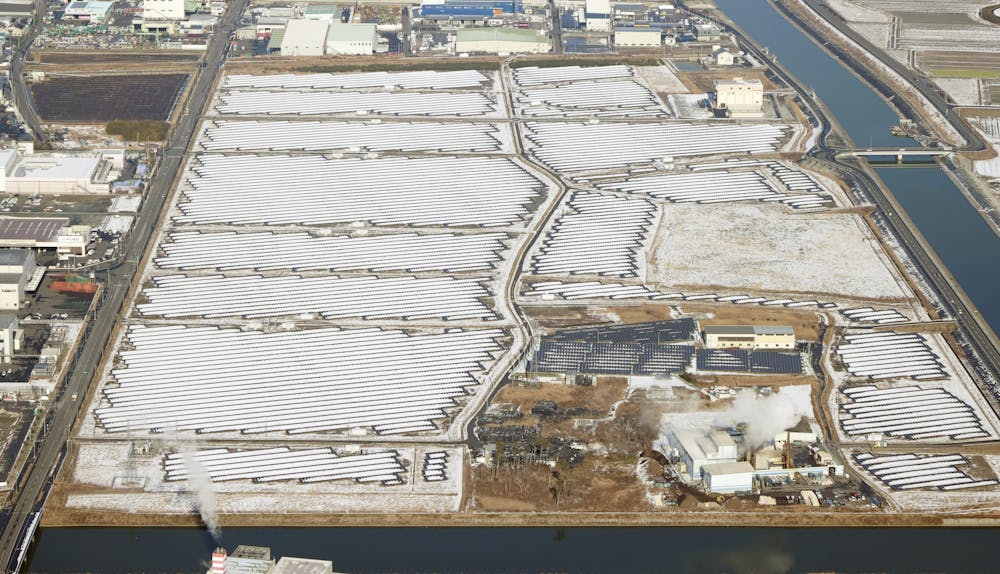
We found[11] that the levelized cost of electricity from an energy system in Japan dominated by solar and wind is US$86-110 (A$115-147) per megawatt hour. Levelized cost is the standard method of costing electricity generation over a generator’s lifetime.
This is similar to Japan’s 2020 average spot market prices (US$102 per megawatt hour) – and it’s about half the cost of electricity generated in Japan using imported green hydrogen from Australia.
So why is it much more expensive to produce electricity from imported Australian hydrogen, compared to local solar and wind?
Essentially, it’s because 70% of the energy is lost[12] by converting Australian solar and wind energy into hydrogen compounds, shipping it to Japan, and converting the hydrogen back into electricity or into motive power in cars.
Thus, hydrogen as an energy source is unlikely to develop into a major export industry[13].
What about exporting sustainable chemicals? Hydrogen atoms are required to produce synthetic aviation fuel, ammonia, plastics and other chemicals.
The main elements needed for such products are hydrogen, carbon, oxygen and nitrogen, all of which are available everywhere in unlimited quantities from water and air. Japan can readily make its own sustainable chemicals rather than importing hydrogen or finished chemicals.
However, the Japanese cost advantage is smaller for sustainable chemicals than energy, and so there may be export opportunities here.
What about other countries?
While large-scale fossil fuel deposits are found in only a few countries, most countries have plenty of solar and/or wind. The future decarbonised world will have far less trade in energy, because most countries can harvest it from their own resources.
Solar and wind comprise three quarters of the new power stations installed around the world each year because they produce cheaper energy than fossil fuels. About 250 gigawatts per annum of solar and wind is being installed globally, doubling every three to four years[14][15]
Densely populated coastal areas – including Japan, Korea, Taiwan, the Philippines, Vietnam and northern Europe – have vast offshore wind resources[16] to complement onshore solar[17] and wind.
 Prime Minister Scott Morrison driving a hydrogen car in November last year.
AAP Image/Pool, William West
Prime Minister Scott Morrison driving a hydrogen car in November last year.
AAP Image/Pool, William West
What’s more, densely populated Indonesia[18] has sufficient calm tropical seas to power the entire world using floating solar panels[19].
Will international markets need Australian energy for when the sun isn’t shining, nor the wind blowing? Probably not. Most countries have the resources to reliably and continuously meet energy demand without importing Australian products.
This is because most countries[20], including Japan (and, for that matter, Australia) have vast capacity for off-river pumped hydro[21], which can store energy to balance out solar and wind at times when they’re not available. Batteries and stronger internal transmission networks also help.
Read more: Indonesia could harvest solar energy from 10 billion panels. So where do we put them?[22]
Australia’s prospects
Getting rid of fossil fuels and electrifying nearly everything with renewables reduces greenhouse emissions by three quarters[23], and lowers the threat of extreme climate change. It eliminates security risks from relying on other countries for energy, as illustrated by Europe’s dependence on Russian gas.
It will also bring down energy costs, and eliminates oil-related warfare, oil spills, cooling water use, open cut coal mines, ash dumps, coal mine fires, gas fracking and urban air pollution.
Australia’s coal and gas exports must decline to zero before mid-century to meet the global climate target, and solar and wind are doing most of the heavy lifting through renewable electrification of nearly everything.
But as our research makes clear, while Australian solar and wind is better than most, it may not be enough to overcome the extra costs and losses from exporting hydrogen for energy supply or chemical production.
Read more: Red dirt, yellow sun, green steel: how Australia could benefit from a global shift to emissions-free steel[24]
One really large prospect for export of Australian renewable energy is export of iron[25], in which hydrogen produced from solar and wind might replace coking coal.
This allows Australia to export iron rather than iron ore. In this case the raw material (iron ore), solar and wind are all found in the same place: in the Pilbara.
While hydrogen will certainly be important in the future global clean economy, it will primarily be for chemicals rather than energy production. It’s important to keep perspective: electricity from solar and wind will continue to be far more important.
References
- ^ latest budget (budget.gov.au)
- ^ Japan (arena.gov.au)
- ^ our latest research (www.sciencedirect.com)
- ^ ammonia (theconversation.com)
- ^ that will share (theconversation.com)
- ^ This includes (www.minister.industry.gov.au)
- ^ Poor policy and short-sightedness: how the budget treats climate change and energy in the wake of disasters (theconversation.com)
- ^ top-three exporter of hydrogen (www.csis.org)
- ^ Our recent study (www.sciencedirect.com)
- ^ doubles or triples demand for electricity (doi.org)
- ^ We found (www.sciencedirect.com)
- ^ 70% of the energy is lost (www.iea.org)
- ^ unlikely to develop into a major export industry (www.eastasiaforum.org)
- ^ three quarters (ieeexplore.ieee.org)
- ^ doubling every three to four years (www.aie.org.au)
- ^ vast offshore wind resources (globalwindatlas.info)
- ^ solar (globalsolaratlas.info)
- ^ Indonesia (www.mdpi.com)
- ^ floating solar panels (www.seris.nus.edu.sg)
- ^ most countries (iopscience.iop.org)
- ^ off-river pumped hydro (theconversation.com)
- ^ Indonesia could harvest solar energy from 10 billion panels. So where do we put them? (theconversation.com)
- ^ reduces greenhouse emissions by three quarters (ourworldindata.org)
- ^ Red dirt, yellow sun, green steel: how Australia could benefit from a global shift to emissions-free steel (theconversation.com)
- ^ export of iron (theconversation.com)