Now Shackleton's Endurance has been found, who determines what happens to the famous shipwreck?
- Written by: Rebecca Hingley, Research associate, University of Tasmania
Tonight’s federal budget will include more than A$800 million over ten years[1] to provide a “clear marker” of Australia’s “scientific leadership” in Antarctica.
The funds will go towards drones and helicopters amid mounting (although somewhat exaggerated[2]) concerns over Chinese activity in the region.
Read more: A krill aquarium, climate research, and geopolitics: how Australia's $800 million Antarctic funding will be spent[3]
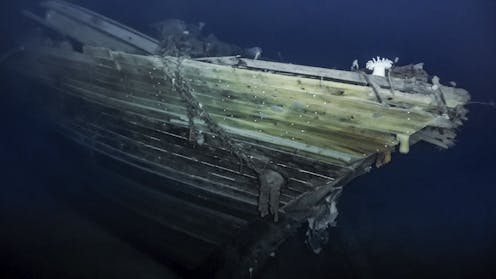
But political assets in the polar region include more than expensive state of the art toys. Earlier this month, one of the most famous shipwrecks in history, Sir Ernest Shackleton’s Endurance, was discovered[4] in the Weddell Sea – a part of Antarctica claimed by multiple nations.
The Endurance
There is enormous excitement around the discovery of the Endurance.
The wreck provides a physical connection to a great tale of human survival, as it was the vessel used during the British explorer’s 1914-1916 Imperial Trans-Antarctic Expedition.
It became stuck in the ice and eventually sunk. Remarkably, none of the men died during the ordeal, despite having to camp on the ice for months during an austral winter.
But now the Endurance has been found, who owns it and who should look after it?
The Antarctic Treaty
Antarctica is governed differently from other parts of the world. The Antarctic Treaty[5] was signed in 1959, with its first provision stating “Antarctica shall be used for peaceful purposes only”. It also provides for free and cooperative scientific investigation on and around the frozen continent.
Read more: Finding Shackleton's ship: why our fascination with Antarctica endures[6]
At the time of signing, seven countries – Argentina, Australia, Chile, France, New Zealand, Norway and the United Kingdom – had territorial claims in the region. But under the treaty, no country can assert (or deny) a claim to territorial sovereignty in Antarctica.
Despite this strong legal foundation, cultural heritage provides an opportunity for nations – in this case Britain – to assert their past, as well as their intended future, presence in the region.
Historic sites in Antarctica
The Antarctic is governed via annual meetings, attended by signatories to the treaty. At these meetings, countries can designate historic remains as official historic sites or monuments[7].
At the 2019 meeting, the UK successfully proposed the Endurance wreck as an official historic site, despite not knowing its location or state at the time. After learning of plans by NGOs to search for the wreck, the UK said it wanted to “confirm the protection status of the vessel in the event that it is located”.
The “historic site[8]” status protects:
all artefacts contained within or formerly contained within the ship, which may be lying on the seabed in or near the wreck within a 150-metre radius.
Who is responsible for the sunken ship?
The Endurance22[9] expedition, backed by the Falklands Maritime Heritage Trust, located the wreck in remarkable condition just over three weeks ago. This expedition had set itself the task of searching for and surveying the shipwreck.
Since 2019, the UK has effectively designated itself as manager of the site – which includes the personal possessions within and all artefacts lying on the seabed nearby. The UK has also stated the wreck should not be not moved or disturbed and only photographed according to strict heritage guidelines[10].
This is also in line with comments from Shackleton’s granddaughter Alexandra Shackleton, who says[11] there should be no “rummaging” and “whatever there is will stay there.”
These preemptive steps are somewhat controversial because the seabed on which the Endurance rests is an area contested between the UK and Argentina.
Although, by definition, a seabed is not within claimed territory, it rests below waters belonging to claimed territory – meaning the wreck could be interpreted by the wider international community as lying outside of the UK’s jurisdiction.
Also worth noting is that the very heritage trust in charge of the expedition originates from hotly contested territory[12] between the two countries – the Falkland Islands/Islas Malvinas.
Other complications
Another challenge is posed by the United Nations Convention on the Law of the Sea[13]. This sets out that archaeological and historical objects found at sea should be protected.
Read more: The wreck of Endurance is a bridge to a bygone age, and a reminder of Antarctica's uncertain future[14]
The ship used to search for the wreck was provided by South Africa, while funding was provided primarily by UK private and commercial sources. South Africa has signed the convention, while the UK has agreed to abide by its rules, but is not a signatory[15].
This has created a feeling of unease among the expert community, who understand that even though the wreck is not currently easy to access (for one, it is more than 3 kilometres below the surface), with technological developments, this situation may change.
What happens now?
Ultimately, the management of the site will set a precedent for the treatment of underwater cultural heritage in the region more widely.
The big question policymakers and diplomats now face is whether a line will be drawn when it comes to having not-yet-found shipwrecks internationally recognised as heritage sites.
Two more sites will likely test this question: the San Telmo and the SS Hampson. Spain proposed the San Telmo – a Spanish naval ship that sunk in the Drake Passage in 1819 supposedly carrying the first “humans to live and die” in Antarctica – as an official historic site at the 2021 meeting.
The SS Hampson is expected to be the large unidentified wooden sailing boat wrecked at Hampson Cove, Elephant Island. The UK is again the manager of the site, given it established the cove’s official heritage status back in 1998.
Like the recent discoveries of other wrecks, the Erebus and Terror[16] in the high Arctic, these sunken ships represent more than just deteriorating artefacts.
They provide a way for countries to demonstrate their historical occupation of a region where traditional displays of territorial sovereignty are banned.
References
- ^ A$800 million over ten years (theconversation.com)
- ^ although somewhat exaggerated (www.aspi.org.au)
- ^ A krill aquarium, climate research, and geopolitics: how Australia's $800 million Antarctic funding will be spent (theconversation.com)
- ^ discovered (www.bbc.com)
- ^ Antarctic Treaty (www.ats.aq)
- ^ Finding Shackleton's ship: why our fascination with Antarctica endures (theconversation.com)
- ^ historic sites or monuments (www.ats.aq)
- ^ historic site (www.ats.aq)
- ^ Endurance22 (endurance22.org)
- ^ heritage guidelines (www.iphc-icomos.org)
- ^ says (www.thetimes.co.uk)
- ^ hotly contested territory (www.smithsonianmag.com)
- ^ United Nations Convention on the Law of the Sea (www.un.org)
- ^ The wreck of Endurance is a bridge to a bygone age, and a reminder of Antarctica's uncertain future (theconversation.com)
- ^ not a signatory (protect-au.mimecast.com)
- ^ the Erebus and Terror (www.theguardian.com)