March 17 is also St Gertrude's Day, commemorating the patron saint of cats
- Written by: Miles Pattenden, Senior Research Fellow, Institute for Religion and Critical Inquiry, Australian Catholic University
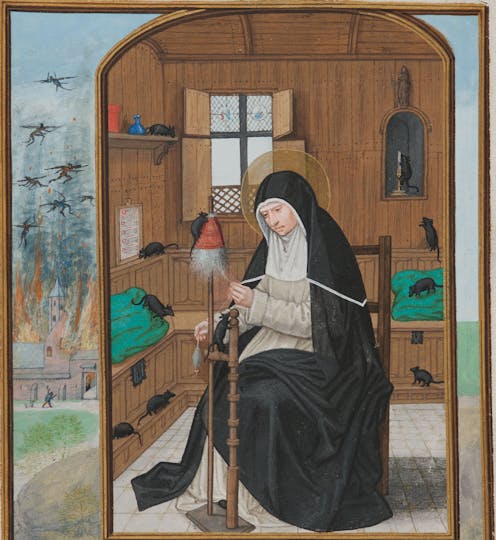
These days many celebrate St Patrick’s Day, even if they’re not Irish.
Happily, the Catholic Church has a range of options for every day of its liturgical calendar so there’s an alternative celebration today for those who would forsake their Guinness, day drinking, and neon-green shamrocks.
Gertrude of Nivelles[1], daughter of Pippin the Elder[2], power behind the Merovingian[3] throne, was both Patrick’s near contemporary and his pioneering equal.
Born around 628, she died on this day in 659 but in that short life had time to found a monastery and rule as its abbess. Her remarkable story provides as valuable record of events during a dark time deep in the European past as that of Olga of Kyiv[4].
And her abbey still stands[5] today, having survived attack by the forces of Revolutionary France in 1794 and bombing by the German Luftwaffe in 1940.
Gertrude’s posthumous legacy also reveals something quirky about the Catholic Church: its unquenchable enthusiasm for having a saint for everything.
Yes, Gertrude is now an unofficial patron saint for cats[6].
Read more: Saint Olga of Kyiv is Ukraine's patron saint of both defiance and vengeance[7]
A princess bride
Gertrude was born into what was to become the most illustrious dynasty of early medieval Europe. Her father was Mayor of the Palace of Austrasia[8] (no, that’s not a typo). The mayor was the highest ranking official in the service of the Frankish King Dagobert[9]. But the mayors soon usurped the kings to take the throne for themselves.
Gertrude’s great-great-great-nephew was Charlemagne[10], who became the first Holy Roman Emperor on Christmas Day 800.
Gertrude was only a minor player in this game of thrones, but her anonymous biographer[11] tells us that as a 10-year-old girl she refused King Dagobert’s offer to find her a nice duke to marry. Indeed, she “lost her temper[12] and flatly rejected him with an oath, saying that she would have… no any earthly spouse but Christ the Lord”.
Normally, such medieval powerbrokers took no notice of a child’s wishes when they had political alliances to arrange. But Gertrude struck it lucky or miraculous. King Dagobert died the following year with her own father following just months later.
The 640s were a perilous time to be a teenage girl or a widowed wife, but Gertrude and her mother Itta, liberated, managed to chart their own course in life.
Gertrude’s biographer tells us that Itta shaved her daughter’s hair[13], so that violent abductors could not tear her away by force. What was left behind looked suspiciously like a tonsure - the outward sign that pious men were already using to show their devotion to a celibate religious life.
And so, in due course, Gertrude and her mother established their monastery. After Itta died in 652[14] Gertrude became the sisters’ unchallenged abbess. She “obtained through her envoy’s men of good reputation, relics of saints and holy books from Rome, and from regions across the sea, experienced men for the teaching of the divine law and to practice the chants for herself and her people.”
She welcomed foreigners, lay or religious, in particular monks from Ireland whose flourishing communities represented the ongoing fruits of Patrick’s recent efforts.
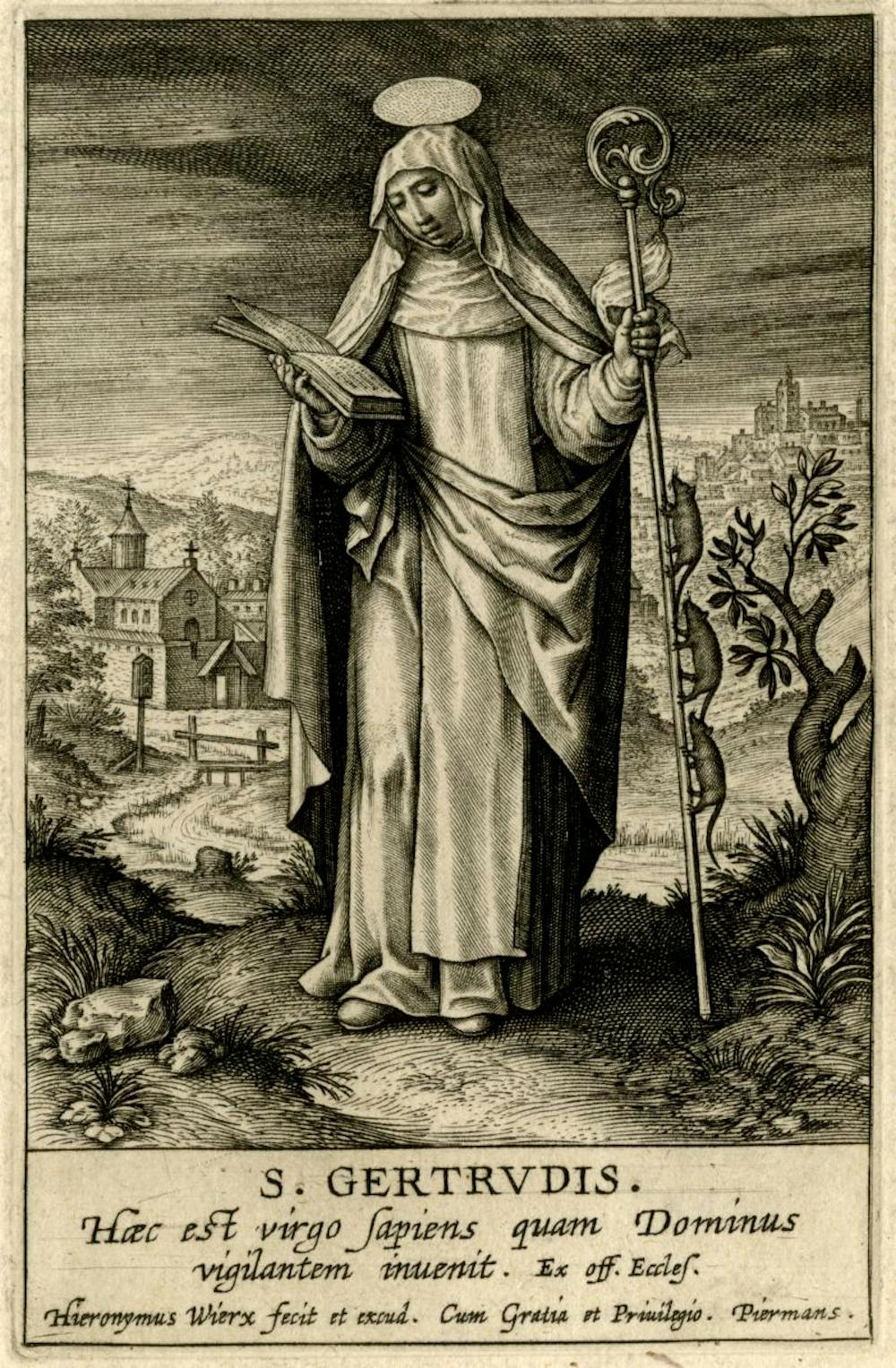
From nuns to cats
Gertrude’s path to feline favour has been a circuitous one. In truth, little in the medieval version of her legend justifies it. Rather the association itself speaks to a particular pathology in certain forms of Christianity.
Catholics, Anglicans, and Eastern Orthodox all recognise patron saints: special figures among the avowedly blessed whom, by choice or by venerable tradition, particular groups have taken on as their primary intercessor with God.
The idea for such patron saints first emerged in the Middle Ages when certain saints became particularly associated with places where they lived (like Patrick in Ireland) or where they were said to work their miracles (like Thomas à Becket at Canterbury). Some saints were also recognised for particular efficacy when interceding to cure particular conditions.
Gertrude seems to have acquired a reputation of this latter kind after the time of the Black Death[16]. In the Low Countries[17] and Western Germany, she was said to protect against rats and the diseases they brought with them.
From there it was only a short leap to making her patron of the creatures that 15th-century folk used to keep those rats in check. And yet, there is no clear evidence that Gertrude was depicted in such a role until well into the 20th century.
 Detail of a 15th-century wall painting with scenes from the life and legend of Saint Gertrude of Nivelles in a chapel of the south aisle in Kruisherenkerk, Maastricht, the Netherlands. This fragment depicts Saint Getrude quenching a fire.
Wikipedia
Detail of a 15th-century wall painting with scenes from the life and legend of Saint Gertrude of Nivelles in a chapel of the south aisle in Kruisherenkerk, Maastricht, the Netherlands. This fragment depicts Saint Getrude quenching a fire.
Wikipedia
Her elevation to celestial guardian of the mousers speaks to a curious development in which popes themselves have encouraged the idea that there ought to be a saint for everything.
Pope Pius XII making Clare of Assisi patron saint of television [18] in 1958 could be said to have been the unlikely event which sparked all that off.
Saints come in all shapes and sizes
Gertrude is by no means the Middle Ages’ strangest or most obscure saint. That honour surely still goes to St Guinefort, the “Holy Greyhound”[19] - an actual dog - who gave his life to save a baby boy from a snake and whose local veneration in 13th-century France scandalised Church leaders in Paris and Rome.
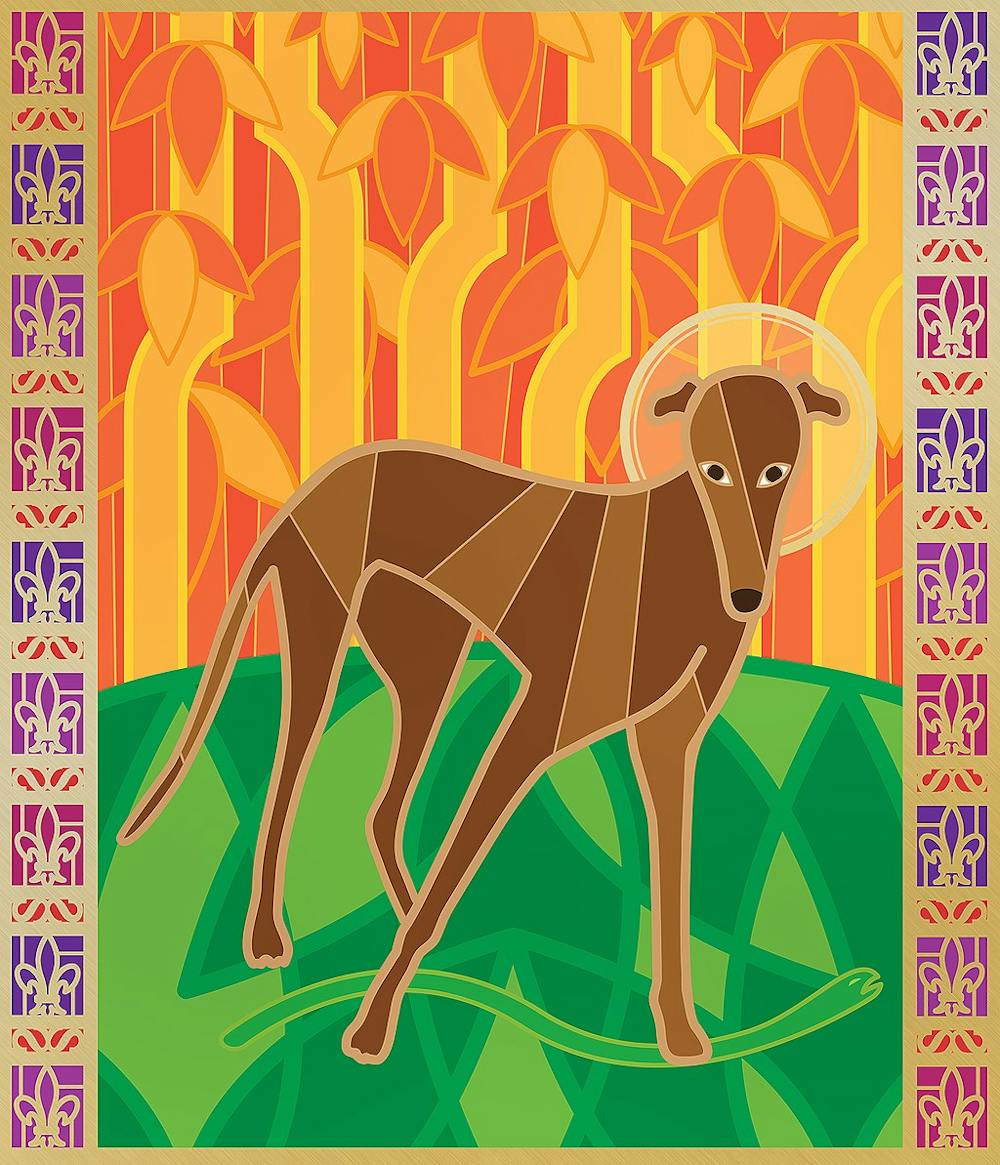 Contemporary illustration of Saint Guinefort, a greyhound sainted by people in the Dombes region of France around the 13th century.
L. Bower/ Wikimedia Commons
Contemporary illustration of Saint Guinefort, a greyhound sainted by people in the Dombes region of France around the 13th century.
L. Bower/ Wikimedia Commons
Yet Gertrude’s example underlines the sheer quantity and variety of those whom Catholics claim to have reached Heaven.
There’s a medieval saint out there for everything and everyone: so why not go and find yours?
References
- ^ Gertrude of Nivelles (catholicsaints.info)
- ^ Pippin the Elder (www.britishmuseum.org)
- ^ Merovingian (www.historyfiles.co.uk)
- ^ that of Olga of Kyiv (theconversation.com)
- ^ still stands (www.tourisme-nivelles.be)
- ^ patron saint for cats (uscatholic.org)
- ^ Saint Olga of Kyiv is Ukraine's patron saint of both defiance and vengeance (theconversation.com)
- ^ Austrasia (www.historyfiles.co.uk)
- ^ King Dagobert (www.britishmuseum.org)
- ^ Charlemagne (www.bbc.co.uk)
- ^ anonymous biographer (archive.org)
- ^ lost her temper (archive.org)
- ^ Itta shaved her daughter’s hair (archive.org)
- ^ died in 652 (archive.org)
- ^ CC BY (creativecommons.org)
- ^ Black Death (www.historytoday.com)
- ^ Low Countries (www.oxfordbibliographies.com)
- ^ making Clare of Assisi patron saint of television (www.vatican.va)
- ^ “Holy Greyhound” (centaur.reading.ac.uk)