


Wearing shoes in the house is just plain gross. The verdict from scientists who study indoor contaminants
- Written by: Mark Patrick Taylor, Chief Environmental Scientist, EPA Victoria; Honorary Professor, Macquarie University
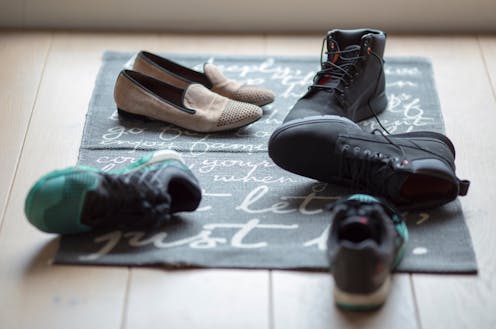
You probably clean your shoes if you step in something muddy or disgusting (please pick up after your dog!). But when you get home, do you always de-shoe at the door?
Plenty of Australians don’t. For many, what you drag in on the bottom of your shoes[1] is the last thing on the mind as one gets home.
We are environmental chemists who have spent a decade examining the indoor environment and the contaminants people are exposed to in their own homes. Although our examination of the indoor environment, via our DustSafe program[2], is far from complete, on the question of whether to shoe or de-shoe in the home, the science leans toward the latter.
It is best to leave your filth outside the door.
Read more: House dust from 35 countries reveals our global toxic contaminant exposure and health risk[3]
What contaminants are in your home, and how did they get there?
People spend up to 90% of their time indoors, so the question of whether or not to wear shoes in the house is not a trivial one.
The policy focus is typically on the outdoor environment for soil, air quality and environmental public health risks. However, there is growing regulatory interest in the question of indoor[4] air quality[5].
The matter building up[6] inside your home includes not just dust and dirt from people and pets shedding hair and skin.
About a third of it is from outside[7], either blown in or tramped[8] in on those offensive shoe bottoms.
Some of the microorganisms present on shoes and floors are drug-resistant pathogens[9], including hospital-associated infectious agents (germs) that are very difficult to treat.
Add in cancer-causing toxins from asphalt road residue[10] and endocrine-disrupting lawn chemicals[11], and you might view the filth on your shoes in a new light.
 Please don’t do this.
Shutterstock
Please don’t do this.
Shutterstock
A roll-call of indoor nasties
Our work has involved the measurement and assessment of exposure to a range of harmful substances found inside homes including:
A strong focus of our work has involved assessing levels of potentially toxic metals (such as arsenic, cadmium and lead)[12] inside homes across 35 nations (including Australia)[13].
These contaminants – and most importantly the dangerous neurotoxin lead – are odourless and colourless. So there is no way of knowing whether the dangers of lead exposure are only in your soils[14] or your water pipes[15], or if they are also on your living room floor[16].
The science[17] suggests a very strong connection between the lead inside your home and that in your yard soil[18].
The most likely reason for this connection is dirt blown in from your yard or trodden in on your shoes, and on the furry paws of your adorable pets.
This connection speaks to the priority of making sure matter from your outdoor environment stays exactly there (we have tips here[19]).
A recent Wall Street Journal article[20] argued shoes in the home aren’t so bad. The author made the point that E. coli – dangerous bacteria that develop in the intestines of many mammals, including humans – is so widely distributed that it’s pretty much everywhere. So it should be no surprise it can be swabbed on shoe bottoms (96% of shoe bottoms, as the article pointed out).
But let’s be clear. Although it’s nice to be scientific and stick with the term E. coli, this stuff is, put more simply, the bacteria associated with poo.
Whether it is ours or Fido’s, it has the potential to make us very sick if we are exposed at high levels. And let’s face it – it is just plain gross.
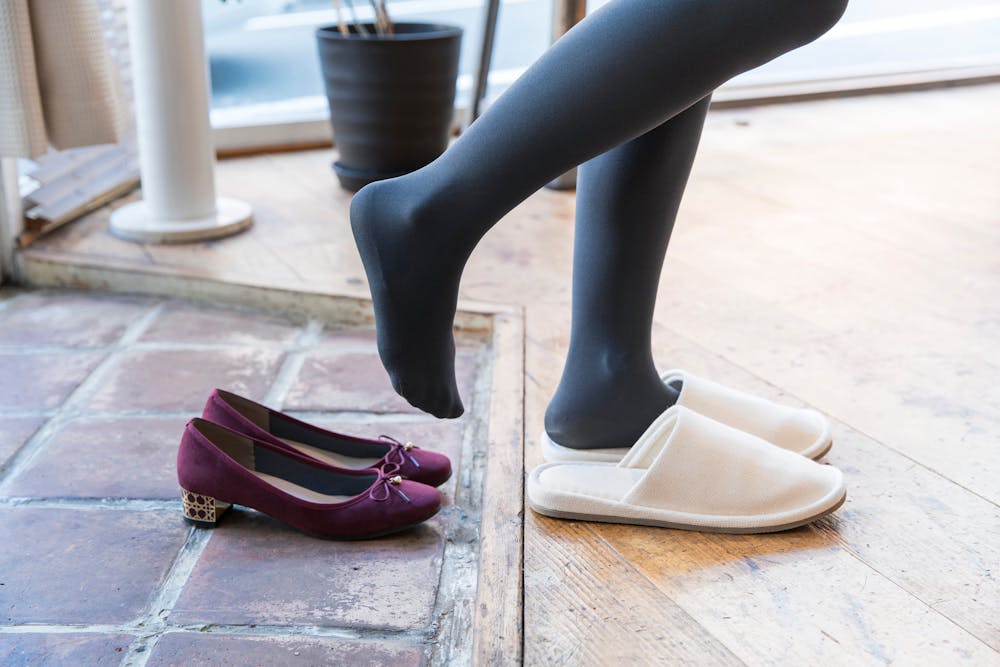
Why walk it around inside your house if you have a very simple alternative – to take your shoes off at the door?
 Why walk muck around inside your house if you have a very simple alternative – to take your shoes off at the door?
Shutterstock
Why walk muck around inside your house if you have a very simple alternative – to take your shoes off at the door?
Shutterstock
On balance, shoeless wins
So are there disadvantages to having a shoe-free household?
Beyond the occasional stubbed toe[21], from an environmental health standpoint there aren’t many downsides to having a shoe-free house. Leaving your shoes at the entry mat also leaves potentially harmful pathogens there as well.
We all know prevention is far better than treatment and taking shoes off at the door is a basic and easy prevention activity for many of us.
Need shoes for foot support? Easy – just have some “indoor shoes” that never get worn outside.
There remains the issue of the “sterile house syndrome,” which refers to increased rates of allergies among children. Some argue it’s related to overly sterile households.
Indeed, some dirt is probably beneficial as studies[22] have indicated it helps develop your immune system and reduce allergy risk.
But there are better and less gross ways to do that than walking around inside with your filthy shoes on. Get outside, go for a bushwalk, enjoy the great outdoors.
Just don’t bring the muckier parts of it inside to build up and contaminate our homes.
Read more: What is dust? And where does it all come from?[23]
References
- ^ drag in on the bottom of your shoes (sfamjournals.onlinelibrary.wiley.com)
- ^ DustSafe program (www.360dustanalysis.com)
- ^ House dust from 35 countries reveals our global toxic contaminant exposure and health risk (theconversation.com)
- ^ indoor (ncc.abcb.gov.au)
- ^ air quality (www.euro.who.int)
- ^ building up (www.tandfonline.com)
- ^ from outside (pubs.acs.org)
- ^ tramped (www.washingtonpost.com)
- ^ drug-resistant pathogens (www.cambridge.org)
- ^ asphalt road residue (www.tandfonline.com)
- ^ lawn chemicals (www.tandfonline.com)
- ^ potentially toxic metals (such as arsenic, cadmium and lead) (theconversation.com)
- ^ 35 nations (including Australia) (doi.org)
- ^ soils (doi.org)
- ^ water pipes (www.abcb.gov.au)
- ^ living room floor (theconversation.com)
- ^ science (theconversation.com)
- ^ home and that in your yard soil (www.mapmyenvironment.com)
- ^ here (www.360dustanalysis.com)
- ^ article (www.wsj.com)
- ^ occasional stubbed toe (www.washingtonpost.com)
- ^ studies (www.jacionline.org)
- ^ What is dust? And where does it all come from? (theconversation.com)










