why the word puzzle Wordle has become a new online obsession
- Written by: Erin Sebo, Lecturer in Medieval Literature, Flinders University
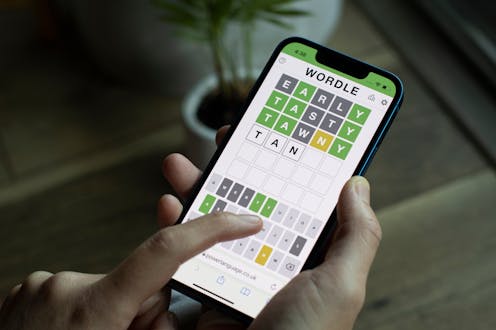
Wordle is a quick English-language word game developed by software engineer Josh Wardle, as a unique gift for his partner, released in October 2021. It’s easily accessible online.[1][2]
The game, in which players guess a five letter word through linguistic inferences, became an unlikely success, suggesting a change in how we communicate – both in terms of how we socialise, and in our relationship with language.
The popularity of Wordle
Wordle has nearly 3 million players across the world and versions of it are appearing in other languages.
People love talking about it – the number of Wordle tweets increases 26% a day on average – even when they hate playing it (a significant number of Wordle tweets are complaints, usually about the volume or smugness of Wordle tweets).
Because the game allows you to share your result without spoilers, it has inspired fierce competition, with social media being flooded with results, especially high scores.
In fact, recently, NBC assured us that being “bad” at Wordle doesn’t make you “dumb”[3].
This is a perplexing idea from a linguistic point of view: solving the puzzle in fewer guesses involves more luck – not more skill.
How to play Wordle
Wordle is often compared to crosswords but the mental process of solving is closer to code-cracking.
Players are able to narrow down possibilities by calculating the probability of different letter combinations. If your first guess produced, say, two letters both yellow, you can make an educated guess about the most likely positions for those letters in English words.
Since the game is based around five letter words, the words almost always involve consonant clusters. These are typically fairly specific to individual languages. In English, “spl” and “spr” are common, for example, but “slr” or “prl” are impossible.
But players also need to be flexible enough not to exclude less likely combinations entirely – and to keep them in mind as you play.
The difficulty of each puzzle depends on the relationship between the solution and the player’s first guess. A lot of this is luck but you can improve your chances statistically by using frequency analysis[4], a cryptolinguistic technique based on which letters are commonest.
I use “share” as my first guess because it includes the two most common vowels, “s” which is the third most common letter and most common final letter in English words, while “h” and “r” are common individually and even more common in consonant clusters, so their presence or absence instantly knocks out a range of possibilities.
But I admire people who play with less strategy. Lots of people guess on whim.
Once you’ve got past your first guess, players use their knowledge of spelling conventions and sound patterns in English to solve the word - another linguistic technique used in code-breaking. After all, some of the most successful code breakers of the pre-computer age were linguists, precisely because of this skill.
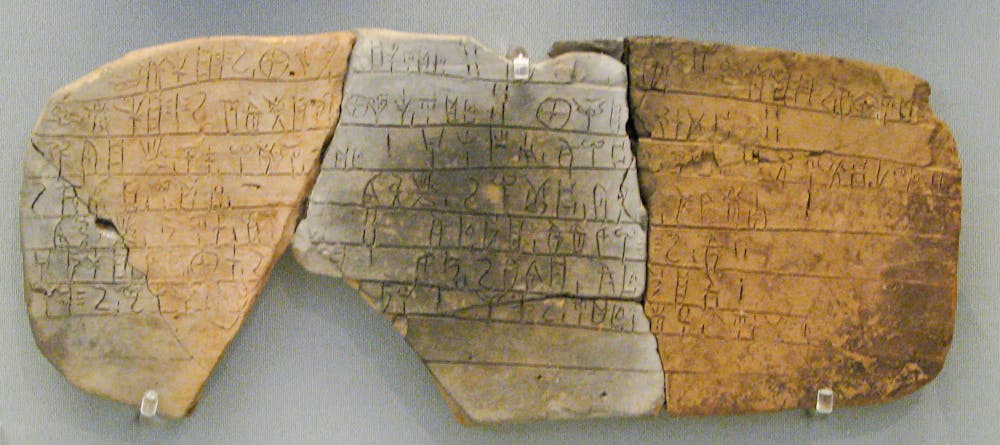
John Chadwick, who is famous among academics for his role in deciphering the ancient script known as Linear B, was also involved in cracking the most famous WWII code, Enigma[5].
Language and linguistics
Puzzles like Strands game are always popular. What is, perhaps, surprising is that a game which relies on such specific linguistic knowledge has become so popular.
Although there is an anxiety about the decline of reading for pleasure, this generation of adults actually consumes more written text than any generation in history. The internet means many previously spoken interactions, both social and business, now happen in writing. It also means mass communication, which means a much greater awareness of writing conventions.
The more people reading a text, the more important conventions become.
That doesn’t mean a greater number of people are using formal English correctly - that would only happen if they were reading more examples of formal English - but it does mean a greater awareness of conventions. You can see this in the way people write differently in text message, to Instagram, to Twitter, according to the conventions developing around each platform. In some online contexts, alternative spellings or misspellings can be used deliberately for specific semantic purposes – a technique which has the paradoxical effect of highlighting the spelling conventions and sound patterns Wordle depends on.
You can see this reliance on conventions develop over the history of written English. In early medieval manuscripts, often intended for only a few readers, there aren’t many rules. No standardised dialect or spelling, no one even cares if you split a word in two. You don’t need standardised rules because the specialised audience understands.
Read more: Orright you spunkrats, here's where all our Aussie summertime language came from[7]
With the invention of printing which allows more books to be produced more cheaply, there is a corresponding development of widely-understood conventions, such as standardised spelling. By sticking to these, publishers make their books readable to a wider audience.
The global audience created by the internet is the next step in this process, increasing our use of conventions like those you need to understand in order to solve Wordle.
Community
The game’s popularity ultimately has to do with community. The fact everyone is solving the same puzzle means people discuss strategies and individual puzzles in friend groups and share their results online on social media.
For many people who aren’t able to see friends and family in person, it gives a focus for socialising. For people isolated by the pandemic, it creates an online community.
The pandemic has meant everyone in the world is facing the same problem, COVID, even if the resources for dealing with it are vastly different, so it’s nice to have a small, fun thing in common as well.
References
- ^ unique gift for his partner (www.nytimes.com)
- ^ It’s easily accessible online. (www.powerlanguage.co.uk)
- ^ being “bad” at Wordle doesn’t make you “dumb” (www.lx.com)
- ^ frequency analysis (en.wikipedia.org)
- ^ most famous WWII code, Enigma (www.classics.cam.ac.uk)
- ^ CC BY (creativecommons.org)
- ^ Orright you spunkrats, here's where all our Aussie summertime language came from (theconversation.com)