With the video game industry under new management, what's going to change?
- Written by: Brendan Keogh, Senior Lecturer, Queensland University of Technology
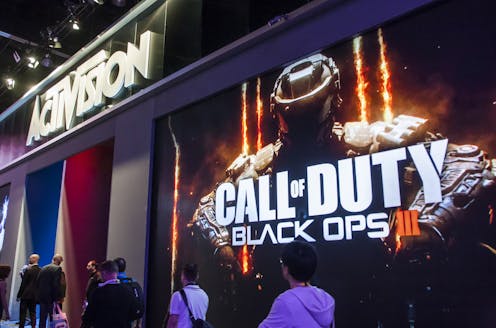
In 1979, a group of disgruntled Atari employees decided to quit and create their own company. Activision was the world’s first “third-party” game development company, producing and publishing titles for other companies’ platforms.
Fast-forward 43 years and the company that is now Activision Blizzard has been bought by one of the major platform owners in the industry[1], Microsoft, for a blistering US$68.7 billion dollars (around A$95.6 billion) – the largest sale in the history of the video game industry.
This sale is also massive in terms of the game franchises Microsoft now has control over; it now owns blockbuster franchises such as Call of Duty, Diablo, Starcraft, Candy Crush and World of Warcraft. And tens of millions of fans of these titles will now be wondering: what does this change in ownership mean for them?
Why now?
Big dollar acquisitions aren’t new in the video game industry. Activision Blizzard itself became one of the largest video game companies in 2008, when Activision merged with Blizzard in a US$18.9 billion dollar deal[2]. Microsoft and Sony regularly buy successful pre-existing development studios to take over their intellectual properties (IP) and make them available exclusively on their platforms.
But Microsoft has become particularly aggressive in its approach. In the last decade alone it has made a number of high-profile purchases, including Minecraft developer Mojang[3] in 2014 for US$2.5 billion, and Elder Scrolls and Doom publisher ZeniMax[4] in 2020 for US$7.5 billion. With the Activision Blizzard acquisition, Microsoft is now the third-largest company in the industry, behind TenCent and Sony[5].
This is all part of Microsoft’s current video game business strategy, which is less about selling game products and more about increasing subscriptions to its Game Pass service. Similar to services like Netflix and Spotify, Game Pass gives subscribers access to a massive digital catalogue of games in exchange for a monthly fee.
In its announcement of the Activision Blizzard purchase, Microsoft also boasted Game Pass has surpassed 25 million users[6]. With each user paying US$16 a month, that’s about US$400 million (or A$556 million) in monthly revenue.
With Activision Blizzard, Microsoft now owns a huge new range of franchises it can make available through Game Pass, attracting even more users.
Gaming landlords
If it wanted, Microsoft might even make these franchises only available through Game Pass, forcing customers away from other consoles like PlayStation and distribution platforms like Steam. In other words, it could pull consumers into its own exclusive sphere.
This is now a common strategy. Now, through subscription-based digital platforms, we have all stopped being owners of product and instead have become renters.
This is also true of individual video games. Call of Duty, Hearthstone, Fortnite (and many others) are no longer games that players purchase once, but are instead their own ecosystems in which players are encouraged to continuously spend money on battle passes, cosmetics and access to new content[7].
Meanwhile, the companies that own these titles can constantly farm new data from their millions of players[8], further increasing their company value.
With the purchase of Activision Blizzard, Microsoft has effectively purchased a city of existing renters in the player ecosystems of Call of Duty, Hearthstone, World of Warcraft and many other titles.
That’s tens of millions of players already committed to closed ecosystems, including many in the difficult-to-penetrate Chinese market playing Blizzard titles Hearthstone and World of Warcraft. All of these players can be farmed for more personal data and more rent.
Read more: The war between Xbox and Playstation is no longer about consoles. It's about winning your loyalty[9]
So what does it mean for players and developers?
In the short term, probably not a whole lot.
Over the coming years, however, Microsoft might decide to keep more of these newly acquired franchises for its own platforms. For a PC player, this might simply mean having to transition away from Steam to the Microsoft Game Store if they want to access the franchises: an inconvenience, but hardly a radical change.
For PlayStation and Mac players, the situation could be more dire, and they might find themselves having to purchase a PC or an Xbox if they want to play new entries to these franchises in the future.
Some are also worried ongoing giant mergers will stifle creativity and innovation across the video game industry. But this is unlikely since the bulk of the revenue generated by the industry has always been concentrated in a relatively small number of risk-adverse companies.
In her book Global Games[10], researcher Aphra Kerr estimated that in 2015, the top ten video game companies accounted for 49% of the entire industry’s revenue. In spite of this concentration of capital, the creativity and innovation that produces new genres almost always emerges at the periphery, in much smaller, independent groups working with far fewer resources.
The explosion of new and diverse genres we’ve seen over the past decade occurred, in large part, because independent creators are now able to access far more powerful tools, such as game engines Unity and Unreal, and greater audiences through digital marketplaces, such as Steam or Xbox Game Pass.
The situation is far from ideal, but the companies that control most of the capital in the video game industry – and the companies that are the most innovative – have rarely been the same. So this latest acquisition is unlikely to stifle creativity.
But there’s more at stake in this historic sale. Activision Blizzard is facing accusations and lawsuits of harassment, abuse and sexism across its offices[11], and CEO Bobby Kotick has been under intense pressure to resign for months[12]. Kotick is now set to walk away from the company with US$400 million[13]; the allegations of a toxic workplace are now Microsoft’s responsibility to clean up.
Perhaps this is the important question coming out of the recent sale: not which piece of hardware will have access to which games, but whether Microsoft will take responsibility for improving the work culture and working conditions for game developers? We’ll have to wait and see.
Read more: Activision Blizzard's sexual harassment scandal is not a one-off for the gaming industry[14]
References
- ^ major platform owners in the industry (www.abc.net.au)
- ^ in a US$18.9 billion dollar deal (web.archive.org)
- ^ Minecraft developer Mojang (www.abc.net.au)
- ^ Elder Scrolls and Doom publisher ZeniMax (news.microsoft.com)
- ^ company in the industry, behind TenCent and Sony (www.theverge.com)
- ^ surpassed 25 million users (www.theverge.com)
- ^ spend money on battle passes, cosmetics and access to new content (journals.sagepub.com)
- ^ constantly farm new data from their millions of players (overland.org.au)
- ^ The war between Xbox and Playstation is no longer about consoles. It's about winning your loyalty (theconversation.com)
- ^ Global Games (www.routledge.com)
- ^ accusations and lawsuits of harassment, abuse and sexism across its offices (www.theguardian.com)
- ^ intense pressure to resign for months (www.eurogamer.net)
- ^ with US$400 million (www.businessinsider.com.au)
- ^ Activision Blizzard's sexual harassment scandal is not a one-off for the gaming industry (theconversation.com)