how leaf-curling spiders pair up and build a family home
- Written by: Jess Marsh, Research fellow at the Harry Butler Institute, Murdoch University
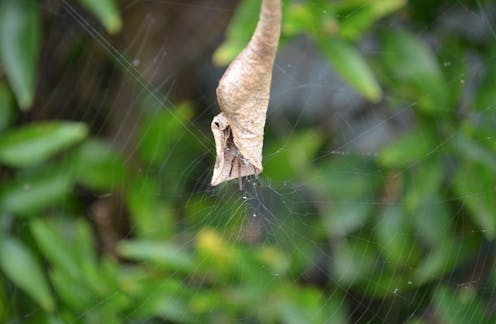
Have you recently spotted a spider peeking out from a brown, curled-up leaf in your garden?
Chances are you’re sharing your yard with the leaf-curling spider[1], Phonognatha graeffei (pronounced fon-og-natha greef-e-i), a fascinating member of the orb-weaving spider family Araneidae (pronounced aran-ee-i-dee).
This spider – found in each state and territory in Australia – builds its orb web in plants and places in it a special custom-built hiding spot: a curled up leaf.
Similar to other orb-weaving spiders, the leaf-curling spider lives for only one year[2] and is most commonly seen in late summer.
They are found in woodlands as well as urban gardens and greenery and have particularly interesting family arrangements.
Why and how do they curl the leaves?
To make their leafy retreats, these spiders use silk to lift a leaf up from the ground and into their orb web.
Using their legs, they then carefully curl it up and secure it with silk in a funnel or cone shape. They weave this curled leaf into the web using more silk.
If they can’t find a suitable leaf, they might use other objects such as snail shells and pieces of paper[3].
Young spiders, which aren’t as strong as adults, start by curling up small, fresh green leaves[4] for their retreats and move on to bigger dry leaves as they get older.
The curled leaves – or bits of paper – protect the spider from hungry predators, such as birds. They also shield the spider from parasitic wasps[5], which lay their eggs on or in the bodies of other insects and spiders, eventually killing their hosts.
The spider can sit safely in their retreat, while keeping their front legs extended and in contact with their orb web. That way, the spider can sense any vibrations caused by an insect trapped in its web – and nip out to grab the food.
Like most other orb-weaving spiders, leaf-curling spiders are not fussy and will eat any insect that happens to get tangled in their web, such as flies, bees, moths and butterflies. They can even handle prey quite a bit bigger than them.
The spiders will spend most of their time in their retreat, only venturing out to get food in the day, or to repair and rebuild their webs (usually at night).
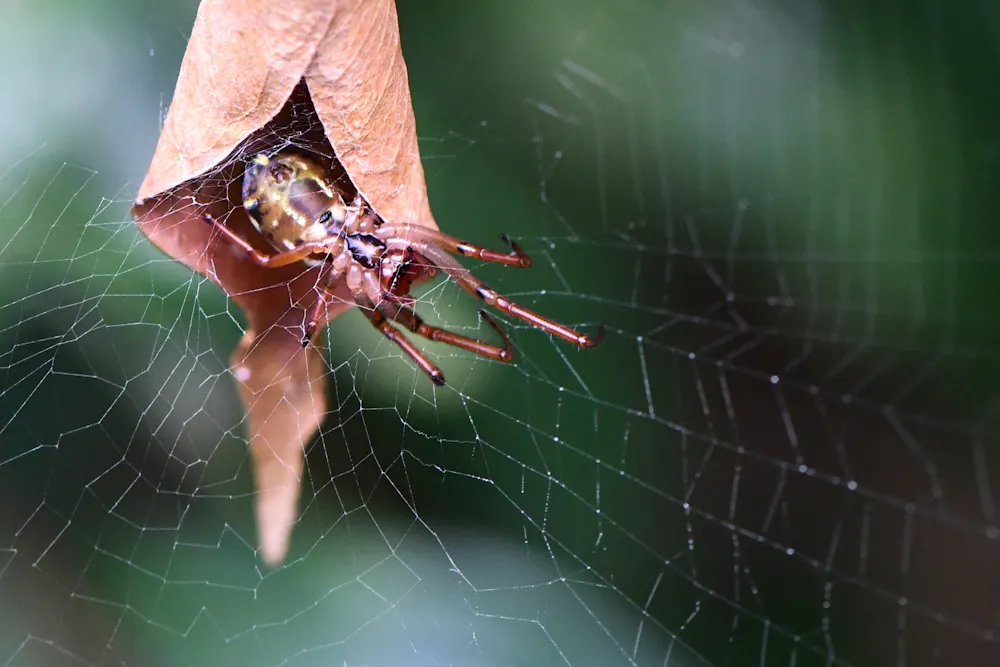
Venomous? Yes. Dangerous? No.
Nearly all spiders you come across are venomous – in other words, they have venom[6].
But being venomous isn’t the same as being dangerous to humans, and like most spiders, leaf-curling spiders aren’t dangerous to us.
The leaf-curling spider has small fangs that point together, a bit like pincers. Bites are rare. If you hassle one, the spider could try to bite, which may cause localised pain and swelling at the site – but the symptoms are generally mild[7].
If you spot one, just “leaf” it alone and it will do the same to you.
And remember: having leaf-curling spiders in your back yard is something to be proud of! These fascinating little creatures are great for keeping down pest insects and are a gardener’s friend.
Are there eggs or baby spiders inside the curled leaves?
These spiders have interesting family arrangements.
Unusually for spiders, males and female leaf-curling spiders form pairs[8] and share a leaf retreat[9].
The male moves in with the female when she is young and once she is mature he will mate with her. According to one study[10][11]
Females may cannibalise cohabiting males, which occurs independently of whether the female has been deprived of food.
After mating, the female makes another curled leaf retreat in vegetation away from her web[12]. This one is a “nursery” retreat, in which she will lay her eggs.
A fascinating and beautiful world
Spiders aren’t top of most people’s favourite animal list, I get that.
But, if you are able to spend a bit of time observing their lives and getting to know them and their stories, it can open up a fascinating and often beautiful world.
Spiders and other invertebrates such as beetles, flies, snails and millipedes are really important for the workings of our natural world, and so for us.
And when you get to know them, they are also pretty cool.
References
- ^ leaf-curling spider (australian.museum)
- ^ one year (australian.museum)
- ^ snail shells and pieces of paper (australian.museum)
- ^ small, fresh green leaves (australian.museum)
- ^ parasitic wasps (citeseerx.ist.psu.edu)
- ^ venom (onlinelibrary.wiley.com)
- ^ symptoms are generally mild (collections.museumsvictoria.com.au)
- ^ males and female leaf-curling spiders form pairs (doi-org.libproxy.murdoch.edu.au)
- ^ share a leaf retreat (academic.oup.com)
- ^ male moves in with the female (www.tandfonline.com)
- ^ study (link.springer.com)
- ^ away from her web (web.archive.org)