30–50 feral hogs? Why Twitter memes are more positive (and much faster) than you might think
- Written by: Naomi Smith, Lecturer in Sociology, Federation University Australia
Have you ever checked your Twitter timeline and wondered what on Earth everyone was talking about? You step away for a few hours and suddenly your timeline is filled with people swapping memes about an event you’ve completely missed.
We studied these “memetic moments”[1] to understand how memes emerge quickly and spontaneously in response to key social events. We found they move even faster than we had thought, sometimes emerging, spreading wildly, and beginning to dissolve in less than a day.
While Twitter and other social media are notorious as sites of abuse, racism, trolling and other toxic content, we found very little of this material in our study of fast-moving memes.
We think the speed of movement itself may provide less opportunity for negative engagement. Memes like these may be an underappreciated element of a positive social media culture – and give hints of how social media platforms can improve.
Feral hogs
We look closely at two memetic moments in particular. The most popular was the “30–50 feral hogs” meme, which started after a weekend of mass shootings in the United States in August 2019.
In response to the shootings, and in particular the role of automatic assault rifles in the events, the musician Jason Isbell tweeted:
If you’re on here arguing the definition of “assault weapon” today you are part of the problem. You know what an assault weapon is, and you know you don’t need one.
The tweet was popular, being liked and retweeted thousands of times.
Among the replies, one stood out. William McNabb, who was not a high-profile user at the time, responded:
Legit question for rural Americans – How do I kill the 30–50 feral hogs that run into my yard within 3–5 mins while my small kids play?
The seeming absurdity of the response, along with the format of the tweet, made for ideal meme material. The jokes soon began, and the meme quickly evolved and began referencing other Twitter memes.
For example, it could be remixed as song lyrics, or as alternative movie titles. While very funny, the meme highlighted the flimsy nature of some arguments for high-powered, rapid-fire weapons, and also led to discussion of other serious issues, such as the ecological destruction caused by feral hogs in many parts of rural America[2]. Feral pigs destroy crops, and damage delicate native vegetation.
As researchers, we had both watched memes like this appear and quickly disappear on our respective feeds many times. We wanted to understand how these memes functioned in the way they did.
How to study a Twitter meme?
To begin untangling the dynamics of these “memetic moments” we had to take a slightly different approach to gather Twitter data. In the past memes were often organised by hashtags, but as that is now rarely the case we conducted searches of words associated with popular Twitter memes.
Read more: Explainer: what are memes?[3]
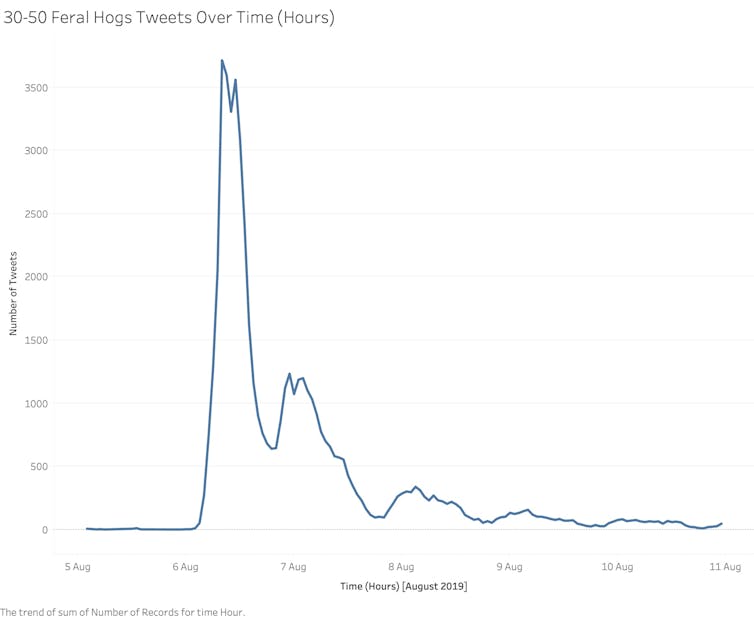
For instance, we collected tweets containing the term “30–50 feral hogs”, finding a total of 54,086 tweets in the week after it first appeared.
We then graphed these tweets over time to study the dynamics. What we found was striking – the memes appeared sharply and with immense speed, and were then followed by a quick decline.
In the case of the 30–50 feral hogs meme, the initial peak only lasted 12 hours – less than one day – before it quickly dissipated.
Some memes are driven by high-profile users who create a “template” that is copied by other users, but the 30–50 feral hogs meme was the opposite. While Jason Isbell was (unwittingly) involved, the vast majority of the initial popular tweets were by users with small followings.
The most popular of the early tweets was from user @BarbiturateCat. It replicated a dating site template, in which users can pick between being “male”, “female” or “30–50 feral hogs”, and seeking “male”, “female” or “a yard with unsupervised small children to run into within 3–5 minutes”.
Another popular tweet was from the user @nomiddlesliders who, riffing off the song Paradise City by Guns N’ Roses, tweeted: “take me down to the paradise city where the hogs are feral and there’s 30–50”.
From here, the meme developed in a range of different directions.
Why study Twitter memes?
So why does studying memes on Twitter matter? Often we think of memes as trivial or mundane parts of online platforms, less important than pressing social issues.
The conditions of social media that produce virality, such as speed, are often blamed for many of its more toxic elements, such as the spread of misinformation.
Read more: Is it actually false, or do you just disagree? Why Twitter’s user-driven experiment to tackle misinformation is complicated[4]
Our research provides a different perspective on how speed functions in digital cultures. The speed at which the two memes we studied grew and “burst” seemed to create a space for low-stakes, humorous and wholesome engagement that is often argued to be lacking on social media platforms.
These memetic moments also show how social media spaces like Twitter can be “networked publics[5]”. These are online spaces generated by user engagement with their own rules and ways of surfacing and responding that do not always play by the rules of the platform’s algorithms.
Memetic moments also serve as a springboard for deeper discussion[6] across other forms of media, underscoring the political and cultural power of memes.
Learning from memes
The harms of social media and the internet more broadly get a lot of attention, but it is also important to focus on how social media can produce genuine engagement and conversation.
Social media isn’t all toxic all the time. By empirically examining some of the instances where social media functions positively (as it does in our research), we can find potential ways to design social media platforms that amplify positive social engagement.
Read more: Twitter's design stokes hostility and controversy. Here's why, and how it might change[7]
This would entail changes to how algorithms arrange content, and refining them to better distinguish between positive and negative engagement. Twitter is already attempting[8] to do this.
Changes to the design of platforms may provide a way out of endlessly and unsuccessfully attempting to moderate the damaging aspects of social media.
References
- ^ studied these “memetic moments” (jdsr.se)
- ^ feral hogs in many parts of rural America (gimletmedia.com)
- ^ Explainer: what are memes? (theconversation.com)
- ^ Is it actually false, or do you just disagree? Why Twitter’s user-driven experiment to tackle misinformation is complicated (theconversation.com)
- ^ networked publics (networkedpublics.org)
- ^ deeper discussion (www.theguardian.com)
- ^ Twitter's design stokes hostility and controversy. Here's why, and how it might change (theconversation.com)
- ^ Twitter is already attempting (techcrunch.com)
-than-you-might-think&media=https://thetimes.com.au/https://images.theconversation.com/files/437077/original/file-20211213-27-s3yj8z.jpg?ixlib=rb-1.1.0&q=45&auto=format&w=754&fit=clip&description=30–50%20feral%20hogs?%20Why%20Twitter%20memes%20are%20more%20positive%20(and%20much%20faster)%20than%20you%20might%20think "Pin It")