Australia's biggest fossil fuel investment for a decade is in the works – and its greenhouse gas emissions will be horrifying
- Written by: Bill Hare, Director, Climate Analytics, Adjunct Professor, Murdoch University (Perth), Visiting scientist, Potsdam Institute for Climate Impact Research
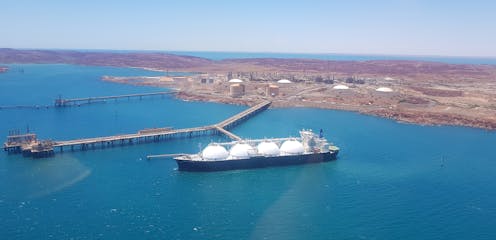
The controversial Scarborough gas project off Western Australia will cause a substantial rise in greenhouse gas emissions at a time when the world must rapidly decarbonise, new analysis released today shows.
The A$16 billion plan by Woodside Petroleum has been described as Australia’s biggest new fossil fuel investment in nearly a decade. The report[1], produced by Climate Analytics, a research organisation I help lead, is the first to examine the full climate impact of the entire expansion project.
The Morrison government has put the gas industry at the heart of its economic recovery from the COVID-19 pandemic. But as the Scarborough example shows, such projects makes it less likely the world will meet the goals of the Paris Agreement.
The sheer scale of emissions from the expansion, and projects linked to it, will make achieving 2030 emissions targets much harder for Western Australia and, by extension, Australia and the world.
Emissions worse than we thought
Woodside’s expansion proposal involves developing the Scarborough offshore gas field 375 kilometres off Australia’s northwest coast. It also includes a new pipeline to the company’s onshore Pluto processing facility on the Pilbara coast, and expansion of that facility.
Woodside last week announced[2] it had approved the final investment decision on the developments. Chief executive Meg O'Neill said the project “supports the decarbonisation goals of our customers in Asia”.
Our study examines the full emissions implications of the expansion and associated projects, including domestic gas supply and a proposed project[3] converting gas to hydrogen.
Estimates of the entire projects’ greenhouse gas implications are spread across several reports and documents. This report assembles these for the first time. The research was commissioned by the Conservation Council of Western Australia.
Read more: 'Unjustifiable': new report shows how the nation's gas expansion puts Australians in harm’s way[4]
We examined the emissions from the gas facilities themselves, and emissions that will, or are likely to, occur as a result of the project. This second group of emissions includes locked-in domestic demand for natural gas and overseas export markets burning its product for energy.
We estimate that by 2055, the expansion and associated projects will emit 1.37 billion tonnes of greenhouse gases. Almost 20% is projected to be emitted in Western Australia and the rest would be emitted overseas where the exported gas will be burnt.
The total emissions we calculate is far more than the 878 million tonnes Woodside says the project will emit.
In a statement to The Conversation, a Woodside spokeswoman said its emissions figure was “correct and has been accepted by the federal regulator NOPSEMA”.
However the NOPSEMA report covers only the emissions that come from gas derived from the Scarborough gas field and not the emissions from the entire Pluto expansion. In contrast, Woodside’s greenhouse gas action plan is based on the entire Pluto expansion, including all aspects of the project we included in our calculations.
Woodside said Scarborough gas, used to generate electricity, could power ten cities the size of Perth for 30 years and the emissions would be around half those for the same electricity generated from coal.
However, we found that introducing Scarborough-Pluto gas into electricity grids of countries decarbonising in line with the Paris Agreement would raise greenhouse gas emissions by several hundred million tonnes between 2026 and 2040.
Questionable emissions reduction plan
Woodside says its “greenhouse gas abatement program[5]” shows how the company will offset a substantial amount of emissions. We believe that plan, approved[6] by the WA government, is questionable on several counts.
For example, a Woodside project approved in 2006[7] at 12 million tonnes of LNG per year was later scaled down[8]. However, Woodside’s plan for emissions reduction plan comes off the earlier high-emissions baseline.
Woodside proposes to reduce emissions reductions using carbon offsets (removing CO₂ from the atmosphere in one place to compensate for emissions made elsewhere). But there appears to be no guarantee these offsets would not have occurred as part of Woodside’s usual business operations.
Woodside says it plans to abate all emissions from the project by 2050. But most of this emissions reduction will not occur until after 2040, and depends on factors[9] such as the availability of technology, government policy and the availability of carbon offsets for purchase.
Woodside has also not accounted for expected global increases[10] in the price of carbon offsets. We calculate that by 2050, the cost of offsets could comprise between 21% and 71% of Woodside’s export revenue for liquified natural gas.
Read more: Big-business greenwash or a climate saviour? Carbon offsets raise tricky moral questions[11]
Bad news for net-zero
In May this year, the International Energy Agency said[12] no new oil and gas fields can be developed if the world is to meet the goal of net-zero emissions by 2050 and avert catastrophic global warming.
This, in our view, includes the Scarborough-Pluto expansion. Introducing gas from the project into electricity grids of importing nations would slow global decarbonisation efforts.
Big buyers of Australian gas, such as South Korea[13] and Japan[14], are moving away from fossil fuels and towards green hydrogen and renewable energy. This suggests a softening, or even collapse, in demand for LNG this decade – a trend consistent with assessments by the International Energy Agency[15] and Australia’s Reserve Bank[16].
For Woodside, the Scarborough-Pluto expansion is increasingly looking like a stranded asset. And the WA government’s support for the project, and the broader gas industry, means it’s missing out on massive, and growing, opportunities in renewable energy and green hydrogen exports.
Read more: International Energy Agency warns against new fossil fuel projects. Guess what Australia did next?[17]
References
- ^ report (climateanalytics.org)
- ^ announced (files.woodside)
- ^ project (www.smh.com.au)
- ^ 'Unjustifiable': new report shows how the nation's gas expansion puts Australians in harm’s way (theconversation.com)
- ^ program (files.woodside)
- ^ approved (files.woodside)
- ^ approved in 2006 (www.epa.wa.gov.au)
- ^ scaled down (files.woodside)
- ^ depends on factors (files.woodside)
- ^ increases (www.sciencedaily.com)
- ^ Big-business greenwash or a climate saviour? Carbon offsets raise tricky moral questions (theconversation.com)
- ^ said (theconversation.com)
- ^ South Korea (www.theguardian.com)
- ^ Japan (www.theguardian.com)
- ^ International Energy Agency (www.iea.org)
- ^ Reserve Bank (www.rba.gov.au)
- ^ International Energy Agency warns against new fossil fuel projects. Guess what Australia did next? (theconversation.com)