Why we're using filmmaking to encourage vaccination by Black and Latino Angelenos
- Written by: Jeremy Kagan, Professor of Film & Television Production, School of Cinematic Arts, University of Southern California
People have recognized the power of storytelling for thousands of years[1]. The Bible relies on parables like the prodigal son[2] because stories successfully convey the underlying message in a memorable way that’s easy to pass along to future generations.
But when public health leaders and medical professionals need to communicate crucial, potentially life-saving health information, they can fail to harness the strength of storytelling.
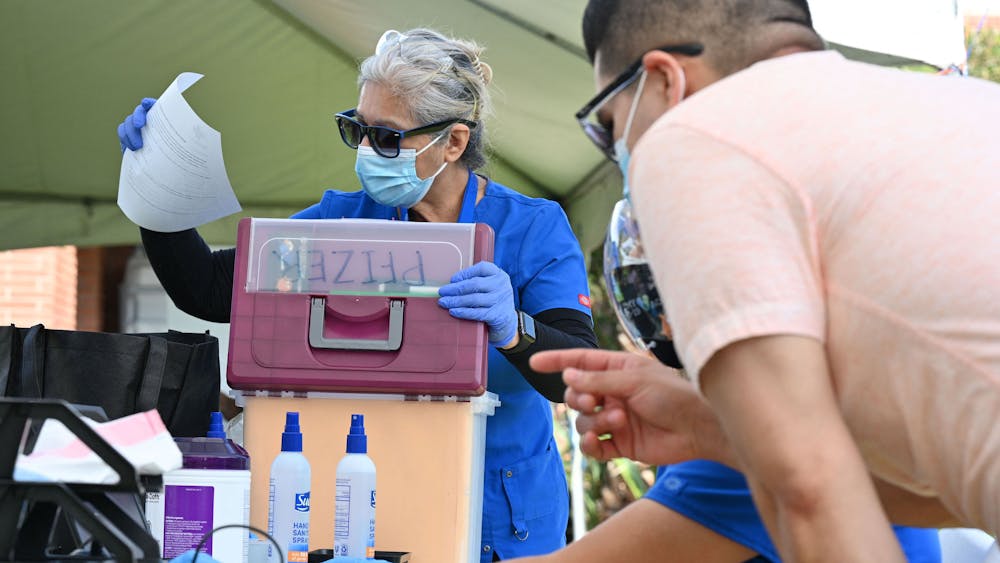
That’s why we, a filmmaking professor[3], a health communications scholar[4] and a public health professor[5] specializing in community outreach, wanted to see if we could help once COVID-19 vaccines became widely available. We stepped up after seeing that the vaccination rates of Latino and Black residents[6] of Los Angeles were roughly 20 percentage points lower than for white Angelenos. By May 1, 2021, 60% of white Angelenos had received at least one dose of the vaccine, compared to 42% for Latinos and 36% for Black residents.
6 key points
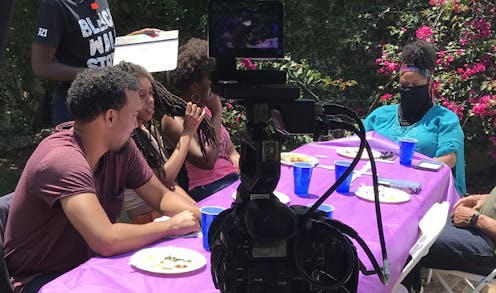
We assembled two separate film crews, comprised of Latino and Black cinematic arts graduate students attending the School of Cinematic Arts at the University of Southern California, to make two short films to counter vaccine hesitancy in both communities. The crews wrote scripts countering the most prevalent COVID-19 myths and then went into production on real locations in Los Angeles.
We worked on this project with VaccinateLA[8], a joint effort between the University of Southern California, multiple hospitals and dozens of community organizations.
The Latino crew’s 6-minute film, “Of Reasons and Rumors[9],” relays the story of a tight-knit Latino family in East LA divided by disagreement over the importance and safety of vaccination against COVID-19. Through the characters, viewers confront what they would do if being unvaccinated kept them away from their loved ones. We also produced another version of this film in Spanish[10].
In the short film ‘Of Reasons and Rumors,’ members of a Latino family discuss their concerns about the importance and safety of COVID-19 vaccines.The Black crew’s 6-minute film, “Happy Birthday, Granny[11],” revolves around an African American family in South LA. The family is celebrating their grandmother’s 80th birthday when an argument leads to a volatile discussion about the truth about the development and safety of COVID-19 vaccines.
During the short film ‘Happy Birthday, Granny,’ an African American family argument leads to a myth-busting discussion about COVID-19 vaccine safety.Research about narrative-driven films that are made to motivate behavioral changes, known as entertainment-education communication theory[12], suggests that facts inform while stories transform. We believed that making these stories effective would rely on two things.
First, the narrative needed to be sufficiently engaging to transport viewers into the narrative world[13] so that they don’t notice, and possibly argue against, the vaccine-related information being conveyed. Second, it was important to use characters with whom viewers can identify[14]. That’s why the casts for both films didn’t include any celebrities.
The films, completed in July 2021, make the following six key points:
The vaccines made use of research underway for more than 20 years[15].
The vaccines don’t affect fertility[16].
Except for the Johnson & Johnson vaccine, at least two doses are required[17].
Too few people have been vaccinated to end the COVID-19 pandemic[18].
People who have gotten COVID-19 still need to be vaccinated[19] to be protected from new variants of the coronavirus.
The vaccines are easily accessible[20] through pharmacies, clinics and mobile vans[21].
Piquing interest in getting vaccinated
We wanted to know whether these films would resonate elsewhere. Before distributing the films more broadly, we first showed them to a national sample of 600 unvaccinated Latinos and African Americans who took part in a forthcoming online study. Some watched films that featured characters of their own ethnicity, and others saw the film featuring the other ethnicity.
Although viewers who saw an ethnically matched film identified more with the characters and showed the greatest increase in their intent to get vaccinated in the next 30 days, viewers of either film could correctly reject the six myths both films seek to debunk.
Based on our results, we believe that both films could also help persuade Black and Latino people outside Los Angeles who haven’t yet gotten vaccinated against COVID-19 to do that.
The disparities in vaccination rates[22] for Latinos and Black Americans[23] relative to whites have persisted, while also narrowing both nationally and locally. In LA County, 75% of white Angelenos were vaccinated as of Nov. 11, 2021[24], versus 66% for Latinos and 58% for African Americans.
[Get the best of The Conversation, every weekend. Sign up for our weekly newsletter[25].]
We are following up with a third film, depicting a multiethnic community. It will encourage parents to have their children vaccinated. Early surveys indicate that many parents are reluctant to take this important step[26], even as shots for kids 5 and up[27] are being rolled out.
Ashley Phelps[28], a University of Southern California doctoral candidate researching vaccine hesitancy, coordinated the COVID-19 protocols for the filmmaking.
References
- ^ thousands of years (www.meetcortex.com)
- ^ prodigal son (www.gotquestions.org)
- ^ filmmaking professor (www.cmml-usc.org)
- ^ health communications scholar (scholar.google.com)
- ^ public health professor (scholar.google.com)
- ^ the vaccination rates of Latino and Black residents (doi.org)
- ^ Robyn Beck/AFP via Getty Images (www.gettyimages.com)
- ^ VaccinateLA (vaccinatela.info)
- ^ Of Reasons and Rumors (vimeo.com)
- ^ film in Spanish (vimeo.com)
- ^ Happy Birthday, Granny (vimeo.com)
- ^ entertainment-education communication theory (www.communicationtheory.org)
- ^ transport viewers into the narrative world (doi.org)
- ^ viewers can identify (doi.org)
- ^ research underway for more than 20 years (apnews.com)
- ^ don’t affect fertility (theconversation.com)
- ^ at least two doses are required (www.cdc.gov)
- ^ end the COVID-19 pandemic (theconversation.com)
- ^ gotten COVID-19 still need to be vaccinated (www.cdc.gov)
- ^ easily accessible (www.cdc.gov)
- ^ pharmacies, clinics and mobile vans (publichealth.lacounty.gov)
- ^ disparities in vaccination rates (www.kff.org)
- ^ Black Americans (theconversation.com)
- ^ vaccinated as of Nov. 11, 2021 (publichealth.lacounty.gov)
- ^ Sign up for our weekly newsletter (memberservices.theconversation.com)
- ^ reluctant to take this important step (khn.org)
- ^ kids 5 and up (www.cdc.gov)
- ^ Ashley Phelps (annenberg.usc.edu)