The ancient history of adding insult to injury
- Written by: Andrew M. McClellan, Lecturer in Classics and Humanities, San Diego State University
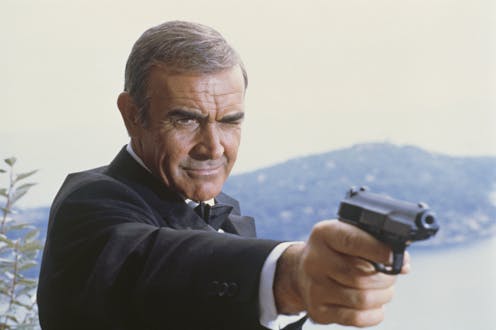
At one point in the latest James Bond installment, “No Time To Die[1],” the henchman Primo has the upper hand on 007. But Bond has a wristwatch that can trigger an electromegnetic pulse keyed to local circuitry. Primo, conveniently, has a biomechanical eye, so when Bond activates his watch next to Primo’s head, it explodes.
Bond’s gadgeteer, Q, radios in, and Bond delivers the rhetorical goods: “I showed him your watch. It blew his mind.”
This sort of witty quip after killing someone isn’t unique to the Bond franchise. From “Dirty Harry[2]” to “Django Unchained[3],” they’ve become staples of the action film genre.
Audiences might assume action films invented these one-liners. But as I’ve demonstrated in my work[4] researching ancient Greco-Roman epic poetry, the origin of this sort of rhetorical violence goes back thousands of years.
A perverse eulogy
The one-liner is in many ways the calling card of action films. The motif took off in the 1960s and peaked in the mid-1980s and early 1990s. Today you’ll see occasional nods to the tradition in films like “No Time To Die.”
Earlier James Bonds also delivered post-kill zingers. In “Thunderball[5],” Sean Connery’s Bond spears a foe with a harpoon gun, then jokes: “I think he got the point.” After “Live and Let Die[6]” villain Dr. Kananga balloons and explodes from ingesting a gas pellet, Roger Moore’s Bond gloats, “He always did have an inflated opinion of himself.”
Roger Moore’s James Bond delivers a classic post-kill zinger.These one-liners had become de rigueur by the 1990s. In “Universal Soldier[7],” Jean-Claude Van Damme’s Luc Deveraux kills Andrew Scott by feeding him through a woodchipper that hurls bits and pieces of his corpse through the air. Deveraux’s companion asks where Scott is, to which Deveraux laconically replies, “Around.” And after killing Screwface in “Marked for Death[8],” John Hatcher, played by Steven Seagal, discovers there’s another Screwface – or, rather, that twins have been running the criminal organization he’s fighting. Hatcher then executes the second Screwface in one of the most violent, prolonged death scenes in film history.
Hatcher catches his breath, before muttering, “I hope they weren’t triplets.”
But Arnold Schwarzenegger, who rose to fame during the golden era of action films in the 1980s[9], was the king of one-liners[10].
“Commando[11]” ends with John Matrix, played by Schwarzenegger, impaling the villainous Bennett with a massive metal pipe that travels through Bennett and, inexplicably, into a boiler. The blast of steam travels back through Bennett and out the end of the pipe. Surveying the carnage, Matrix quips: “Let off some steam, Bennett.” In “Predator[12],” Schwarzenegger’s character pins an enemy to a wall with a knife, inviting him to “stick around.” And in “The Running Man[13],” he chainsaws his adversary Buzzsaw vertically, crotch up.
When asked what happened to Buzzsaw, he reports: “He had to split.”
Arnold Schwarzenegger, virtuoso of verbal daggers.The quips literally add insult to injury, defaming the victim immediately after their demise, emblazoning the death with a caption, like a perverse eulogy. Film heroes deliver the best taunts because their rhetorical skill is linked to their physical prowess.
This might seem incongruous. But the link between martial and rhetorical skill goes back to Western literature’s beginning.
The ‘vaunts’ of the ancient epics
Ancient epic poems are, in many ways, the antecedents to today’s action flicks; they were the violent, thrilling blockbusters of their era.
Homer’s heroes in the “Iliad[14],” written sometime between 750 and 700 B.C., are not just deft fighters but also adroit talkers. Achilles, for example, is lauded as both the best fighter and the best speaker among the Greeks at Troy.
The parameters of ancient epic duels mirror action film fights. When two warriors square off, they taunt each other. When one warrior wins, typically the victory is punctuated by a witty defamatory “vaunt[15]” that signals the champion’s prowess and the loser’s now-verified inadequacy.
In Virgil’s “Aeneid[16],” Turnus avoids damage from a spear cast by the young warrior Pallas thanks to his thick shield. After hurling a spear of his own that pierces Pallas, Turnus boasts of the performance of his weapon by comparison. The taunt is soaked in sexual innuendo: “See whether my weapon can penetrate better.”
Turnus later sneers over the slain Eumedes, whose throat he’s severed: “Hey, Trojan, the Western land you hoped to conquer, measure it with your corpse.” Since Eumedes sought to colonize parts of modern-day Italy, he would have surveyed the land for settlements; Turnus sardonically suggests using his dead body as a measuring stick.
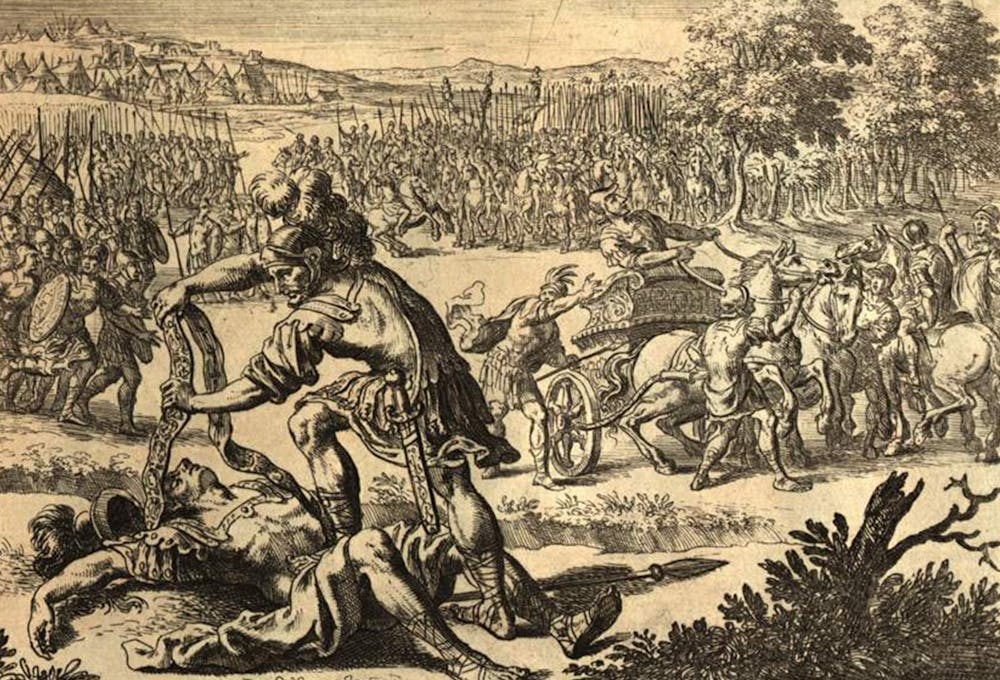
In the “Iliad,” Polydamas spears Prothoenor in the shoulder. He falls and dies, whereupon Polydamas jokes that the spear will be useful to lean on “like a staff when he descends to the underworld.”
At another point in the “Iliad,” Patroclus kills the Trojan charioteer Cebriones by smashing his face with a stone. The force of the strike ejects Cebriones’ eyes from their sockets; they hit the ground, and Cebriones follows them headfirst onto the battlefield. The bizarre situation elicits Patroclus’ zesty bon mot: “What a spring the man has! Nice dive! Think of the oysters he could come up with if he were out at sea …”
In this vaunt-cum-metaphor, Cebriones’ eyes, which he “chases” into the sand, have become precious pearls in the oysters he’s imagined to be hunting.
Breaking the fourth wall
What value does wit hold in genres defined by brute strength?
Never mind the fact that a corpse is hardly a suitable target for clever punchlines. The jokes are for the audience, and it’s as close as the genre gets to breaking the fourth wall. Viewers are attuned to these witticisms not simply because they are funny, but because they’re self-consciously ridiculous. They help distance the audience[18] from the often horrific levels of violence on display.
[Over 115,000 readers rely on The Conversation’s newsletter to understand the world. Sign up today[19].]
Epic poetry has traditionally held a highbrow status in literary criticism, while action films are regarded as puerile and brutish. These designations collapse at the level of rhetorical violence. In truth, epics like the “Iliad” skew more “action film” than most literati would like to admit, and vice versa.
The larger-than-life heroes from John Matrix to James Bond are ultimately the silver screen progeny of warrior-poets from antiquity.
References
- ^ No Time To Die (www.imdb.com)
- ^ Dirty Harry (www.imdb.com)
- ^ Django Unchained (www.imdb.com)
- ^ But as I’ve demonstrated in my work (www.cambridge.org)
- ^ Thunderball (www.imdb.com)
- ^ Live and Let Die (www.imdb.com)
- ^ Universal Soldier (www.imdb.com)
- ^ Marked for Death (www.imdb.com)
- ^ golden era of action films in the 1980s (doi.org)
- ^ king of one-liners (muse.jhu.edu)
- ^ Commando (www.imdb.com)
- ^ Predator (www.imdb.com)
- ^ The Running Man (www.imdb.com)
- ^ Iliad (www.google.com)
- ^ vaunt (www.jstor.org)
- ^ Aeneid (www.google.com)
- ^ Bavarian State Library (dcc.dickinson.edu)
- ^ distance the audience (www.doi.org)
- ^ Sign up today (theconversation.com)
Read more https://theconversation.com/the-ancient-history-of-adding-insult-to-injury-170612