Australia has not just had a 'diplomacy fail' – it has been devaluing the profession for decades
- Written by: Melissa Conley Tyler, Honorary Fellow, Asia Institute, The University of Melbourne
We are seeing an unusual level of discussion about Australian diplomacy.
There’s been harsh criticism[1] – and some degree of embarrassment[2] – surrounding what has been described been as a “diplomacy fail[3]” in managing relations with France[4].
The head of the Australian Strategic Policy Institute, Peter Jennings, has gone as far as saying[5]:
If it looks like our foreign policy is all a bit rough and ready, it’s because we have not invested in our diplomatic capability for a long time […] Acquiring some diplomatic smarts would be a damned sight cheaper than a nuclear sub.
So, what is diplomacy – and is it in decline?
Diplomatic smarts
Diplomacy is the operating system[6] of international relations.
The responsibilities of diplomats[7] include gathering and reporting information, communication and negotiation (both with foreign governments and other actors), promoting friendly relations (including economic, cultural and scientific) and protecting citizens abroad.
These are often in high-pressure and crisis situations.
Former ambassador Sue Boyd[8] recalls Gough Whitlam articulating the key questions a diplomat’s job should centre on: “What’s going on? What does it mean for Australia? And what should we do about it?”.
If there’s one key diplomatic skill, it is perspective-taking: being able to see the world as others see it. Most other countries don’t share our viewpoint and don’t care about our interests. If we want to understand and communicate with them, we need to enter imaginatively into their worldview.
The analytical abilities and relationships required to answer such questions are specialist skills. Diplomats are, by definition, elite – they spend years studying other cultures, societies and economies and developing the intercultural skills required to communicate and persuade.
Read more: 'The Australian way': how Morrison trashed brand Australia at COP26[9]
This doesn’t appeal to populists[10]. Politicians such as Donald Trump prefer to see international relations as something they or their family members can do through force of personality (note how this approach to diplomacy brought no discernible dividends[11] for the former US president with North Korea).
Underinvesting in diplomacy
We can see the decline in diplomacy starkly through Australia’s resource allocation.
In research for Australian Foreign Affairs, I charted the decline[12] in resourcing stretching over decades from 8.9% of the federal budget in 1949 dedicated to diplomacy, trade and aid compared to only 1.3% in 2019. To compare[13] Australia to other developed countries with similar-sized economies, Canada and the Netherlands invest 1.9% and 4.3% of their budgets in this area.
Looking at the last 20 years, there has been a pronounced drop in funding for diplomacy at the same time as funding for defence and intelligence has increased[14]. As of 2019-20[15], the Department of Defence budget increased by 291% since 2011, while the allocation for the Australian Security Intelligence Organisation grew by 528% and the Australian Secret Intelligence Service by 578%.
More subtly, you can see the devaluing of diplomacy in other indicators.
This includes the Department of Foreign Affairs and Trade not being consulted[16] on major foreign policy decisions, not being perceived as having “heft[17]” in policy debates within government and the record level[18] of political appointments (rather than career diplomats) to diplomatic posts.
Why the decline?
It’s worth noting, this is not just an Australian problem[19], with diplomatic approaches being sidelined in countries from the United States to Brazil. So the wider question is why does diplomacy get overlooked? There are three reasons:
1. Diplomacy is no longer widely regarded as a special skill
In the golden age of diplomacy, diplomats were an exclusive club that managed international engagement. Today, real-time communication technologies and ease of travel give the (false) impression that anyone can communicate seamlessly across borders.
2. Security approaches are preferred
Diplomacy deals with nuance (which can sound like being an apologist) and engagement (which can sound like appeasement). A security mindset – which sees things in black and white, defining enemies and friends – is much more comforting. In some places, like Xi’s China, diplomats are under pressure to show their patriotism and “fighting spirit”, which does not help good diplomatic communication. This is related to the third issue, that –
3. Domestic politics is seen as more important
There is always a danger[20] good foreign policy will be crowded out by domestic political considerations. To avoid this, we need leaders who care about the long-term interests of the country as well as immediate political gain. That requires both largeness of vision and self-restraint.
Making the case for diplomacy
So, how do we make the case for diplomacy[21]?
It begins with a dose of realism[22]. Valuing diplomacy requires a degree of acceptance about what is possible, living with compromises, stop-gaps and partial solutions. It is incremental, rather than revolutionary.
By contrast, politics can fall into the trap of magical thinking – that if only we say what we want loud enough, it will occur.
Australia is, for example, only one moderate-sized power among many, meaning there are significant limits on how much it can get of what it wants. It’s a big, tough world out there and we need the very best people trying to make sense of it and shape it to our interests.
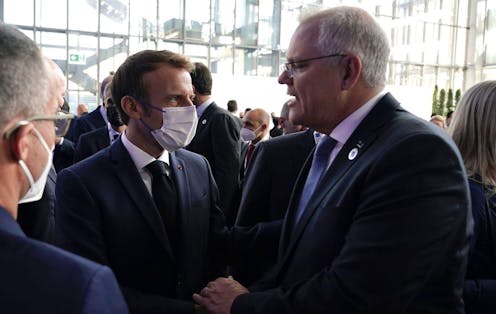
For me, commentary that describes the Macron/Morrison episode[23] as a “failure of Australia’s diplomacy[24]” misses the point: in a real sense, diplomacy wasn’t even tried.
It is the sidelining of diplomacy that is the problem.
Read more: 'I don't think, I know' – what makes Macron's comments about Morrison so extraordinary and so worrying[25]
References
- ^ harsh criticism (www.theguardian.com)
- ^ embarrassment (www.smh.com.au)
- ^ diplomacy fail (www.thesaturdaypaper.com.au)
- ^ relations with France (theconversation.com)
- ^ as saying (www.smh.com.au)
- ^ operating system (link.springer.com)
- ^ responsibilities of diplomats (legal.un.org)
- ^ Sue Boyd (www.australianforeignaffairs.com)
- ^ 'The Australian way': how Morrison trashed brand Australia at COP26 (theconversation.com)
- ^ doesn’t appeal to populists (www.orfonline.org)
- ^ no discernible dividends (www.theatlantic.com)
- ^ decline (www.australianforeignaffairs.com)
- ^ compare (pursuit.unimelb.edu.au)
- ^ funding for defence and intelligence has increased (theconversation.com)
- ^ 2019-20 (pursuit.unimelb.edu.au)
- ^ consulted (www.abc.net.au)
- ^ heft (www.afr.com)
- ^ record level (www.afr.com)
- ^ not just an Australian problem (www.orfonline.org)
- ^ danger (www.lowyinstitute.org)
- ^ case for diplomacy (www.lowyinstitute.org)
- ^ dose of realism (www.internationalaffairs.org.au)
- ^ Macron/Morrison episode (theconversation.com)
- ^ failure of Australia’s diplomacy (www.thesaturdaypaper.com.au)
- ^ 'I don't think, I know' – what makes Macron's comments about Morrison so extraordinary and so worrying (theconversation.com)