The view from inside the Glasgow climate summit – signs of progress as talks intensify, amid grandstanding and anger outside
- Written by: Rachel Kyte, Dean of the Fletcher School, Tufts University
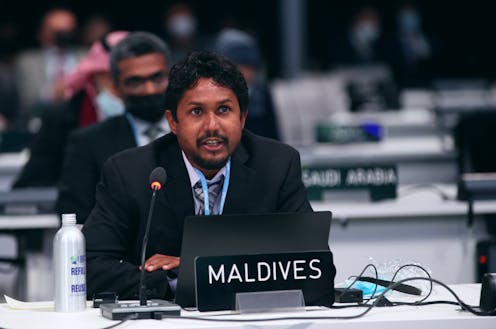
Young people poured into the streets[1] of Glasgow on Nov. 5 and 6, 2021, angry and impatient as the first week of the U.N. climate summit[2] ended. Their anger is matched by anxiety in the conference halls as the enormity of what has to be achieved in such a short period of time hovers over a complex process that can become sclerotic.
I’ve been involved in the climate negotiations for several years as a former senior U.N. official[3] and I am in Glasgow now. At the start of the second week, here’s what I’m seeing and hearing, both inside the negotiations and outside.
A shift from 2050 to 2030 goals
To slow climate change, every part of our economies will transform, and that is reflected in the conference sessions[4] running in parallel to the formal negotiations and in the constituencies that turned out in real strength the first week – executives from central banks[5], CEOs of global banks and institutional investors, young people, indigenous peoples leaders, faith communities, advocacy groups and the world’s media.
There has been a shift at this year’s summit, from making pledges to reach net zero emissions by 2050 to a focus on actions to cut emissions by 2030.
Research shows the world needs to cut global emissions 45% by 2030[6] to keep global warming under 1.5 degrees Celsius (2.7 F) compared to pre-industrial times, an aim of the Paris climate agreement[7].
The Energy Transitions Commission[8], a coalition of businesses and nongovernmental organizations, calculated that if the commitments made at COP26 are delivered, it will cut the gap between today and the 1.5 C trajectory in half for carbon dioxide emissions and by almost 40% for methane. In total, the world would be about 9 gigatons closer to the 22 gigatons of emissions reductions needed.
That’s a start.
Big deals, big claims
The first week of COP26 was about building momentum – big deals and big claims outside the negotiations, with different coalitions of countries, companies and others, pushing action forward.
Some of those pledges will likely collapse like a souffle in the weeks and months that follow, when a company’s board balks at some of the details or when they re-run the numbers under greater scrutiny.
But there were notable coalitions announcing pledges on cutting methane[9], ending deforestation[10] and diverting international public finance away from fossil fuels[11] and into clean energy. The international financial community[12] formed a broad alliance of firms committed to net zero, attracting accusations of greenwashing[13].
The U.N. secretary-general announced an expert group[14] to propose clear standards for companies and others making net zero commitments.
The formal negotiations intensify
At this point in the negotiations, the U.K. – which holds the COP26 presidency[15] – will drive efforts to wrap up some remaining parts of the rulebook for implementing the Paris climate agreement.
It will also be pushing for agreement on a “cover statement,” which will include a whole raft of issues. At this point, it is a long list of issues ranging from human rights, youth engagement and a just transition to more technical and procedural issues, such as how to recalibrate countries’ climate commitments and actions each year and how to ensure finance flows to adaptation, not just mitigation[16].
A “High Ambition Coalition” is emerging, led by the Climate Vulnerability Forum[17], a group of around 20 countries facing high risks and sometimes existential threats from climate change. They have called for a Climate Emergency Pact[18] that would include: a plan to deliver finance to help them adapt to climate change over the next few years, an agreement to increase those funds beyond that period, progress on finance involving loss and damage from climate change, an agreement on carbon markets, and a process for raising countries’ commitments each year until the world is on track.
Now, in the second week, government ministers from the around the world are becoming personally involved in loosening log jams and taking over from their negotiators.
Joining the inside and outside
The gulf between what’s happening inside the negotiations, and what press releases from events outside the negotiating rooms are saying could widen.
Inside, negotiators cannot agree on billions of dollars[19] in climate finance expected to flow from wealthy countries to help poorer countries. Yet on the outside, press releases discussing trillions of dollars in private investment[20] committed to net-zero emissions imply the problem is fixed.
And on the outside, while some analysts tally commitments[21] to see if each gets the world closer to a trajectory that keeps warming under 1.5 C, inside discussions on transparency and reporting on climate progress are stalled.
But the atmosphere is not all bleak. There is optimism that agreement on carbon markets[23] may be found after painfully elongated talks at the summits two years ago in Madrid and three years ago in Katowice.
Ultimately, the Glasgow conference can only be called a success when emissions start to slow and reverse and wealthy nations are able to put finance and real support behind poorer communities’ adaptation so they can become more resilient to the climate driven crises still to come.
Opportunity for talent
While all of this is resolved, think about this: In every meeting I have been in – with green banks in developing countries and their micro-entrepreneurs, Silicon Valley CEOs, finance chiefs, management consultancies and mayors – there is an additional concern that goes beyond the need for better policy, new regulation and a braver political class. Their concern is about the talent pipeline, or its absence. As every country, company, fund and bank shifts to a net-zero pathway, the world will need engineers, data analysts, policy experts and planners to plot the course and lead.
The transition is underway, Glasgow needs to deliver, and the world needs to train and prepare for the sprint to 2030 in a race to zero emissions.
References
- ^ poured into the streets (www.bbc.com)
- ^ U.N. climate summit (ukcop26.org)
- ^ a former senior U.N. official (fletcher.tufts.edu)
- ^ the conference sessions (unfccc.int)
- ^ central banks (www.wsj.com)
- ^ cut global emissions 45% by 2030 (www.ipcc.ch)
- ^ Paris climate agreement (unfccc.int)
- ^ Energy Transitions Commission (www.energy-transitions.org)
- ^ cutting methane (theconversation.com)
- ^ ending deforestation (news.un.org)
- ^ away from fossil fuels (theconversation.com)
- ^ international financial community (www.un.org)
- ^ accusations of greenwashing (www.stand.earth)
- ^ expert group (news.un.org)
- ^ COP26 presidency (www.gov.uk)
- ^ mitigation (theconversation.com)
- ^ Climate Vulnerability Forum (thecvf.org)
- ^ Climate Emergency Pact (thecvf.org)
- ^ billions of dollars (www.nature.com)
- ^ trillions of dollars in private investment (www.gfanzero.com)
- ^ analysts tally commitments (theconversation.com)
- ^ Peter Summers/Getty Images (www.gettyimages.com)
- ^ agreement on carbon markets (www.carbonbrief.org)
- ^ Read more of our U.S. (theconversation.com)
- ^ global coverage (page.theconversation.com)