how courtesans in Ancient Greece crossed the mind/body divide
- Written by: Dawn LaValle Norman, Research Fellow and ARC DECRA Fellow, Institute for Religion and Critical Inquiry, Australian Catholic University
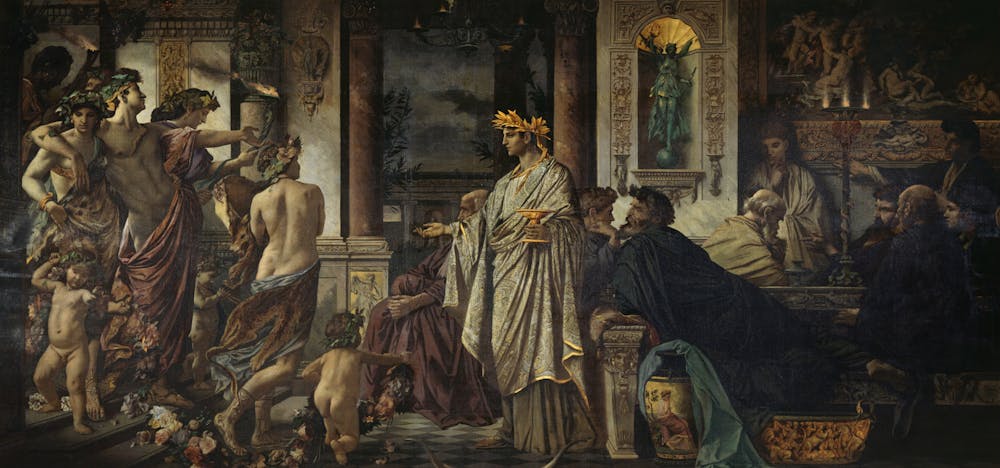
As the philosopher and historian Xenophon tells the story[1], Socrates and his friends gathered around a classy sex worker, watching her as if she were a tableau, using her beautiful body to talk about other things that they care more about: desire, love, philosophy.
Then suddenly, the woman they are analysing joins the conversation. Theodote, a rich and beautiful courtesan, asks Socrates a question. Socrates gamely engages her in a witty conversation about the best way to increase desire. Socrates claims he wants to learn the skills of a courtesan in order to attract young men to join his life of philosophy.
While exchanging sexy philosophical chat with Theodote, Socrates had at least one wife of his own at home (possibly two at once[2]). But his biographers never show him engaging his wives Xanthippe or Myrto in conversation. Instead, we see Xanthippe encumbered by a baby boy on her knee, sent away[3] from Socrates’ deathbed in order for the philosophising to begin in earnest among the men.
Socrates can talk philosophically to Theodote and not to Xanthippe because the two women filled very different cultural roles in ancient Greece. Xanthippe’s respectable marriage – even to the controversial vagabond Socrates – placed her in a web of social obligations that prioritised her public silence and her physical obligations of caring for the family’s children and material wealth.
Theodote, on the other hand, made a living by being seductive, through her persuasive rhetoric and her adroitness at caring for her clients.
Her life, and those of women like her, depended on persuasion.
Participants in the world of thought
Sex workers in Ancient Greece divided into two somewhat overlapping types. The most common were those who lived in brothels, often enslaved sex workers providing a sanctioned service to the men of the ancient Greek city. The word for this role was porne, from where we get the English word pornography.
Not only did these women lack freedom, but their profession could also be dangerous. Women consigned to this life had no leisure and no expectation of education.
But there was another kind of sex worker who gripped the imagination of writers in the ancient world. These women did not live in brothels, but in their own homes. They granted favours, rather than being bought for a fee, and participated in the language of aristocratic exchange of goods.
They were called “friends”, hetairai in Greek, or, as they came to be known in English, courtesans.
Read more: Hidden women of history: Neaera, the Athenian child slave raised to be a courtesan[4]
These women were seen as having captivating minds, not just captivating bodies. They could be conversation partners and were allowed unprecedented freedom in the ancient world.
Theodote was one of these women. When Socrates sees her, she is sitting next to her “mother”: it was common for courtesans to form female social clusters using the language of family even when the relationship was not biological.
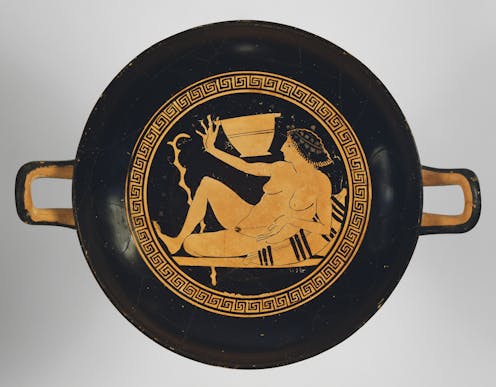
Their public status made many of these women notorious. We know a disproportionate amount about women like Neaera[5], one of several young girls raised to be sex workers by a madam named Nicarete, who called them all her “daughters”; Aspasia[6], the most famous and controversial courtesan of Classical Greece, whom Aristophanes claims ran a brothel[7]; and the plethora of named (albeit fictional) courtesans in Lucian’s Dialogues of the Prostitutes[8], including the widow Crobyle who persuades her young daughter Corinna to begin a life of high-class sex work in order to support the family.
Read more: Wise women: 6 ancient female philosophers you should know about[9]
A story told by men
Stories about philosophical courtesans formed part of elite male fantasy. Athenaeus of Naucratis, in the thirteenth book of his Deipnosophistae[10], preserves a long speech in praise of such high-class sex workers, put in the mouth of the character Myrtilus.
Myrtilus is in turn relying on an ancient book of witticisms, the Chreiae of Machon[11] written around 250 BCE, which gathered together the clever sayings of many different courtesans. Educated men thought it worthwhile to record and recollect the witty sayings of such women, who (unlike their wives) led a very public life, often as companions of politicians and philosophers.
Of course, in the ancient world, those who preserved and consumed such tales of witty courtesans were men. Women were excluded from the production of their own portrayal.
The connection between sex work and philosophy had a long life in the western tradition. In the 16th century, Tullia d'Aragona featured as a character[12] in Sperone Speroni’s On Love, is given the role of mouthpiece for the carnal, physical side of love. Like Theodote, the male author of the dialogue used the voice of a female sex worker as an expert on the body and its desire.
However, for the first time in the history of the genre of the philosophical dialogue, the woman who was written into a dialogue replied with her own literary work. Tullia soon wrote her own dialogue, On the Infinity of Love[13], in which she critiques Speroni’s stereotypical portrayal of her.
Renaissance women had means of responding to their portrayal in literature in a way unimaginable to their ancient Grecian sisters.
Ancient male writers fantasised alternatives to their wives: sexy philosophers with sharp tongues. But in the ancient world, such women were just as restricted by their stereotypes as the wives with whom they were contrasted.
Read more: Sex and the sisterhood: how prostitution worked for women in 19th-century Melbourne[14]
References
- ^ tells the story (www.perseus.tufts.edu)
- ^ two at once (www.perseus.tufts.edu)
- ^ sent away (www.perseus.tufts.edu)
- ^ Hidden women of history: Neaera, the Athenian child slave raised to be a courtesan (theconversation.com)
- ^ Neaera (theconversation.com)
- ^ Aspasia (theconversation.com)
- ^ ran a brothel (www.perseus.tufts.edu)
- ^ Lucian’s Dialogues of the Prostitutes (www.sacred-texts.com)
- ^ Wise women: 6 ancient female philosophers you should know about (theconversation.com)
- ^ Deipnosophistae (www.perseus.tufts.edu)
- ^ Chreiae of Machon (www.jstor.org)
- ^ featured as a character (www.jstor.org)
- ^ On the Infinity of Love (press.uchicago.edu)
- ^ Sex and the sisterhood: how prostitution worked for women in 19th-century Melbourne (theconversation.com)