Joyce says Nationals don't want bigger 2030 climate target as party room frets about regional protections
- Written by: Michelle Grattan, Professorial Fellow, University of Canberra
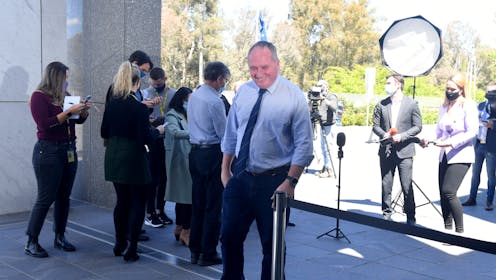
Deputy Prime Minister Barnaby Joyce killed the prospect of the Nationals agreeing to a more ambitious 2030 emissions reduction firm target, before his party room met to consider the government’s proposed new climate policy.
Later, the Nationals on Sunday night broke after four hours of briefing, questions and discussion, without a final position on the government’s climate policy, the core of which is a 2050 net zero target.
Nationals deputy leader David Littleproud said after the meeting that there were still more questions to be answered, and the party would take its time to get things right.
Sources said there had been some concern about the policy’s guarantees for job protection and creation.
Littleproud said: “How do we protect regional Australia is the real question we want answered. […] We want to be confident if we do sign up to [the net zero by 2050 plan], it protects regional Australia.”
The Nationals will discuss the policy further at their regular party meeting on Monday.
Asked ahead of the meeting whether there was any chance of it agreement to a new hard target for 2030, Joyce said: “On this issue, I would say no.
"I’ve got to be honest and say, well, what’s the views of the room on that issue? I don’t think that’s going to happen,” he told a news conference.
This confirms earlier indications the government is likely to present projections only, rather than targets, for the medium term in its policy for next month’s Glasgow climate conference.
These would be more ambitious than Australia’s present 2030 target of cutting emissions by 26-28% on 2005 levels. But the failure to have a firm improved medium-term commitment would disappoint allies such as the US and UK. It could potentially also leave the government exposed on climate policy in those Liberal electorates where it is a major issue.
Littleproud said the only question the Nationals party room had been asked to look at was the 2050 target.
The Liberal party meets on Monday to consider the government’s policy. Debate there will gauge whether moderate Liberals will be satisfied so long as the policy has an unequivocal 2050 net zero target, regardless of the line on the medium term.
Asked what message he would have for the Nationals about the concerns to consider in making a decision on the climate policy, Joyce said: “I’d say, you’ve been listening to your phones, you’ve been talking to your people in your electorates. This is your opportunity to convey those concerns and issues and sentiments of those electorates into this room and then in a collegial way with others we will try and land a position as best we can”.
Read more: Yes, Australia can beat its 2030 emissions target. But the Morrison government barely lifted a finger[1]
Prime Minister Scott Morrison, who confirmed on Friday he will attend the Glasgow conference, needs as a minimum to be able to declare Australia embraces a firm 2050 net zero target, rather than just having a plan to reach net zero without being absolutely locked into the date.
While the Nationals are being given guarantees the regions will be protected, as well as offered largesse, as part of a climate policy deal, they are suspicious because they feel they were dudded in the past.
Joyce referred back to what had happened under the Howard government and then environment minister Robert Hill, in relation to the Kyoto climate agreement.
“He [Hill] did us over on vegetation laws, and worked out a swindle through state governments to dispossess us of an asset, which to this day no one’s ever offered to pay us back for. So this time, we’re going to be super cautious.”
Read more: Morrison set for Glasgow but has to finish packing his bag[3]
Energy minister Angus Taylor briefed the Nationals meeting.
Taylor said in a statement afterwards there had been a “constructive and collegiate discussion” about the future of the regions, traditional industries and jobs.
“There was a strong joint commitment to policies that strengthen our regions – not weaken them.
"It was also clear that there was absolutely no appetite for policies that impact jobs or add to cost of living though an explicit carbon tax or a sneaky carbon tax. Which we won’t be doing,” Taylor said.
Read more: Climate wars, carbon taxes and toppled leaders: the 30-year history of Australia’s climate response, in brief[4]
The meeting saw Victorian Nationals Darren Chester back in the party room. Chester, with differences with colleagues on various matters, had been taking a break from party meetings. But he wanted to add his weight at the meeting to support the 2050 target.
Writing in the Guardian on Friday Innes Willox, chief of the Australian Industry Group, said the government’s policy should have three major elements.
The first was a commitment to net zero by 2050.
“The second pillar of a climate strategy should be a commitment to deeper emissions reductions this decade.
"Australia’s advanced economy peers and our own largest states have been setting 2030 goals ranging from cuts of 40% (Korea), 40-45% (Canada), 46% (Japan), 50-52% (US), 55% (EU) and 68% (UK) below their emissions peaks. There is no magic number, but roughly halving Australia’s emissions from our own peak would put us in the mainstream on 2030 goals.”
The third pillar was policy directions to accompany the goals, Willox wrote.
References
- ^ Yes, Australia can beat its 2030 emissions target. But the Morrison government barely lifted a finger (theconversation.com)
- ^ Mick Tsikas/AAP (photos.aap.com.au)
- ^ Morrison set for Glasgow but has to finish packing his bag (theconversation.com)
- ^ Climate wars, carbon taxes and toppled leaders: the 30-year history of Australia’s climate response, in brief (theconversation.com)