Tense decision-making as CDC joins FDA in recommending Pfizer booster shot for 65 & up, people at high risk and those with occupational exposure to COVID-19
- Written by: Matthew Woodruff, Instructor of Human Immunology, Emory University
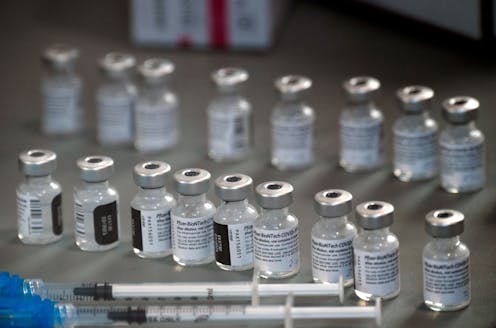
Following the recommendations of its vaccine advisory committee[1], the Food and Drug Administration gave emergency use authorization[2] to Pfizer-BioNTech’s COVID-19 vaccine booster dose for certain populations. The single shot is to be administered six months following completion of the original two-dose course.
The FDA’s Sept. 22, 2021, decision to not extend boosters to the general population – at least not yet – was a direct rebuke[3] to the Biden administration’s announcement in August that booster shots would be rolled out to all eligible Americans beginning in late September. Biden’s pledge had been widely criticized for getting out in front of the science[4] and the regulatory process.
The FDA instead limited its authorization of the third Pfizer dose to people 65 and older, people ages 18-64 at high risk of severe COVID-19 due to pre-existing conditions, and individuals with frequent risk of exposure to the coronavirus through their work, such as health care workers and teachers.
The Centers for Disease Control and Prevention’s Advisory Committee on Immunization Practices[5] then issued its own booster recommendations on Sept. 23, 2021. Its guidance aligned with the FDA’s authorization of boosters for use in ages 65 and up and people at high risk of severe COVID-19, but stopped short of endorsing booster shots for people with frequent occupational exposure. However, in an effort to realign the two agencies’ recommendations, CDC director Dr. Rochelle Walensky overrode the CDC advisory committee[6], providing the go-ahead[7] for all groups listed under the FDA’s emergency use authorizations – including those with increased job-site risk.
Despite the mixed messaging between the agencies, the immediate effect is that millions of Americans will be in line for added protection amid concerns over waning vaccine immunity[8]. An ongoing evaluation of whether COVID-19 boosters should be administered more broadly among vaccine-eligible people is likely to take place in the coming months[9], as more data becomes available to inform questions of safety, need and efficacy of boosters.
Fault lines between the FDA and CDC
This fraught booster approval process may strike some as strange, as the FDA is solely responsible for drug approval in most contexts[10]. However, as the body responsible for managing U.S. public vaccination programs, the CDC’s approval is required in order to begin the distribution and administration of vaccines.
The close intersection of the two agencies in approval and distribution of vaccines has recently become a point of contention for some high level officials, with two senior FDA vaccine leaders resigning[11] from their posts in early September 2021. One former FDA leader cited the expanding role of the CDC in vaccine evaluation as a major reason for their departure[12].
The tensions between these agencies was on full display when the CDC’s advisory committee excluded high occupational exposure risk as a booster-eligible group, breaking from the FDA recommendation and authorization[13]. The committee’s vote to not authorize boosters for those with frequent occupational exposures stemmed primarily from concerns that the recommendation was overly broad – potentially leading to confusion as to who counts as a worker at “high risk.”
This, combined with a shared view – including among some public health officials[14] – that critical pieces of data being used to advocate for the booster in the broader population were incomplete and open to interpretation[15], resulted in a 9-6 vote from the CDC committee against the third dose[16] for those at increased occupational risk.
Back in alignment
Ultimately, Walensky’s decision to side with the FDA on extending boosters to those with frequent occupational exposure – such as health care workers and teachers – brings the two agencies into alignment. And while it still falls short of the Biden administration’s pledge of boosters for all vaccine-eligible people in the U.S., the decision will pave the way for millions of third Pfizer doses to be administered in the coming months.
“As CDC Director, it is my job to recognize where our actions can have the greatest impact. At CDC, we are tasked with analyzing complex, often imperfect data to make concrete recommendations that optimize health. In a pandemic, even with uncertainty, we must take actions that we anticipate will do the greatest good,” Walensky said in a statement[17].
More guidance on COVID-19 boosters is expected to be issued soon for people who received the Moderna[18] and Johnson & Johnson[19] vaccines.
[Research into coronavirus and other news from science Subscribe to The Conversation’s new science newsletter[20].]
References
- ^ recommendations of its vaccine advisory committee (theconversation.com)
- ^ gave emergency use authorization (www.fda.gov)
- ^ direct rebuke (apnews.com)
- ^ getting out in front of the science (www.cnn.com)
- ^ Advisory Committee on Immunization Practices (www.cdc.gov)
- ^ overrode the CDC advisory committee (www.nytimes.com)
- ^ providing the go-ahead (www.cdc.gov)
- ^ waning vaccine immunity (www.nature.com)
- ^ likely to take place in the coming months (www.statnews.com)
- ^ in most contexts (doi.org)
- ^ two senior FDA vaccine leaders resigning (www.cnn.com)
- ^ a major reason for their departure (endpts.com)
- ^ breaking from the FDA recommendation and authorization (thehill.com)
- ^ including among some public health officials (doi.org)
- ^ incomplete and open to interpretation (www.cnbc.com)
- ^ against the third dose (www.statnews.com)
- ^ Walensky said in a statement (www.cdc.gov)
- ^ Moderna (www.nbcchicago.com)
- ^ Johnson & Johnson (theconversation.com)
- ^ Subscribe to The Conversation’s new science newsletter (theconversation.com)