School year off to a rocky start? 4 ways parents can help kids get back on track
- Written by: Christopher A. Kearney, Professor of Psychology, University of Nevada, Las Vegas
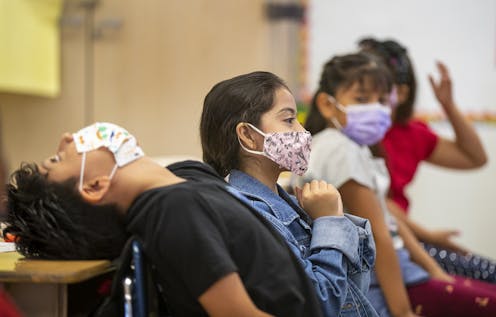
Sending a child to school in the morning is a daily ritual for millions of families worldwide. Unfortunately, the attendance process has become highly disrupted[1] due to COVID-19. The fact that many kids have been away from a physical school building for a year or more presents a number of challenges[2] for them and for their family members as schools reopen and resume in-person classes.
As a clinical child psychologist[3] who specializes in school attendance problems[4], I offer four ways parents can help students adapt to the new school year and improve their attendance.
1. Solidify the morning routine
Morning preparation routines may have become very laid-back or even unnecessary during the pandemic.
Parents and children will need to practice their routines[5] by setting waking times for all family members and having a regular order for getting ready for school. Give everyone more than enough time to complete all their tasks and try to complete the entire routine about 30 minutes before everyone has to leave home in case any problems arise.
2. Get academic help if needed
Another important challenge for students reentering a physical school space is the need to relearn important academic skills.
Many kids lost ground in reading and mathematics[6] during school shutdowns and will need to focus again on key basic skills such as comprehension, writing and multiplication tables. This may require extra help and tutoring as well as class time devoted to reviewing older material. In addition, many kids will need to relearn basic classroom routines as well as new health and safety protocols such as social distancing or mask mandates.
Parents are encouraged to work with teachers to understand the expectations[7] for homework and behavior and remain aware of, and ready for, sudden changes to learning formats. If a child’s progress in these areas seems a bit behind, then a conversation with the school counselor may be a good idea to set up a plan to help the student reach grade-level work.
3. Practice social skills
Students reentering a physical school space will also need to relearn and practice important social skills that may have slipped a bit through all the Zoom conversations.
Although kids may have had virtual discussions with their friends, direct contact with others presents its own challenges. Many kids will need to practice again how to start and maintain a conversation, control their anxiety[8] and anger, assert themselves in different situations and perform in front of others – for example, for an oral presentation, athletic event or music recital.
Parents can help their children practice these skills and give them methods to cope with stress, such as relaxation and breathing techniques[9], that can be used at school or in situations where the child feels anxious.
4. Speak up about trauma issues
Other children will have even more substantial challenges returning to school, perhaps because of trauma experienced outside of school. Parents should work with school officials to let them know of any special problems or issues a child may have faced during a shutdown and work out a plan to help the child ease back into school. This could involve, for example, identifying places at school a child could use to calm down or allowing extended times for work and other tasks.
In some cases, therapy may be an important choice for children with emotional or behavioral problems and their families. Working with a school counselor[10] to seek out mental health services may be helpful in this regard, especially if a child is missing school or is very distressed about going to school.
References
- ^ highly disrupted (www.npr.org)
- ^ number of challenges (doi.org)
- ^ clinical child psychologist (scholar.google.com)
- ^ specializes in school attendance problems (global.oup.com)
- ^ practice their routines (global.oup.com)
- ^ lost ground in reading and mathematics (www.mckinsey.com)
- ^ understand the expectations (theconversation.com)
- ^ control their anxiety (theconversation.com)
- ^ relaxation and breathing techniques (theconversation.com)
- ^ Working with a school counselor (theconversation.com)