the internal 'magma filter' that prompts ocean island volcanoes to erupt
- Written by: Teresa Ubide, Senior Lecturer in Igneous Petrology/Volcanology, The University of Queensland
The volcanoes we see on Earth’s surface are just the tip of the iceberg. Beneath the surface, they are fed by a complex network of conduits and reservoirs that bring molten rock, called magma, to the surface.
When the magma erupts, it can generate lava flows that cool down to become volcanic rocks. These rocks hold key clues about volcanoes’ inner workings, and what triggered them to erupt in the past. But decoding these clues is a puzzling task.
Our new research, published in the journal Geology[1], reveals previously hidden information in the chemistry of erupted lavas. Intriguingly, we discovered that many volcanoes have an internal “filter” that prompts them to erupt.
If we can detect magma at this crucial tipping point inside the volcano, it might even help us detect when an eruption is imminent.
Hotspot volcanoes
Most volcanoes, such as those in the Pacific Ring of Fire and the mid-Atlantic, are at the boundaries between tectonic plates[2]. But some volcanoes, including the ones that created the Hawaiian islands, occur where hot plumes from deep inside Earth reach the surface. These are known as “hotspot” volcanoes.
Australia hosts the longest track[3] of hotspot volcanoes in a continental setting. Over tens of millions of years, volcanoes such as The Glass House Mountains in Queensland, or Wollumbin (Mount Warning) in New South Wales, tracked the movement of the Australian continent over a stationary hotspot.
In the oceans, hotspots build chains of paradise islands such as Hawaii, the Galapagos or the Canary Islands. These ocean island volcanoes were previously thought to have been made of magma that welled up from tens of kilometres beneath the surface, deep in Earth’s mantle.
But our new research suggests ocean island volcanoes may erupt magma that has been filtered and modified at shallower depth.
Crystal-rich, not crystal clear
Volcanic lavas often contain crystals from inside the volcano, that were mixed in with the erupting magma. The crystals tell us a lot about the volcano’s insides, but they can also disguise the chemistry of the lava itself[4].
Read more: Volcano crystals could make it easier to predict eruptions[5]
Think of it like rocky road chocolate. If we want to analyse the ingredients of the chocolate itself, we first need to disregard the marshmallows and nuts.
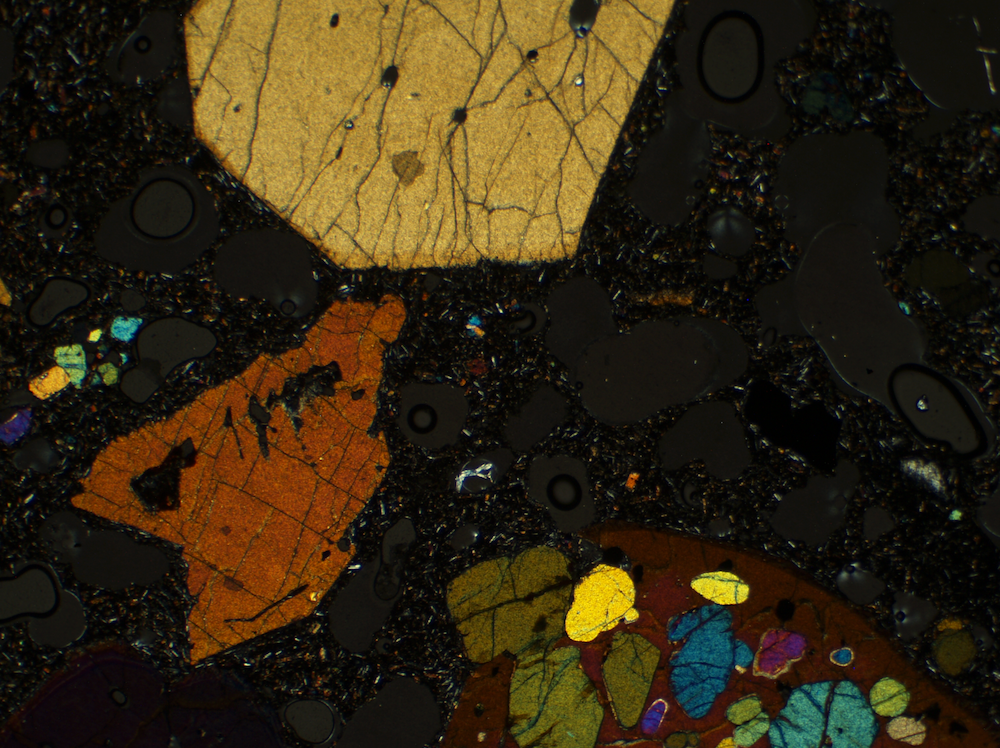 Microscopic image of crystals in magma.
Author provided
Microscopic image of crystals in magma.
Author provided
We can do this by analysing rocks made from crystal-free lavas. In our study, we compared crystal-free and crystal-rich magmas from El Hierro volcano in the Canary Islands, which last erupted in 2011.
It turns out that the crystal-free magma from these volcanoes is very similar across millions of years of volcanic activity, and across many ocean island volcanoes around the world, including the Canary Islands and Hawaii. This is how we realised the magma was not pristine and coming directly from great depth, but rather filtered at shallower depths.
And if the magma from hotspot island volcanoes is so similar, the chances are their eruptions are triggered by common mechanisms too.
The ‘secret volcano filter’
When crystals form inside the volcano, this “steals” chemical elements from the magma. In turn, this alters the composition of the leftover magma, almost as if it had been passed through a sieve.
This filtering process makes the magma less dense, and increases its gas content. This gas can then bubble up and propel the magma to the surface, just like the cork popping from a bottle of champagne.
In ocean island volcanoes, the magma can reach this “tipping point” at the base of the Earth’s crust, just a few kilometres beneath the surface, rather than at depth. This means that if we detect magma at this depth with the help of earthquake monitoring equipment, an eruption might follow. This is exactly what happened when El Hierro erupted in 2011[6].
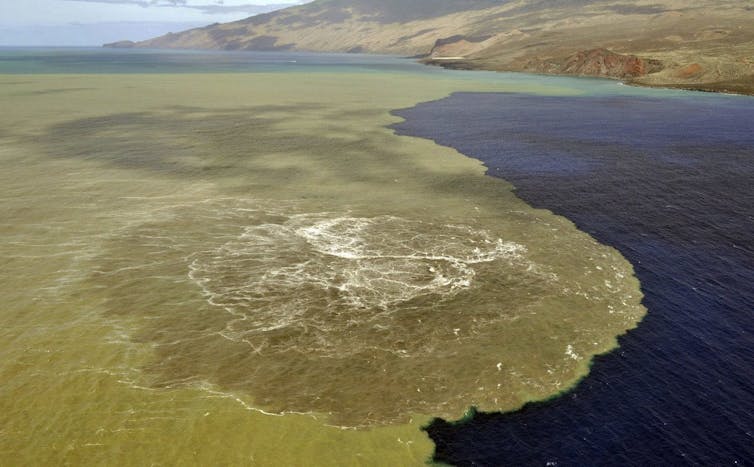 Volcanic activity under the sea during El Hierro’s 2011 eruption.
Spanish Civil Guard/AAP
Volcanic activity under the sea during El Hierro’s 2011 eruption.
Spanish Civil Guard/AAP
Does this make it easier to forecast eruptions?
If we could open a volcano like a doll’s house, we would be able to track the movement of magma towards the surface. It’s a pity we can’t, although we can try to “see” this journey indirectly, by monitoring[7] earthquakes, deformation and gas emissions, all of which can indicate magma rising inside a volcano.
But to assess whether a volcano is likely to erupt, or whether a dormant volcano is reawakening, we also need to compare current observations with information about what triggered eruptions in the past[8].
This is where our new discovery could prove especially useful. If the eruption triggers happen at similar depths in ocean island volcanoes globally, warning signs from such depths may be particularly important to monitor and consider as the precursory signs of eruption.
Read more: Australia's volcanic history is a lot more recent than you think[9]
References
- ^ published in the journal Geology (doi.org)
- ^ tectonic plates (www.nationalgeographic.org)
- ^ longest track (www.nature.com)
- ^ disguise the chemistry of the lava itself (www.sciencedirect.com)
- ^ Volcano crystals could make it easier to predict eruptions (theconversation.com)
- ^ El Hierro erupted in 2011 (agupubs.onlinelibrary.wiley.com)
- ^ monitoring (www.usgs.gov)
- ^ past (www.sciencedirect.com)
- ^ Australia's volcanic history is a lot more recent than you think (theconversation.com)