How bans on mask mandates affect students with disabilities – 4 questions answered
- Written by: Claire Raj, Associate Professor of Law, University of South Carolina
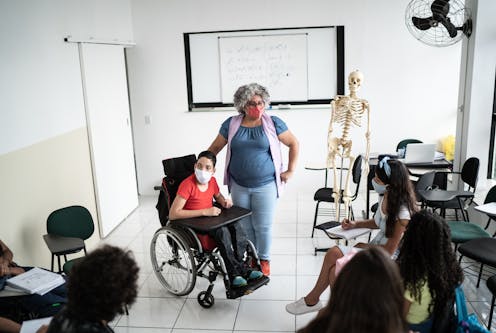
As if back-to-school season weren’t stressful enough already amid a U.S. surge in the delta variant[1], bitter wrangling over school mask mandates[2] has added to the fear and confusion for many students and parents.
Nine states – Arizona, Arkansas, Florida, Iowa, Oklahoma, South Carolina, Tennessee, Texas and Utah – have passed laws or issued executive orders that restrict local school districts’ ability to enact mask requirements[3] in public schools.
Supporters of such actions tend to frame school masking as a question of parents’ rights. Iowa Gov. Kim Reynolds characterized[4] her state Legislature’s action as “a law to support a parent’s right to decide what’s best for their own children.” South Carolina Gov. Henry McMaster has stated[5] that masks themselves inhibit students’ ability to learn.
However, parents in South Carolina[6], Texas[7] and Florida[8] have filed class-action lawsuits[9] that argue the bans on mask mandates violate the rights of students with disabilities.
As a law professor[10] who specializes in special education law, I offer answers to some questions parents might have about mask mandate bans and students with disabilities.
1. How do mask mandate bans discriminate against students with disabilities?
Two federal statutes, the Americans with Disabilities Act[11] and Section 504[12] of the Rehabilitation Act of 1973, prohibit public schools from discriminating against students with disabilities.
Discrimination in this context means more than just treating students with disabilities differently from their nondisabled peers. Rather, both the ADA and Section 504 require schools to make reasonable modifications that are necessary to ensure equal access to public schools. Further, both laws prohibit schools from needlessly segregating students with disabilities into separate learning environments when they could participate in regular classrooms with appropriate supports.
Some students with disabilities have underlying health conditions[13] that make exposure to the coronavirus riskier. For these students, a case can be made that both Section 504 and the ADA require schools to require masks as a way to ensure equal access to a safe learning environment.
2. What are ‘reasonable modifications’?
There is no bright-line rule setting the limits of what modifications – often referred to as “reasonable accommodations” – a school must provide to ensure equal access for students with disabilities. That’s because these decisions are highly individualized and based on students’ needs arising out of the impacts of their disability.
Certainly there are limits to what is considered “reasonable,” and schools are not required to undertake modifications that would fundamentally alter the nature of their programs or activities. However, the Department of Education has stated[14] that schools must ensure that learning environments are as safe for students with disabilities as they are for students without disabilities.
For example, in certain instances schools must offer allergen-free spaces such as nut-free classrooms when tasked with educating students with severe or life-threatening allergies to certain foods. Schools may have to take other precautions to ensure safe classrooms for students with severe allergies, such as wiping down tables frequently, installing or changing air filters, or running air-quality tests to ensure that a child with chemical or other allergen sensitivities can safely attend.
3. What has the federal government said?
On Aug. 30, 2021, the U.S. Department of Education’s Office for Civil Rights opened investigations[15] into five states – Iowa, Oklahoma, South Carolina, Tennessee and Utah – to determine whether statewide prohibitions on mask mandates discriminate against students with disabilities. They declined to investigate the other four states – Florida, Texas, Arkansas and Arizona – because court orders or other state actions currently prevent the bans on universal indoor masking from being enforced in those states.
The Department of Education has not taken a position on whether prohibitions on mask requirements do, in fact, violate federal anti-discrimination laws. But the Office of Civil Rights will begin its investigative process[16], which may include interviews and site visits, and eventually issue its conclusions about whether these prohibitions violate federal law.
4. What happens next?
If the Office of Civil Rights determines that states are discriminating against students with disabilities, it may then negotiate agreements with individual states to bring them into compliance with federal laws. It could also refer its findings to the U.S. Department of Justice for prosecution, and in some cases withdraw federal funding. However, Education Secretary Miguel Cardona has suggested[17] that last scenario is unlikely.
[Understand key political developments, each week. Subscribe to The Conversation’s politics newsletter[18].]
References
- ^ surge in the delta variant (www.wsj.com)
- ^ bitter wrangling over school mask mandates (www.texastribune.org)
- ^ enact mask requirements (www.edweek.org)
- ^ Kim Reynolds characterized (governor.iowa.gov)
- ^ has stated (www.wltx.com)
- ^ parents in South Carolina (www.aclu.org)
- ^ Texas (www.disabilityrightstx.org)
- ^ Florida (www.justdigit.org)
- ^ class-action lawsuits (www.usatoday.com)
- ^ law professor (sc.edu)
- ^ Americans with Disabilities Act (www.ada.gov)
- ^ Section 504 (www.ecfr.gov)
- ^ have underlying health conditions (www.aclu.org)
- ^ has stated (cdn.theconversation.com)
- ^ opened investigations (www.ed.gov)
- ^ investigative process (www2.ed.gov)
- ^ has suggested (www.forbes.com)
- ^ Subscribe to The Conversation’s politics newsletter (theconversation.com)