Solar power project transforms desert into energy hub
ORDOS, CHINA - Media OutReach Newswire - 8 September 2025 - From September 16 to 17, 2025, the 10th Kubuqi International Desert Forum will convene in Ordos, Inner Mongolia Autonomous Region.
Recently, reporters visited the Kubuqi Desert to investigate desertification control measures.

Seen from the air, 196,000 solar panels stretch across the Kubuqi Desert in a striking horse-shaped mosaic, while on the ground, visitors to Chaideng Village, Ordos City, stroll along the solar station and nearby farmstays, savouring local delicacies in what was once the desolate "sea of death."
The Kubuqi Desert, China's seventh-largest, located in Inner Mongolia Autonomous Region, was once known as the "sea of death." However, it boasts abundant solar resources and is an ideal place to build a solar power station.
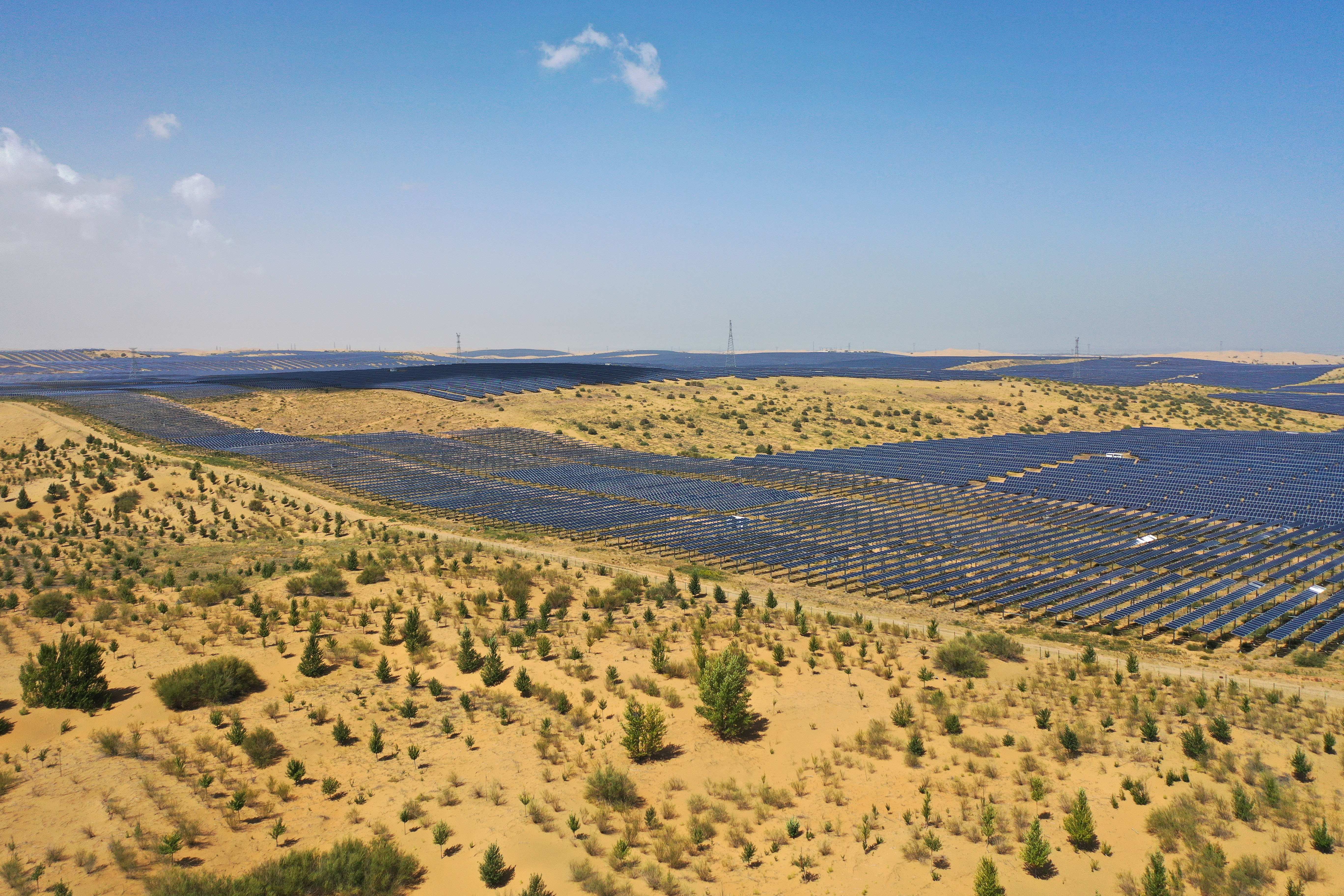
The Junma solar power station -- "Junma" meaning "fine horse" in Chinese -- is part of an ambitious desert reclamation project known as the "great photovoltaic wall," stretching along the northern edge of the Kubuqi Desert.
The grand project is planned to extend about 400 kilometers with an average width of five kilometers. Upon completion, it is set to have an installed capacity of 100 million kilowatts.
At the Kubuqi Desert Ordos Central-Northern New Energy Base project, located in the central section of the "great photovoltaic wall," rows of blue solar panels glisten under the sun.
"The first and second phases of the project, each with an installed capacity of one gigawatt, have been successfully connected to the grid, transforming over 63,000 mu (about 4,200 hectares) of desert into a sea of solar panels," said Na Guiting, deputy president of Inner Mongolia Three Gorges Mengneng Energy Co., Ltd., the company responsible for the project.
As one of China's first large-scale renewable energy bases with a capacity exceeding 10 gigawatts, the base is set to develop eight gigawatts of solar power, four gigawatts of wind power, and four gigawatts of supporting coal power.
Once the project is completed, it will deliver approximately 40 billion kilowatt-hours of electricity annually to the Beijing-Tianjin-Hebei region, with over 50 percent coming from clean energy sources, according to Na.
It is equivalent to saving about 6 million tonnes of standard coal and reducing carbon dioxide emissions by around 16 million tonnes each year, Na added.
Beneath the solar panels, various sand-fixing plants are thriving.
The panels provide shade, cut groundwater evaporation and reduce wind speeds, all of which support plant growth, said Hong Guangyu, a researcher with the Academy of Forestry Sciences of Inner Mongolia Autonomous Region, adding that the plants prevent dust from rising, which in turn benefits solar power generation.
The city of Ordos, also known for its abundant coal resources, has several large coal mines around the Kubuqi Desert. The treated drainage water from the coal mines is channeled to the solar power base and used to clean the solar panels and water the plants.
Local residents are also reaping the benefits of the solar projects. "These projects shield us from wind and sand, allowing our village to cultivate over 10,000 mu of high-standard farmland this year. If leased out, the land can bring villagers 900 yuan (about 126.6 U.S. dollars) per mu each year," said Han Rongkuan, a local farmer.
At the 16th Conference of the Parties to the United Nations Convention to Combat Desertification, Ordos shared its experience in photovoltaic-based desertification control with other cities.
"The story of solar power projects in Kubuqi Desert embodies Chinese wisdom and solutions, demonstrating a sustainable path that combines ecological and economic benefits in the fight against desertification," Hong said.
Under China's Three-North Shelterbelt Forest Program (TSFP), the world's largest afforestation initiative launched in 1978 to combat desertification across the country's northwestern, northern and northeastern regions, a total of 480 million mu of forests have been planted and preserved, while 1.28 billion mu of degraded grasslands have been successfully restored.
At the Central Economic Work Conference in 2024, China urged efforts to push for major progress in the landmark projects of the TSFP and promote faster construction of new energy bases in sandy areas, rocky areas and deserts.
The issuer is solely responsible for the content of this announcement.