Qianjiangyuan: "China’s Amazon Rainforest" Nurtures Innovative Examples of Ecological Protection
QUZHOU, CHINA - Media OutReach Newswire - 14 August 2024 - Aug. 15 of this year marks China's second National Ecology Day. Across the country, various forms of ecological conservation education activities have been carried out recently, aiming to enhance the awareness of ecological protection among the entire society.

Primary evergreen broadleaf forest in Qianjiangyuan
Located in the eastern part of China, Zhejiang Province is home to the renowned Qiantang River, known for its spectacular "world's largest tidal bore."
Today, the source of this mighty river, Qianjiangyuan in Kaihua County in west Zhejiang, which is one of the country's first batch of pilot areas for national parks, has been attracting increasing global attention for its stunning scenery, rich biodiversity, and innovative conservation measures.
The Qianjiangyuan National Park Administration has leveraged digital technology to empower ecological conservation, unveiling a sophisticated intelligent governance system that has achieved remarkable success in the field of ecological protection.
The regions located between 23° and 33° north latitude are covered by predominantly desert or sparse grassland vegetation. However, Qianjiangyuan, which falls into this latitude range, boasts a unique and abundant landscape.
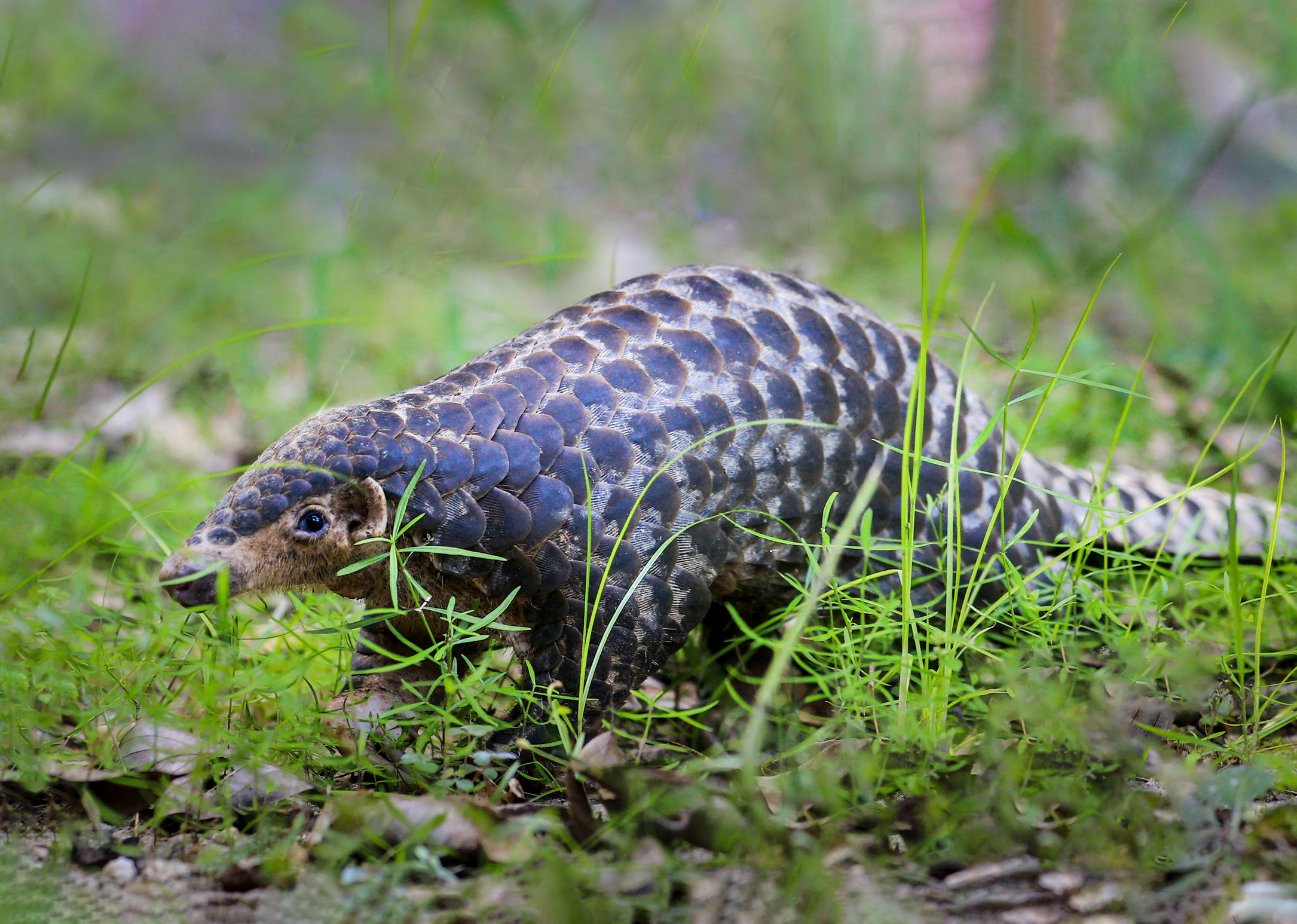
Chinese pangolin, a wild animal under first-class state protection
It's characterized by a vast area of globally rare, subtropical low-altitude evergreen broad-leaved forest vegetation. Qianjiangyuan is home to over 2,200 species of higher plants, more than 440 species of large fungi, and over 2,400 animal species, including the black muntjac, which rivals the giant panda in terms of rarity. It is often referred to as the "China's Amazon rainforest."
As the administrative region of Qianjiangyuan National Park, Kaihua County in Quzhou City has made numerous innovative practices in addressing the relationship between conservation and development, achieving unified management of collective natural resource assets, and scientifically promoting biodiversity conservation.
The Qianjiangyuan National Park Administration has conducted collective forestland and rural land contracting rights reforms, establishing a scientific, reasonable mechanism for ecological compensation and community co-management.
This has achieved unified regulation of important natural resources within the national park, encouraging villagers to commit to not using pesticides, fertilizers, and other chemicals in agricultural fields. These efforts have laid a solid foundation for the effective protection of the Qianjiangyuan ecosystem.
Monitoring and managing such a vast forest area, covering approximately 252 square kilometers, may seem like a daunting task. However, in Zhejiang, where digital technology is highly developed, this task has become rather smart and efficient.
The Qianjiangyuan National Park Administration has leveraged digital technology to empower ecological conservation, introducing a smart governance system that encompasses unmanned aerial vehicle disaster prevention and inspection, wildlife recognition, and other perception systems and scenarios.
This system enables long-term and dynamic monitoring of the entire Qianjiangyuan area, important ecosystems, and critical species.
"In the forested areas with complex terrain, one drone patrol is equivalent to the workload of a forest ranger for 10 days," said Wang Hao, a staff member of the Qianjiangyuan National Park Administration. The unmanned aerial vehicle inspection system can achieve automatic patrol of over 80 percent of the national park area.
In addition to park's staff and scientific researchers, local residents are also keen on biodiversity conservation. They provide assistance and support to researchers in conducting field investigations, specimen collection, and data recording, and some of them have become "farmer scientists."
The local government has also established nature education venues such as the Science Museum of Qianjiangyuan National Park and the Kaihua Dark-Sky Park Astronomy Museum, which have become popular destinations for study tours among teenagers.
Thanks to a series of innovative practices aimed at enhancing the diversity, stability, and sustainability of the local ecosystem, the Qianjiangyuan ecological conservation and restoration project has been selected as an excellent case study in China in 2023. Furthermore, the region was recognized as one of the world best protected areas.
In 2024, Kaihua seeks to balance conservation and development, accelerating the development of a pilot zone for biodiversity conservation and sustainable utilization. It aims to become a pioneering base for the practice of the development concept of "Lucid waters and lush mountains are invaluable assets."
With constant and innovative efforts, the ecological conservation success story from a county-level region in China will continue to unfold.
Hashtag: #Qianjiangyuan
The issuer is solely responsible for the content of this announcement.