HKU Chemists Develop a Chameleon-like Molecular Chain with Dual Ion Binding Capability
HONG KONG SAR - Media OutReach Newswire - 7 July 2024 - Everyday objects such as metal chains, handcuffs, and key rings are examples that demonstrate a unique combination of properties where hard, rigid rings are interlocked together to exhibit flexibility and strength as a whole, and as such enabling them to perfect their intended functions.
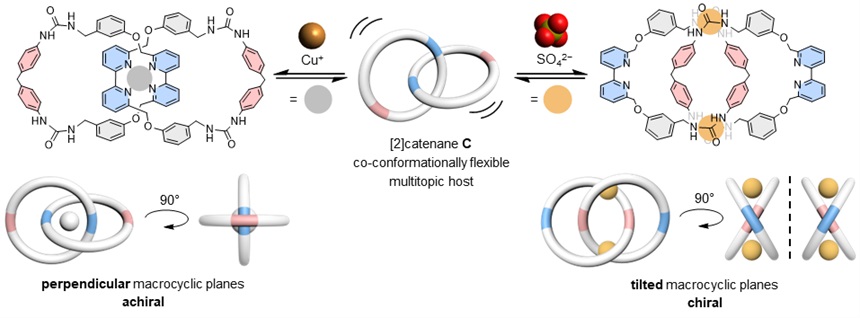
The “180°-turn” of the interlocked macrocycles allows the catenane host to switch binding modes to accommodate copper(I) or sulfate ion guests selectively. Image adapted from Nature Communications.
At the molecular level, molecules composed of interlocked, nano-sized rings are known as catenanes, which are promising candidates for developing molecular switches and machines. Yet, due to their challenging synthesis, applications of catenanes in other areas are largely unexplored. Recently, a research team led by Professor Ho Yu AU-YEUNG from the Department of Chemistry at The University of Hong Kong (HKU) has synthesised a catenane composed of two freely-rotating rigid macrocycles and showed that the catenane can bind strongly and selectively to either copper(I) cation or sulfate anion despite their opposite charge and different geometry. The ability to detect and differentiate these specific ions has important implications for applications in areas like environmental monitoring and medical diagnostics.
As same charges repel and opposite charges attract each other, a binding site that attracts a positively charged cation will normally experience a repulsive interaction with the negatively charged anion and vice versa, which made designing a host that is suitable for both cation and anion very challenging. To overcome this challenge, the team installed both cation and anion binding sites on each of the interlocked rings, and by virtue of the rotatory motions of the catenane, the host can efficiently adjust the relative position of the binding sites and freely adapt a specific form favourable for the spherical copper(I) cation or the tetrahedral sulfate anion, resembling a chameleon that can change its appearance to fit in specific environments. This work has recently been published in the leading scientific journal Nature Communications.
Apart from their industrial and environmental significance, both copper(I) and sulfate ion are essential for proper cell growth and organism development. The strong and selective binding to these ions by the catenane host could hence be exploited for the extraction and recycling of these ions from environmental samples. Also, just as the measurement of sodium ions, chloride and other electrolytes in blood samples can be a routine test for blood pressure monitoring and general health, new technologies for selective recognition and binding of ions and minerals will be useful for diagnostic and therapeutic purposes.
'This work highlights catenane as an efficient candidate for potent molecular receptors with versatile structures, switchable properties and guest binding behaviours.' stated Professor Au-Yeung. In terms of future plans, Professor Au-Yeung and his group are developing more sophisticated catenane hosts for the simultaneous binding of multiple cations, anions and ion pairs.
About the Research Paper
Journal title: 'Dynamic mechanostereochemical switching of a co-conformationally flexible [2]catenane controlled by specific ionic guests' (Nature Communications, 2024).
The journal paper can be accessed from the following link: https://t.ly/FZzte
Mr Yueliang YAO from Professor Au-Yeung's group at HKU Chemistry is the first author of this paper. Other researchers affiliated with HKU, including Dr Yuen Cheong TSE, Dr Samuel Kin-Man LAI, Dr Yixiang SHI, Dr Kam-Hung LOW also contribute greatly to this work.
This work is supported by the CAS-Croucher Funding Scheme for Joint Laboratories, the Collaborative Research Fund and General Research Fund from the Research Grants Councils of Hong Kong.
About Professor Ho Yu AU-YEUNG
Professor Ho Yu AU-YEUNG is an Associate Professor in the Department of Chemistry at HKU. He graduated from The Chinese University of Hong Kong, and obtained his PhD degree from the University of Cambridge. He has received the Croucher Innovation Award (2016), the Graeme Hanson Early Career Researcher Award (2016), Thieme Chemistry journals Award (2016), Asian Core Program Lectureship Award (Taiwan, 2018), and the HKU Outstanding Young Researcher Award (2020), and was a member of the inaugural Early Career Advisory Board of Chemical Review (2020-2021). Since 2020, he serves as a committee member of the Committee of Young Chemists of the Chinese Chemical Society.
His research group focuses on the chemistry of mechanically interlocked molecules, including the synthesis of high-order [n]catenanes, the isomerism, dynamics of mechanically interlocked molecules, as well as their applications in coordination chemistry, host–guest recognition, catalysis and materials. The group's research outputs have been published in leading scientific journals, including Nature Communications, Journal of the American Chemical Society, Angewandte Chemie, Chemical Science, etc.
More information about Professor Ho Yu Au-Yeung's research group can be found at https://chemistry.hku.hk/staff/hoyuay/index.html
Images download and captions: https://www.scifac.hku.hk/press
Hashtag: #HKU
The issuer is solely responsible for the content of this announcement.