Molex Releases Report on Thermal Management Challenges and Opportunities for I/O Modules amid Emerging Solutions for Next-Gen Data Center Cooling
- Fueled by heightened demand for the fastest data rates, optical I/O module power requirements push traditional forced-air cooling to operational limits
- Shift to 224 Gbps PAM-4 interconnects creates nearly a 4X increase in power density, increasing thermal management costs and complexities
- Advancements in server and optical module thermal management encompass advanced liquid cooling solutions and new drop down heat sink (DDHS) technology
LISLE, IL - Media OutReach Newswire - 14 June 2024 - Molex, a global electronics leader and connectivity innovator, has published a report that examines thermal management pitfalls and possibilities as data center architects and operators strive to balance high-speed data throughput requirements with the impacts of growing power density and the need for heat dissipation on critical servers and interconnect systems.
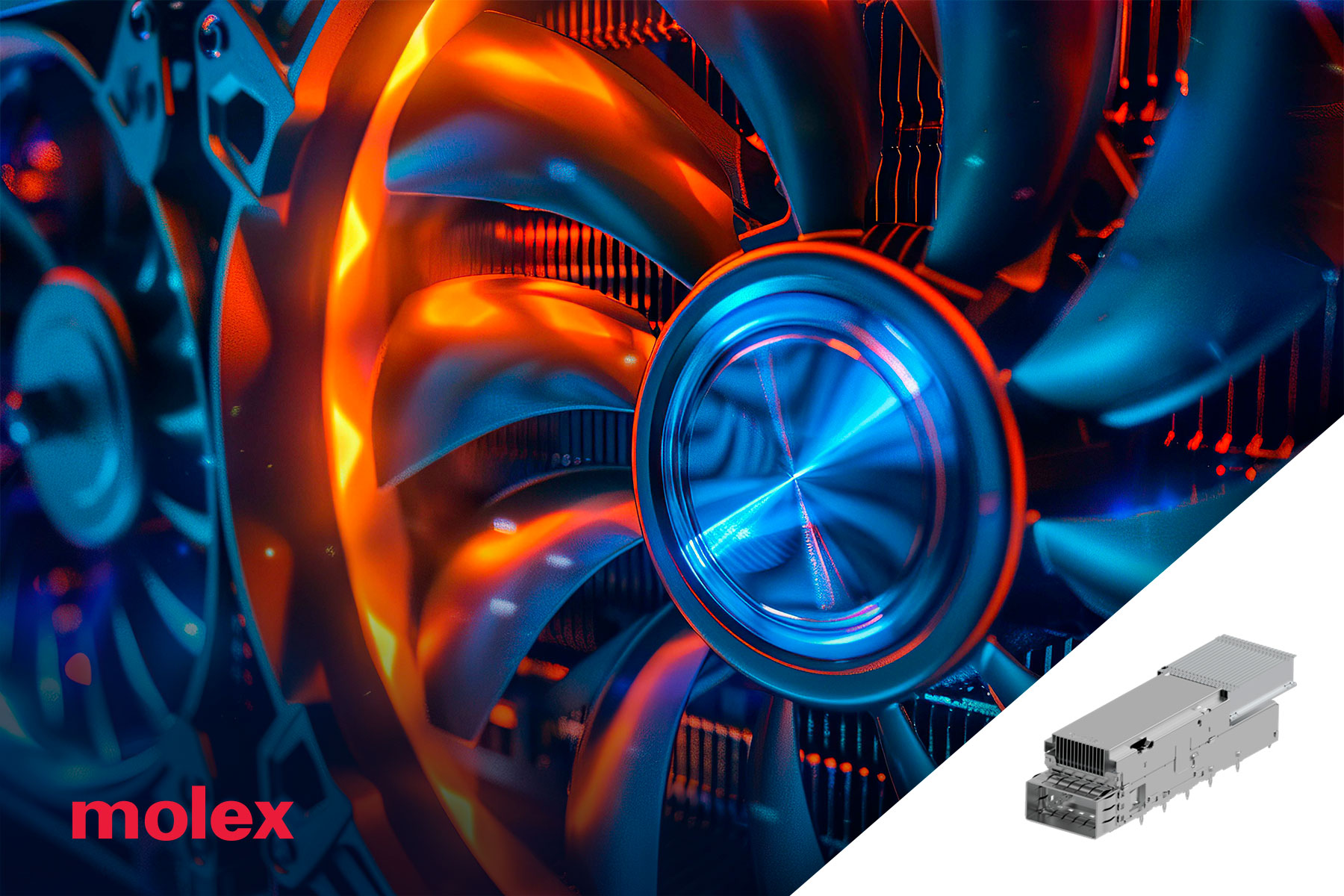
Molex's In-Depth Report of Thermal Management Solutions for I/O Modules addresses the limitations of legacy approaches for thermal characterization and management and explores new innovations in server and optical module cooling to better support 112G and 224G connectivity.
"As demand for faster, more efficient data processing and storage continues to rise rapidly, so does the heat generated by the high-performance servers and systems needed to scale generative AI applications and support the transition from 112 Gbps PAM-4 to 224 Gbps PAM-4," said Doug Busch, VP & GM, Enabling Solutions Group, Molex. "The integration of optical connectivity and optical modules, applied with new cooling technologies, will optimize airflow and thermal management within next-gen data centers. Molex is driving innovations in thermal management across both copper and optical platforms, as well as within our power management products, to help our customers improve system cooling capabilities and enhance energy efficiency within next-gen data centers."
Shift to 224 Gbps PAM-4 Shines Light on Creative Liquid Cooling
The move to 224 Gbps PAM-4 interconnects between servers and network infrastructure represents a doubling of the per-lane data rate. Power consumption is also surging, with optical modules alone reaching as high as 40W over long-range coherent links, up from 12W just a few years ago, representing nearly a 4X increase in power density.
In this informative report, Molex explores the latest in air cooling, along with the integration of creative liquid cooling solutions within existing form factors to address increased power and thermal demands on I/O modules. Direct-to-chip liquid cooling, immersion cooling and the role of passive components to enhance active cooling are addressed. The report also delineates cooling methods that may be most effective for accommodating power demands in chips and I/O modules that scale to high levels.
To solve persistent challenges in cooling pluggable I/O modules, Molex features a liquid cooling solution, called the integrated floating pedestal. In this scenario, each pedestal that contacts the module is spring-taught and moves independently, allowing implementation of a single cold plate to different 1xN and 2xN single row and stacked cage configurations. For example, this solution for a 1x6 QSFP-DD module utilizes six independently moving pedestals which can compensate for varying port stack heights while ensuring seamless thermal contact. As a result, heat flows directly from the module generating heat to the pedestal over the shortest possible conduction path to minimize thermal resistance and maximize heat transfer efficiency.
Additionally, the Molex report outlines the inherent costs and risks associated with immersion cooling, which offers highly effective thermal cooling that exceeds roughly 50kW per rack but requires a complete overhaul of a data center's architecture.
Molex Drop Down Heat Sink (DDHS) Technology
Beyond liquid cooling, Molex's In-Depth Report of Thermal Management Solutions for I/O Modules details advanced approaches to module design and thermal characterization poised to transform the performance of high-speed network interconnects. For I/O specifically, new solutions can be integrated into servers and switches for greater levels of heat sinking without compromising reliability. To that end, the report describes an innovative Molex Drop Down Heat Sink (DDHS) solution that maximizes heat transfer capability of a traditional riding heat sink while minimizing metal-to-metal contact, which can create wear-and-tear on components.
Through the DDHS, Molex replaces current riding heat sinks with a solution that eliminates direct contact between the optical module and thermal interface material (TIM) for a simpler and more durable installation without friction or piercing. As a result, Molex's DDHS allows successful TIM implementation for more than 100 insertion cycles. This reliable heat management solution fits within standard module and rackmount form factors while effectively cooling higher power modules and improving overall power efficiency.
Future of Optical Module Cooling
As an active participant in the Open Compute Project (OCP) and its Cooling Environments project, Molex is collaborating with other industry leaders to develop next-gen cooling technologies that meet the evolving thermal management needs of today's most demanding data center environments.
Hashtag: #Molex
The issuer is solely responsible for the content of this announcement.
About Molex
Molex is a global electronics leader committed to making the world a better, more connected place. With presence in more than 40 countries, Molex enables transformative technology innovation in the automotive, data center, industrial automation, healthcare, 5G, cloud and consumer device industries. Through trusted customer and industry relationships, unrivaled engineering expertise, and product quality and reliability, Molex realizes the infinite potential of Creating Connections for Life. For more information, visit www.molex.com.