Molex Reveals Global State of Reliability and Hardware Design Survey Results
- More than half of the survey participants assert that reliability drives brand loyalty
- Top reliability challenges include adequate time for testing, supplier quality, cost and correlation of product design attributes to their impact on reliability
- 46% of respondents believe AI, ML, simulations and analytics are best bets to boost product reliability
- 92% expect to lose reliability experts to retirement over the next five year
LISLE, IL - Media OutReach - 15 November 2023 - Molex, a global electronics leader and connectivity innovator, today announced the results of a global reliability survey that reveals the challenges facing system architects and design engineers for hardware, including devices, when balancing growing expectations for reliability with ever-increasing product complexity, diminishing time for testing, as well as constant cost and manufacturing constraints. However, the results also demonstrate excitement for the future, largely due to opportunities associated with critical technologies, such as artificial intelligence (AI), machine learning (ML), simulations and advanced analytics.
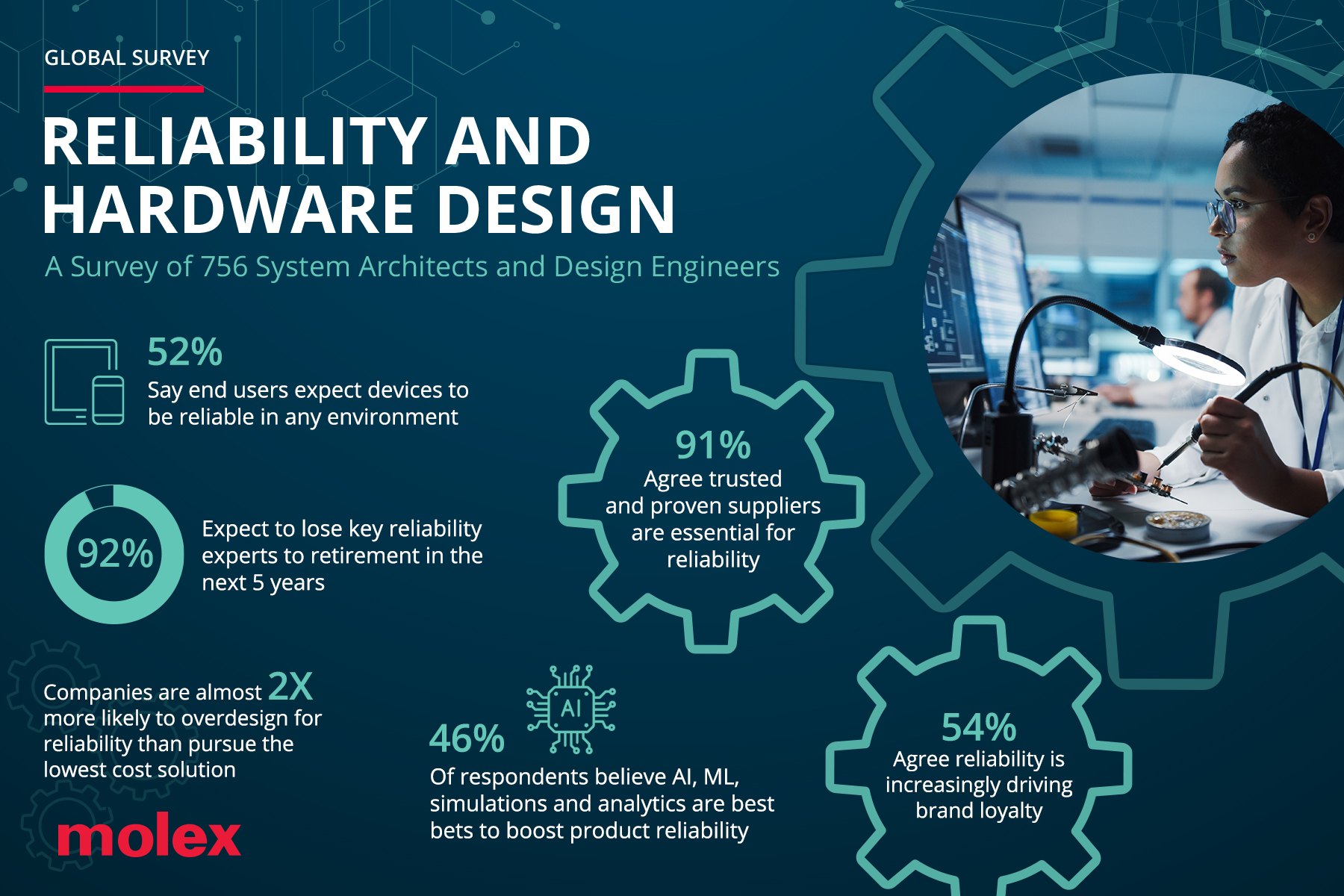
Equally important, 91% of the survey participants reported a strong correlation between their ability to deliver reliable products with having trusted, proven supplier relationships. To that end, 96% of the respondents have changed part suppliers due to reliability issues, with more than a quarter reporting frequent changes. Overall, these supplier relationships are becoming increasingly critical, as evidenced by 74% of respondents who believe reliability is at risk due to shortening design cycles.
"Reliability is a real 'rubber meets the road' topic with far-reaching implications across every facet of product development, manufacturing and ultimately, end-user experience," said Scott Whicker, SVP and president, Transportation Innovative Solutions, Molex. "It's so critical to pick the right partners, deploy the most effective processes, and leverage the latest data insights to accelerate the design and development of the most reliable products possible. Our latest global industry survey offers a snapshot of changing expectations for product reliability and the realities of design tradeoffs, along with growing optimism that AI and data-driven innovations will take product reliability to the next level."
Current State of Reliability
Molex commissioned Dimensional Research to survey more than 750 qualified global participants with direct or managerial responsibility for hardware design or system architecture. Respondents shared reactions to shifting reliability expectations among end users, with 54% of the participants asserting that reliability increasingly drives brand loyalty. Additionally, 52% of those polled believe customers expect devices to perform reliably under any environmental condition, including dust, water and vibration.
Most companies (64%) rely on their quality team, followed by test engineering (60%) and product development (58%), to drive reliability efforts. But in the Automotive & Transportation sector, test engineering ranked highest (71%) in ensuring products meet rigorous reliability requirements. In describing their companies' approaches to reliability, survey participants from all industries reported a tendency to overdesign products nearly twice as often as they pursue lower-cost solutions. Many stakeholders (42%) design hardware with a goal to surpass current industry certifications and standards while 44% strive to align with possible future requirements. Datacom respondents led the way with more than half (51%) working to address both present and potential future requirements. Although reliability is critical, only 18% of engineers polled develop verification and validation plans before starting product designs. The majority (44%) develop those plans in parallel to product design efforts.
Reducing Reliability Risks
In prioritizing the biggest difficulties when designing for reliability, respondents cited adequate time for testing (42%), followed by a three-way tie at 37% for supplier quality, cost or correlating design attributes to their impact on reliability. Most often, engineers prioritized cost (50%), manufacturability (46%) and user experience (35%) over reliability when making tradeoffs. In contrast, they were least likely to favor weight (35%), features (26%) and form factor/size (26%) over reliability.
Rise in AI and Data-Based Tools
Today, only 33% of the respondents use data-based models to help evaluate design tradeoffs, but that number likely will change as the survey revealed growing optimism in the role of data to elevate reliability. Looking ahead, almost half of the respondents (46%) listed AI, ML, simulations and data analytics innovations as the best overall bets for improving the reliability of future electronics products. In fact, 83% of those polled are optimistic about AI's potential to improve product reliability. In ranking AI use cases, respondents noted the ability to identify and predict failures (43%), optimize designs for reliability (31%), execute more complete verification and validation simulations (31%), as well as build better test plans and models (29%).
Workforce Dynamics Expected to Increase Concerns
Within five years, more than half of those surveyed (51%) predict experience will become more important in understanding product complexity, yet 92% expect to lose their experts to retirement. While 83% of the participants expect this loss of critical engineering expertise to create risk across employee satisfaction, brand reputation and even cause lost revenue, only 39% have a plan in place to mitigate associated risks.
Global Consensus on Reliability
On a global scale, engineering experts agreed on the biggest impacts on reliability, with participants from the Americas reporting the most optimism for AI to improve product reliability within five years. European survey respondents were most bullish on using AI to identify and predict failures. Additionally, survey results among participants throughout the APAC region demonstrated the greatest awareness of the potential risks of losing key individuals with deep reliability expertise.
Hashtag: #Molex
The issuer is solely responsible for the content of this announcement.
About Molex
Molex is a global electronics leader committed to making the world a better, more-connected place. With presence in more than 40 countries, Molex enables transformative technology innovation in the automotive, data center, industrial automation, healthcare, 5G, cloud and consumer device industries. Through trusted customer and industry relationships, unrivaled engineering expertise, and product quality and reliability, Molex realizes the infinite potential of Creating Connections for Life. For more information, visit www.molex.com.