Tanoto Foundation gives S$1m to Singapore National Eye Centre to Combat Age Related Macular Degeneration
- Tanoto Foundation's donation will advance research into gene therapy to address eye condition that is a major cause of vision loss
- The condition affects 200 million globally and 5 out of 100 in Singapore; number of cases expected to rise with Singapore's ageing population
SINGAPORE - Media OutReach - 8 September 2023 - Tanoto Foundation today announced a donation of S$1 million to the Singapore National Eye Centre (SNEC) to support a three-year research programme into gene therapy to combat age-related macular degeneration (AMD), a chronic, irreversible eye condition that affects 200 million people worldwide. Due to ageing population and longer life spans, this number is set to increase to 240 million by 2030.
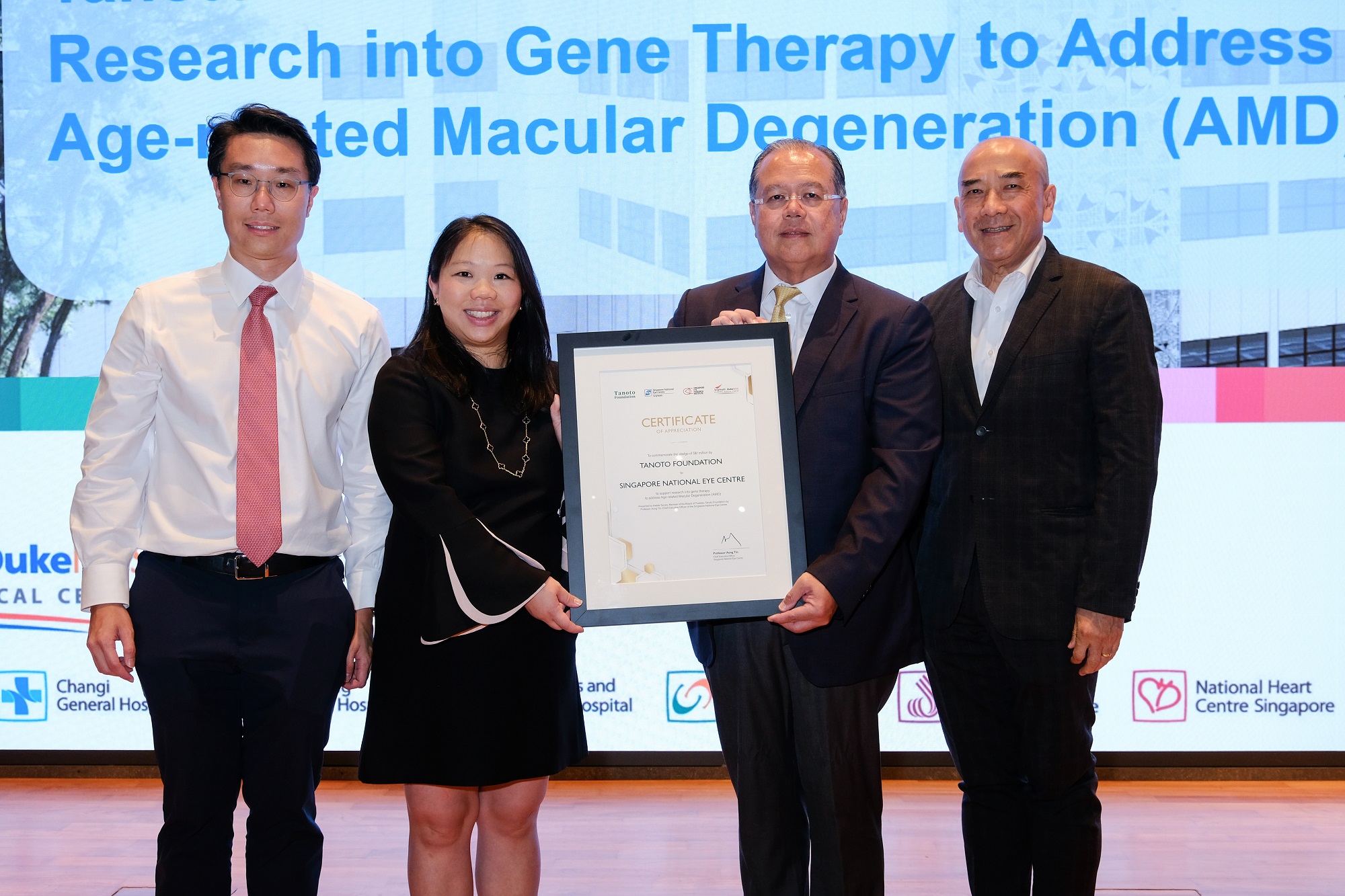
Left to Right: Dr Ng Choon Ta, Member, Board of Trustees, Tanoto Foundation; Ms Imelda Tanoto, Member, Board of Trustees, Tanoto Foundation; Prof Aung Tin, CEO, Singapore National Eye Centre; Dr J. Satrijo Tanudjojo, Global CEO, Tanoto Foundation
AMD can result in loss of vision because of damage to the macula, or central part of the retina, and is a major cause of blindness in those over 50 years old. The condition is more prevalent in countries with ageing populations, such as Singapore, where around one in four citizens will be over 65 years old by 2030.
There are two forms of AMD, early and late. The early form of AMD is not immediately sight threatening but the late neovascular form of AMD (nAMD), where there is abnormal growth of blood vessels that can result in bleeding or swelling, is responsible for 90% of blindness in AMD cases. In Singapore, the prevalence of AMD is estimated to be about 5.1% (five out of every 100 individuals) for early AMD and one in every 200 individuals for nAMD, above the age of 40.
The research programme, which will be funded by Tanoto Foundation and led by scientists from the SNEC and the Singapore Eye Research Institute (SERI), will focus on the development of new gene therapies to address AMD. Gene therapy is broadly defined as a therapeutic technique to modify a patient's genes to treat or cure disease. This can work by replacing or inactivating defective genes.
Imelda Tanoto, Member of the Board of Trustees, Tanoto Foundation, said: "We recognise that in old age, vision, which impacts mobility significantly, affects the quality of life. With a long standing commitment to support medical research especially in Asia-prevalent diseases, we also leverage Singapore's quality healthcare and research ecosystem to build meaningful partnerships and pilot medical innovations that are scalable to the region. Our partnership with SNEC to advance gene therapy research is a great example."
Since 2009, the Tanoto Foundation has contributed more than S$20 million towards research and advocacy for various treatments for major health issues, such as cardiology, oncology and diabetes.
Professor Aung Tin, CEO, SNEC, said: "We are grateful for the support from Tanoto Foundation in advancing research into the use of gene therapy to address AMD. This condition is a major cause of vision loss, resulting in significant economic and healthcare costs. The number of individuals affected by AMD is fast rising, partly due to our ageing population. The support from Tanoto Foundation will help us devise promising new gene therapies, which can potentially reduce the required number of treatments per year for nAMD patients and can help improve their quality of life."
Current treatments are in the form of regular, often lifelong injections of anti-vascular endothelial growth factor (VEGF) agents into the eye, administered on average about every two to three months. The overall healthcare burden in the United States for AMD is estimated to be US$4.6 billion. This burden is also comparable to other first world nations such as Singapore. By introducing a new gene into the body to trigger its own cells to produce therapeutic agents, this gene therapy research programme can potentially significantly reduce the number of injections a patient may require to combat AMD as this treatment will be long-lasting. If the research is proven to be successful, it can potentially be extended to other retina diseases such as diabetic retinopathy and retinal vessel occlusion.
The research team comprises clinicians and scientists from SNEC/SERI, the Agency for Science, Technology and Research's (A*STAR) Genome Institute of Singapore and the Centre for Vision Research at Duke-NUS Medical School. This clinician-scientist collaboration is a testament to the ongoing strong collaborative efforts to translate novel therapies from bench to bedside.
Hashtag: #TanotoFoundation
The issuer is solely responsible for the content of this announcement.
About Tanoto Foundation:
Tanoto Foundation is an independent philanthropic organisation founded in 1981 by Sukanto Tanoto and Tinah Bingei Tanoto based on the belief that every person should have the opportunity to realise his or her full potential. Tanoto Foundation programmes stem from the belief that quality education accelerates equal opportunity. We harness the transformative strength of education to realise people's full potential and improve lives. Tanoto Foundation focuses on making an impact in three main areas: improving learning environments, future leader's development, as well as medical research and sciences.
More information is available at www.tanotofoundation.org/en/.