AI Singapore Awards S$20M in Research Funds to Address Challenges Relating to Increase Use of AI in Emerging Apps
Research outcomes have potential for dual-use applications, for leverage by both the industry & defence
SINGAPORE - Media OutReach - 26 July 2023 - AI Singapore (AISG) announced today that it will award up to S$20 million, through the Robust AI Grand Challenge and the AI for Materials Discovery Grand Challenge, to support five multidisciplinary teams which will address challenges related to the increasing use of AI in emerging applications.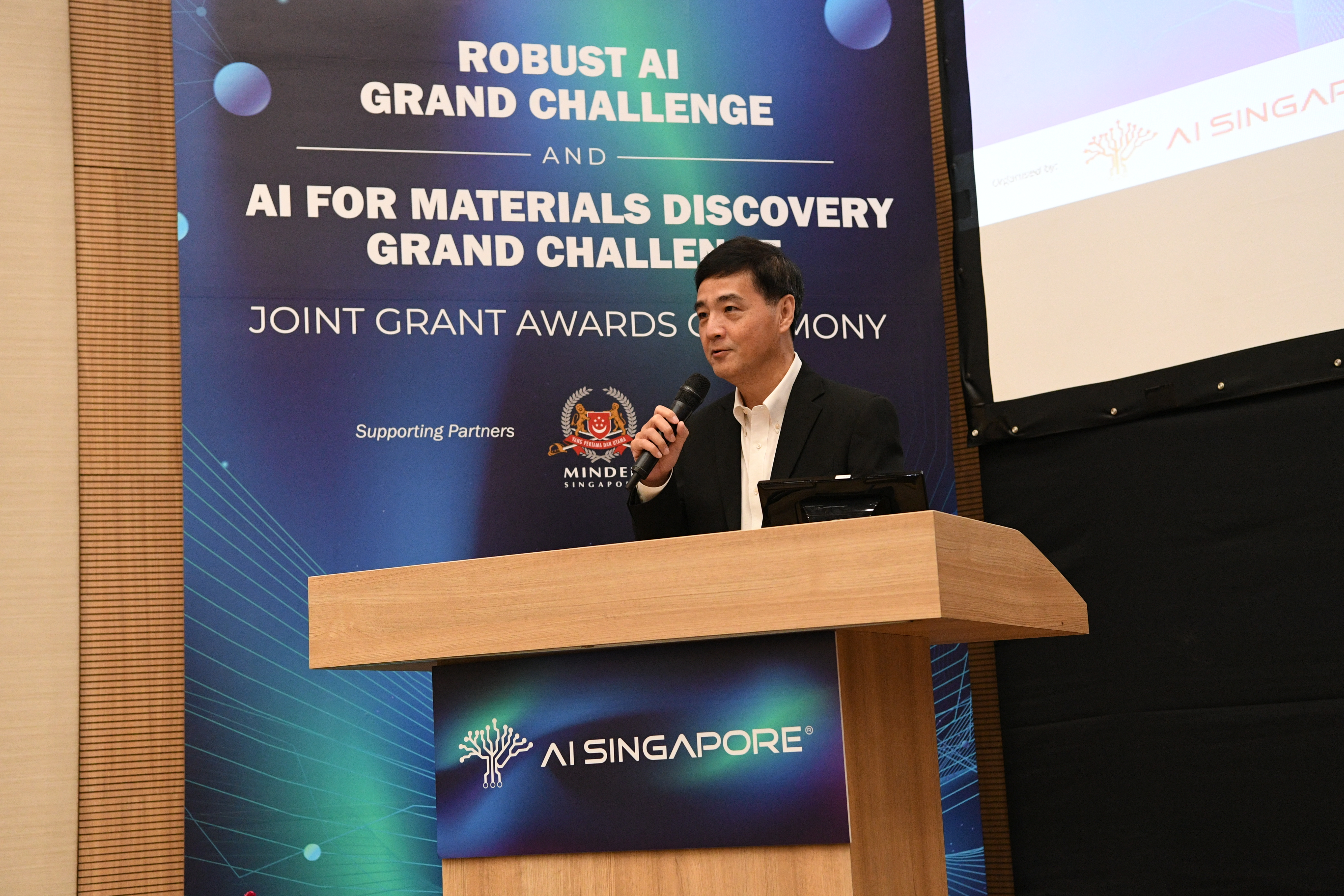
AISG launched both Grand Challenges in December 2022 in collaboration with the Future Systems and Technology Directorate (FSTD), MINDEF Singapore, and DSO National Laboratories (DSO).
Each Challenge is a first-of-its-kind and represents a major milestone in research collaboration between the academia and defence ecosystems. The research outcomes will have the potential for dual-use applications and can be leveraged by both the industry and defence to benefit Singapore.
The grant awards were presented by Mr Heng Chee How, Senior Minister of State for Defence at the Joint Grant Awards Ceremony.
In his speech, Mr Heng said, "The advancement of Artificial Intelligence (AI) will open up new possibilities and MINDEF/SAF is poised to harness its power to build important capabilities for our future. MINDEF's approach is to collaborate extensively with local and global partners from research institutes, and institutes of higher learning and industry. MINDEF's Defence Technology Community, which designs and develops technological capabilities for the SAF, will play a key role in this effort.
"Moving forward, we will also be expanding our partnerships with industry, to accelerate progress in developing AI technologies and applications. I encourage the various communities to come together to co-ideate and co-innovate. I would like to invite all researchers and practitioners with bold ideas to reach out to us. Together, let's collaborate, innovate and build an exciting and better future, he added."
Professor Mohan Kankanhalli, Deputy Executive Chairman for AISG, said that the current development efforts and outcomes can be translated into better and safer technologies for everyday living.
"The problems that are being addressed have dual-use applications and can be leveraged by both industry and defence ecosystems to benefit Singapore. We are excited to work with our valued collaborators, FSTD and DSO, as they have deep expertise in both grand challenges to advise, guide and empower our research teams to develop novel AI solutions that can effectively address important problems faced by Singapore and the world. We believe that there is potential for these technologies to be scaled globally in the future".
Robust AI and AI for Materials Discovery Grand Challenges
AISG's Grand Challenge programme takes an outcome-driven approach to solve important problems faced by Singapore and the world through multidisciplinary collaboration and translation of AI-based solutions from research to deployment.
Researchers from local Institutes of Higher Learning (IHLs) and Research Institutes (RIs), along with their collaborators from the public and/or private sectors, were invited to propose ground-breaking research ideas that adopt AI techniques to address both Grand Challenges' statements.
Each challenge statement was jointly defined by AISG, DSO and FSTD.
Robust AI Grand Challenge - "How can we design robust CV systems for AVs that can recover at least 80% of their original accuracy after physical testing-time adversarial attacks?"
Computer vision (CV) systems based on AI/ML are vulnerable to adversarial attacks which could compromise their safety and security, thus limiting their performance and adoption in critical environments. In the field of autonomous vehicles (AV), these could result in delays, accidents and potentially, even death.
This Grand Challenge aims to encourage the development of innovative approaches that increase the robustness of these CV systems, to accelerate the adoption of CV systems in critical environments.
AI for Materials Discovery Grand Challenge - "How can AI accelerate inverse material design to discover advanced materials that are 50% lighter while retaining and/or enhancing their functional properties?"
Technological breakthroughs and the development of next-generation systems such as lightweight transportation vehicles and energy-efficient buildings are often underpinned by the discovery and development of new and advanced materials. However, this discovery process can be prohibitively long and expensive. In addition, conventional methods can be limited by a scientist's personal experience, knowledge and even biases, resulting in only incremental discoveries.
This Grand Challenge aims to advance the state-of-the-art applications of AI in materials discovery, to develop solutions that can help scientists accelerate material discovery process and overcome the constraints of conventional methods. This would in turn enable them to keep pace with the increasing demand for new and advanced materials for next-gen systems.
AISG received 16 (7 Robust AI; 9 AI for Materials Discovery) quality research proposals from multidisciplinary teams in response to both grant calls. The teams comprise lead Principal Investigators (PIs) and Co-PIs from the National University of Singapore (NUS), Nanyang Technological University (NTU), Agency for Science, Technology and Research (A*STAR), Singapore Management University (SMU), Singapore University of Technology and Design (SUTD) and Singapore Institute of Technology (SIT). They also involve industry partners and/or collaborators from overseas universities.
An Evaluation Committee comprising members from various stakeholders in the AI ecosystem selected five projects to be awarded Stage 1 funding:
Robust AI Grand Challenge
- Holistic Moving Target Defence for Autonomous Driving Perception (by Associate Professor Rui Tan, NTU)
- This project will develop a Moving Target Defence (MTD) approach that creates and deploys AI mechanisms that are diverse and rapidly changing to limit the exposure of vulnerabilities and opportunities for attacks, increase the complexity and cost for attackers. - Development of Stable Robust and Secure Intelligent Systems for Autonomous Vehicles (by Professor Shuzhi Sam Ge, NUS)
- This project will harness the collective strengths of machine learning, stable control and generative AI to develop a robust and intelligent system that can adjust its neural network's behaviour and characteristics in real- time to counter adversarial attacks in complex environments. - Towards Building Unified Autonomous Vehicle Scene Representation for Physical AV Adversarial Attacks and Visual Robustness Enhancement (by Professor Yang Liu, NTU)
- This project will develop novel multi-view and multi-modal defences based on a unified framework that comprises a novel AV scene representation that will be used to generate realistic scenes with diverse conditions and attack vectors.
AI for Materials Discovery Grand Challenge
- MATAI: An AI-Powered Generalist Material Discovery Platform (by Professor Bo An, NTU)
- This project will develop an AI-powered generalist platform with three key components: a holistic material database, a foundational material property predictor and a generalist multi-property material designer in a large search space. - Design Beyond What You Know: Material Informed Differential Generative AI (MIDGAI) for Light-Weight High-Entropy Alloys and Multi-functional Composites (by Professor Ivor Tsang, A*STAR)
- This project will develop a generative AI framework for materials design that combines with discriminative models to enhance robustness and overcome data scarcity. By incorporating domain knowledge, the AI model will enable a more controllable, directed, and efficient exploration of material design spaces through advanced optimisation algorithms.
The projects are expected to deliver AI solutions that can be used by AI and materials researchers to (i) discover novel materials based on performance needs, (ii) efficiently explore beyond the boundaries of conventional methods, (iii) exploit new and existing scientific knowledge and (iv) reduce resource and time cost of material discovery cycles.
In Stage 1, the teams will be awarded up to S$4M each to work on their project for the next three years. Funding support for Stage 2 will be determined as part of the final evaluation near the end of Stage 1. Selected teams could be funded up to S$5M over 2 years where the teams will have the opportunity to work with agencies to adapt and scale up the developed AI techniques for dual-use applications.
Hashtag: #AISingapore
The issuer is solely responsible for the content of this announcement.
About AI Singapore
AI Singapore (AISG) is a national programme launched by the National Research Foundation (NRF) to catalyse, synergise and boost Singapore's artificial intelligence (AI) capabilities to power our future, digital economy.
AISG will also bring together all Singapore-based research institutions and the vibrant ecosystem of AI start-ups and companies developing AI products, to perform use-inspired research, grow the knowledge, create the tools, and develop the talent to power Singapore's AI efforts.
AISG is driven by a government-wide partnership comprising NRF, Smart Nation and Digital Government Office (SNDGO), Infocomm Media Development Authority (IMDA), Economic Development Board (EDB), Enterprise Singapore (ESG), amongst others.