KAUST partnerships in China to accelerate knowledge, technology exchange
Agreements signed between KAUST and Chinese partners aim to maximize joint research and development capabilities to stimulate innovation and economic growth.
HONG KONG SAR - Media OutReach - 29 March 2023 - As a leading institute of research excellence in the Kingdom of Saudi Arabia, King Abdullah University of Science and Technology (KAUST) joined forces with leading business and academic institutes in Shenzhen, China to sign strategic agreements of cooperation that align strengths in research, development and innovation.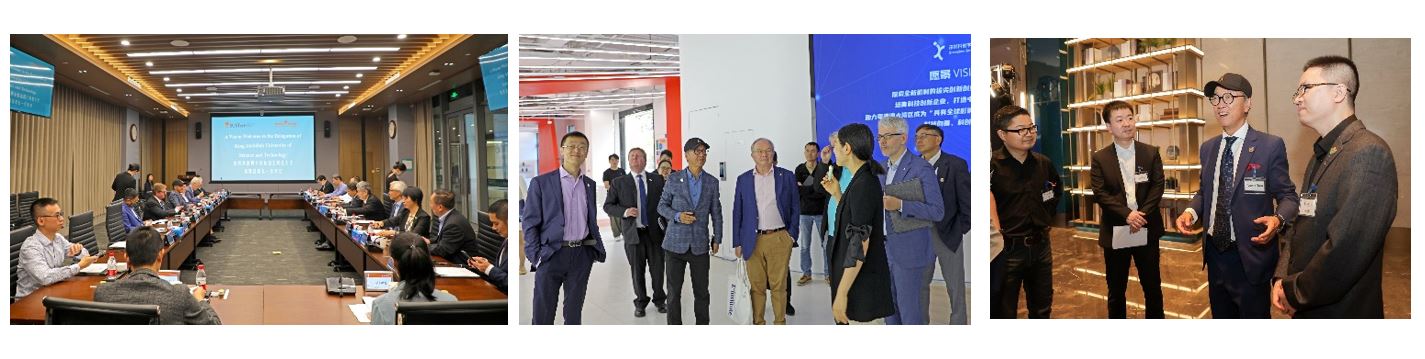
[LEFT] A delegation from King Abdullah University of Science and Technology met with representatives from the Southern University of Science and Technology, Schenzhen, China to initiative agreements centered on research exchange.
[CENTRE] A KAUST delegation meeting with business and academic leaders in Schenzhen, China, enjoyed a guided tour at Shenzhen Innox Academy, where they signed agreements centered on tech innovation, transfer and talent exchange.
[RIGHT] At a KAUST alumni event in Shenzhen, China, President Tony Chan (middle) speaks with (left to right) Yanlong Tai, a professor at Shenzhen Institute of Advanced Technology; Jian Pan (second from left), president of the KAUST China Alumni Chapter; and Caigui Jiang, a professor at Xi'an Jiaotong University. The alumni reunion was part of a larger mission to Schenzhen, China with KAUST delegates and Schenzhen business and academic leaders focused on research exchange and tech innovation.
Shenzhen, the third largest city in China, is dubbed the "Silicon Valley of China" for being a major global technology, manufacturing and research hub with many important institutions headquartered there. KAUST President Dr. Tony Chan and a delegation of 10 university representatives met with diverse leaders there to create partnerships that will accelerate knowledge exchange and the commercialization of impactful technologies into innovative, market-ready products that can address global challenges.
KAUST's assets include its globally recognized faculty and student subject experts; world-class facilities, including the Core Labs and Shaheen III supercomputer — to be the most powerful supercomputer in the Middle East; advanced training and specialized equipment; and network of partnerships with Saudi industries, ministries and academic entities in fields such as telecommunications, semiconducting, energy and environmental engineering, artificial intelligence, materials design, computer science and bioscience, to name a few.
High-innovation, China partners involved in the signings include the Research Institute of Tsinghua University in Shenzhen; Shenzhen Innox Academy; International Digital Economy Academy; X-Institute; Southern University of Science and Technology; Xbotpark; Shenzhen Institute of Advanced Technology; and Shenzhen Research Institute of Big Data. The objectives of the agreements leverage complementary strengths intended to expand capabilities in areas including but not limited to industrial innovation and exchange; technology transfer and incubation; knowledge sharing of talent and materials; joint laboratories and research and development platforms; and entrepreneurship training.
"Why did we visit Shenzhen?" asked KAUST President Tony Chan. "Shenzhen was a fishing village that has since emerged with a GDP exceeding Seoul, South Korea in just a short four decades. This evolution was made possible by building the world's most effective and efficient innovation ecosystem. Our visit gave us much insight on how Shenzhen achieved this miracle."
Cheng Buyi and Zheng Hongbo, members of the Standing Committee of the Municipal Party Committee who met with President Chan to discuss the cooperative exchange, said that KAUST and Shenzhen have achieved rapid development in the fields of education, technology, and talents, and there is broad space for cooperation. They will continue to consolidate and expand exchanges and cooperation in scientific and technological research, innovation and entrepreneurship, and talent training, and other areas of mutual development.
"In the coming days, we hope to identify mechanisms and platforms to help accelerate innovation at KAUST up to 'Shenzhen speed'," Chan added.
The Shenzhen agreements build on another example of thriving Saudi-China exchange as reflected in the growing demographic of Chinese academics at KAUST. Approximately 20% of KAUST's students, 34% of its postdoctoral researchers, and 9% of its distinguished faculty are from mainland China, with the China alumni group being the biggest and most engaged of all chapters. President Chan met with some 130 China alumni attendees at a special dinner event as part of the larger Schenzhen visit. These research relations are poised to increase as a result of the Shenzhen agreements, and, in turn, will help drive the growth and engagement of Saudi Arabia with China.
Hashtag: #KAUST
The issuer is solely responsible for the content of this announcement.
About KAUST
Established in 2009, King Abdullah University of Science and Technology (KAUST) is a graduate research university devoted to finding solutions for some of the most pressing scientific and technological challenges in the world as well as Saudi Arabia in the areas of food and health, water, energy, environment and the digital domain. KAUST is a curiosity-driven, interdisciplinary problem-solving environment, with state-of-the-art labs, distinguished faculty and talented students.
KAUST brings together the best minds from around the world to advance research. More than 120 different nationalities live, work and study on campus. KAUST is also a catalyst for innovation, economic development and social prosperity, with research resulting in novel patents and products, enterprising startups, regional and global initiatives, and collaboration with other academic institutions, industries and Saudi agencies.
For additional information, visit www.kaust.edu.sa.