You Have 28 Days: The Sydney Water Rule That Decides Whether Your New Garden Survives
The short version
Sydney has no drought restrictions in force right now. Catchment storage is sitting at 92%. The Water Wise Guidelines still apply every day of the year: lawns and gardens may be watered with drinking water before 10am and after 4pm, and new turf or new plantings may be watered at any time for 28 days. That 28-day allowance starts the day the turf lands, cannot be extended, and is the single biggest variable in whether a new garden establishes. Sequence the build, not just the budget.
The numbers that matter
|
What |
Figure |
Source |
As at |
|
Greater Sydney catchment storage |
92% (Warragamba 95%) |
WaterNSW |
18 Aug 2026 |
|
Watering window, drinking water |
Before 10am and after 4pm |
Sydney Water |
Current |
|
New turf and gardens allowance |
28 days, any time of day |
Sydney Water |
Current |
|
Residential water usage charge |
$3.41 per kilolitre |
Sydney Water |
2026–27 |
|
Drought rate, dams below 60% |
$3.84 per kilolitre |
Sydney Water |
2026–27 |
Two pallets of freshly cut buffalo land on a driveway in Kellyville at 3pm on a Friday in January. The family flies out on Saturday morning. A neighbour has agreed to give it a squirt.
By the following Thursday, the joints have opened, and the edges have gone the colour of straw.
Nobody on that street is under water restrictions. The dams are close to full. That lawn is still in trouble, and the reason has nothing to do with drought.
Sydney's water rules are a timetable, not a fuel gauge. They do not cap how much water your garden drinks. They dictate when.
Once you see it that way, the order in which you build a garden matters more than the size of your budget.
Does Sydney have water restrictions right now? Not the kind you are thinking of
Short answer: no emergency restrictions, but permanent rules that never switch off.
Sydney Water's Water Wise Guidelines are mandatory rules of water use for every resident and business in Sydney, the Blue Mountains, and the Illawarra. Year-round. Drought or no drought.
What binds you today:
-
The window. Drinking water on lawns and gardens before 10am and after 4pm, using a hand-held hose with a trigger nozzle, a sprinkler, or a watering system.
-
The midday exception. Smart watering systems and drip irrigation may run between 10am and 4pm.
-
No run-off. Water must not run off or overspray onto hard surfaces such as pathways.
-
No unattended hoses. Taps and hoses must never be left running.
-
Hard surfaces are off limits. Hosing paths, driveways and paved areas is not permitted unless it is necessary for safety, health, an emergency, construction activity or surface contamination.
That last clause has a carve-out worth knowing mid-build. Washing concrete slurry off a slab after a cut is covered. Rinsing the driveway on a Sunday because the site looks messy is not.
And the garden is not a rounding error in this. Australian Government guidance puts around 40% of a typical household's water use outdoors, higher again for properties with large gardens or a pool.
What the 28-day turf rule actually gives you, and why most people waste it
Short answer: 28 days of unrestricted watering, no permit, starting the moment the turf hits the ground.
Sydney Water permits drinking water at any time for 28 days after turf is laid or a garden is planted, provided you follow the care instructions given by the supplier, installer or care professional.
No application. No fee. No extension.
Treat it as a prepaid credit that begins expiring on delivery day, whether or not anyone is home to spend it.
Two failures account for almost every dead new lawn in Sydney.
The empty house. That Kellyville pallet is the classic. Turf is a live product, harvested the morning it is delivered, and it does not wait for your holiday to finish. Nine days of a 28-day allowance can disappear before anyone with a hose comes home.
The unready soil. During a renovation in the Hills District, a bobcat had run over the same strip of clay for three weeks before the turf arrived. The owner watered hard for a month, exactly as instructed, and the water simply moved sideways to the driveway. Ten minutes with a sprinkler, and you could watch it happen. That lawn did not have a watering problem. It had a compaction problem, and no allowance can irrigate its way out of one.
The care instructions matter legally as well as horticulturally here, because the exemption is expressly tied to them. A grower cutting to order, such as A View Turf in Sydney, sends establishment guidance with the delivery, and that guidance is effectively the document your 28 days is measured against.
Can your garden survive on a before-10, after-4 watering window?
Short answer: only if the plants were chosen for the window rather than the honeymoon.
On day 29, your garden inherits the permanent watering window and lives inside it for the next twenty years. Most designs quietly fail here because they were specified for the four weeks of unlimited watering that came first.
A plant list is a water-policy decision. Make it like one.
Group plantings by water need so a native border is not irrigated at the same rate as a vegetable patch. Water deeply and less often, because shallow daily drinks build shallow roots that panic in February.
Do not assume a controller solves it. Sydney Water is blunt on this point: automatic irrigation is not a set-and-forget option, and a system that is poorly designed, programmed, or maintained can use more water than the garden actually needs.
For lawn, shade tolerance, and watering frequency should outrank appearance. Soft-leaf buffalo turf has become the default in Sydney for that reason: it holds condition in filtered light where couch and kikuyu thin out, and its density suits deep, infrequent watering. A lawn that needs three drinks a week to look acceptable will look terrible the first summer you go away.
What happens to your bill when the dams drop below 60%
Short answer: the tariff steps up automatically, with no announcement required.
Sydney Water's residential drinking water charge is $3.41 per kilolitre for 2026–27, up from $3.17. If Greater Sydney dam levels fall below 60%, a drought rate of $3.84 per kilolitre applies until storage recovers above 70%. These prices are set by IPART, the state's pricing regulator, and the trigger is a storage number published daily by WaterNSW.
Read that again. The drought response is not only a restriction. It is a price switch.
The establishment arithmetic is simple enough to do at the kitchen table. Ten millimetres of water across 100 square metres is 1,000 litres, or one kilolitre. A fortnight of daily establishment watering on a 100 square metre lawn is therefore about 14 kilolitres, roughly $48. Across the full 28 days, tapering as roots take hold, call it $65 to $70. Against a typical quarterly bill of $387 for a house using 50 kilolitres, that is noticeable but survivable, and it buys you an asset.
The recurring cost is the one that hurts. Establishment happens once. A garden that needs propping up through every February drinks that much every summer, at a rate that steps up 13% the moment the dams cross a line you do not control.
How to get the middle of the day back, legally
Short answer: change the water source, or change the delivery method.
The most useful sentence in the rulebook is the one about what the rules do not cover. The Water Wise Guidelines apply to drinking water only. Rainwater, recycled water, greywater, and bore water sit outside them.
|
Source or method |
When may you use it in the garden |
What it means for your build |
|
Trigger-nozzle hose |
Before 10am, after 4pm |
Fine for spot work, hopeless as an establishment plan |
|
Sprinkler or standard system |
Before 10am, after 4pm |
Workable, but you water on a timetable, not on demand |
|
Smart or drip irrigation |
Any time, including 10am to 4pm |
The only mains-fed way to legally water midday |
|
Rainwater, recycled or greywater |
Any time, no limits |
Removes the timetable, and sits outside the drought tariff |
For the first 28 days after turf is laid or a garden is planted, drinking water may be used at any time, following the supplier's care instructions.
Two moves are worth making before a single roll of turf is ordered.
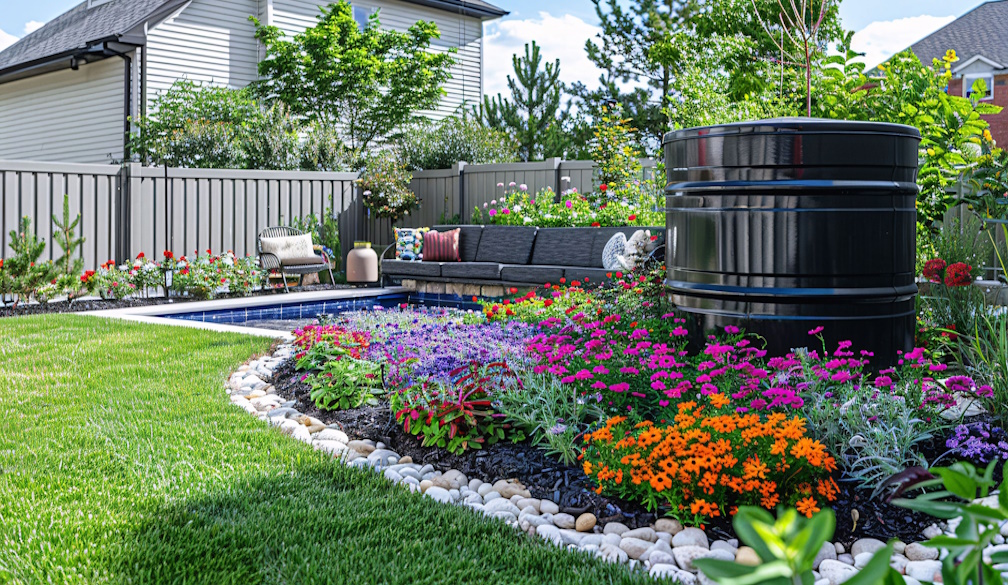
Plumb the rainwater tank into the garden line while the ground is already open, because retrofitting after landscaping costs several times more. Then specify a weather-responsive controller, one that pulls Bureau of Meteorology data over your home wi-fi and cancels a cycle when rain is close to certain. That single purchase cuts the bill and legally hands you back the middle of the day.
Before you order turf: four decisions, in this order
-
Fix the soil. Rip or scarify compacted ground and add quality sandy loam. Water cannot enter soil that will not accept it.
-
Commission the irrigation. A system switched on day nine has already eaten a third of your allowance.
-
Book delivery Monday to Wednesday, and be home. Never lie before you go away. A neighbour with a hose is not an establishment program.
-
Choose for the window. Match variety and plant selection to before-10 and after-4 watering, not to the first four weeks.
Sydney's storage sits at 92% today. The NSW Government's own Greater Sydney Water Strategy is built on the assumption that it will not hold forever, and the drought response plan for the next dry stretch is already written.
The gardens that come through it looking like they cost something will belong to the people who read the water rules as a design brief rather than a rain check.
Frequently asked questions
Do I need a permit to water new turf outside the normal hours in Sydney?
No. The 28-day allowance for new turf and new gardens applies automatically under the Water Wise Guidelines. There is no application and no fee. The condition is that you follow the watering instructions provided by your supplier or installer, and that water does not run off onto paths or driveways.
When do the 28 days start?
The day the turf is laid or the garden is planted, not the day you begin watering. It cannot be paused or extended, which is why delivery timing matters as much as delivery price.
Can I use a sprinkler in Sydney?
Yes, before 10am or after 4pm. Smart watering systems and drip irrigation may also run between 10am and 4pm, because they apply water at a lower rate with less loss.
Does the watering window apply to rainwater tanks?
No. The guidelines cover drinking water only. Rainwater, recycled water, greywater and bore water fall outside them, which is why a tank plumbed into the garden line effectively buys back the middle of the day.
Will restrictions get tighter?
Elevated restrictions are triggered by storage levels rather than by the calendar. Greater Sydney storage is currently around 92%, and both the pricing and the response plans already specify what changes if it falls below 60%.