How Golda Meir, Israel's 'Iron Lady', helped establish an independent Jewish state
- Written by: Jordana Silverstein, Historian, The University of Melbourne
This piece is part of a new series in collaboration with the ABC’s Saturday Extra program. Each week, the show will have a “who am I” quiz for listeners about influential figures who helped shape the 20th century, and we will publish profiles for each one. You can read the other pieces in the series here[1].
Golda Meir was the fourth prime minister of Israel and the first woman to hold that position. She was hugely influential in the building of a Jewish and Zionist Israel, and a significant – and also controversial – figure in world politics.
Born Golda Mabovitch in Kiev, Ukraine, in 1898, Meir grew up in the United States and died in Jerusalem in 1978. This was a common Jewish migration pattern in that era, as people escaped the persecutions of the Pale of Settlement[2] – the areas of the Russian empire in which Jews were allowed to settle – for a new life in the West.
Having served as Israeli ambassador to the Soviet Union, minister of foreign affairs, minister of labour and minister of internal affairs, Meir became prime minister in 1969. She held this role until 1974, resigning after the end of the 1973 Arab-Israeli War[3].
Her political philosophy
One of her biographers[4], Meron Medzini, has asserted:
The outside world saw her as the nice, gentle, pleasant and fragile Jewish grandmother.
But Meir was also, he wrote:
[…] a ruthless political animal, possessing an iron will and self-discipline […] She detested criticism and refused to acknowledge errors.
In her late teens, Meir joined the Labor Zionist[5] movement in the United States. After finishing school she travelled the country selling their message.
At 20[6], she was a speaker at the first American Jewish Congress in Philadelphia in 1918. Here, the impact of the Balfour Declaration[7], in which in 1917 the British government had declared support for the establishment of a national home for the Jewish people, was discussed.
Meir committed fully to the Zionist idea that Jewish life outside of Israel was incomplete and inadequate. It was this ideological position that led her to move to Israel, to live on a kibbutz[8]. When she became foreign minister in 1956, she changed her married name, Meyerson, to the Hebraicised[9] version, Meir.
Read more: Fifty years on from the Six Day War, the prospects for Middle East peace remain dim[10]
In 1928, Meir became secretary of the Women’s Labor Council of the Histadrut[11], an Israeli trade union. This was[12] her entry point into the political elite. She would go on[13] to travel to Britain and the United States for the Women’s Labor Council, building support and raising money to create Jewish settlements in Palestine, before taking up a series of other senior roles within the pre-state political establishment.
Meir was one of the signatories of Israel’s Declaration of Independence[14]. After the creation of the State of Israel in 1948, she continued to play a formative role in shaping Israel’s domestic and foreign policy.
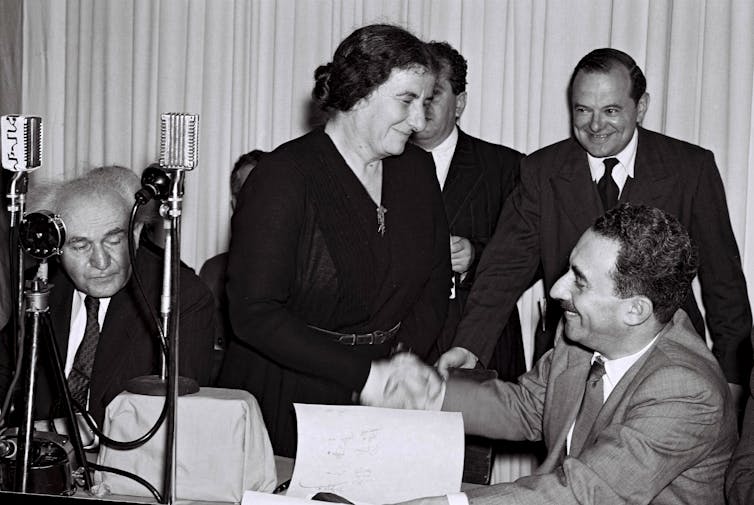 Meir shakes hand with Moshe Sharett, Israel’s second prime minister, after signing the Israeli Declaration of Independence in 1948.
AAP/EPA/ Shershel Frank-Israeli
Meir shakes hand with Moshe Sharett, Israel’s second prime minister, after signing the Israeli Declaration of Independence in 1948.
AAP/EPA/ Shershel Frank-Israeli
In her work within Israel, Meir – and the overwhelmingly Ashkenazi[15] governments and leadership she was part of – was hostile to[16] Jews who were Mizrahi[17] and Sephardic[18].
In response, these Jews formed a political organisation to protest the racial and economic injustice and persecution they faced. They took the name “Black Panthers”, partly as homage to the Black Panthers in the United States.
When they met with Meir in April 1971[19], Reuven Abergel – a Moroccan Jew and co-founder of the Black Panthers – told her:
Here are many obstacles for people like me: they don’t have the opportunity to rise [socio-economically].
After the meeting, Meir famously told the press the Black Panthers were “not nice[20]” people.
Her thoughts on Palestinians
Meir is often referred to[21] as Israel’s “Iron Lady”, and she is perhaps best known for her attempts to project responsibility for Israeli violence onto Palestinians. She is regularly quoted[22] as having said:
We can forgive the Arabs for killing our children. We cannot forgive them for forcing us to kill their children
and
We will only have peace with the Arabs when they love their children more than they hate us.
While there has been some debate[23] as to whether or not she said these exact words, they accurately reflect her political position of antipathy towards Palestinian people.
Read more: 'I can live with either one': Palestine, Israel and the two-state solution[24]
She saw Palestinians simply as an enemy to be defeated. In these quotes, she makes a claim it was the Palestinians’ sense of themselves that was the roadblock to peace – rather than the Israeli-perpetrated Nakba[25] and its continuing[26] wars, injustices and effects.
In an article published in Foreign Affairs in 1973[27], Meir rehearsed common settler-colonial false claims of an empty land – or terra nullius, to use language familiar to Australians. She said:
Israel has brought to fruition the labor of Jewish pioneers who, since the turn of the century, gave their lives to transform a barren and denuded land into fertile fields, flourishing settlements and new patterns of society.
These “young settlers”, she continued, had come to a land that was “rich only in historic memories and religious associations”. In this piece, Palestinian – as well as Middle Eastern Jewish – histories were erased; their lives and communities had no place in Meir’s Israel.
Meir was part of a political project of building a Jewish and Zionist Israel. As the first woman prime minister she was remarkable, but her legacy for both Israel and the world is more complex when we remember what she was part of building, and at whose expense she pursued her political and ideological ambitions.
References
- ^ here (theconversation.com)
- ^ Pale of Settlement (yivoencyclopedia.org)
- ^ 1973 Arab-Israeli War (en.wikipedia.org)
- ^ One of her biographers (library.oapen.org)
- ^ Labor Zionist (www.jewishvirtuallibrary.org)
- ^ At 20 (books.google.com.au)
- ^ Balfour Declaration (en.wikipedia.org)
- ^ kibbutz (archive.jewishagency.org)
- ^ Hebraicised (en.wikipedia.org)
- ^ Fifty years on from the Six Day War, the prospects for Middle East peace remain dim (theconversation.com)
- ^ Histadrut (www.jewishvirtuallibrary.org)
- ^ This was (books.google.com.au)
- ^ would go on (books.google.com.au)
- ^ Israel’s Declaration of Independence (mfa.gov.il)
- ^ Ashkenazi (www.britannica.com)
- ^ was hostile to (israeled.org)
- ^ Mizrahi (www.myjewishlearning.com)
- ^ Sephardic (www.myjewishlearning.com)
- ^ When they met with Meir in April 1971 (israeled.org)
- ^ not nice (www.jta.org)
- ^ referred to (azm.org)
- ^ regularly quoted (www.jewishvirtuallibrary.org)
- ^ some debate (www.haaretz.com)
- ^ 'I can live with either one': Palestine, Israel and the two-state solution (theconversation.com)
- ^ Nakba (overland.org.au)
- ^ continuing (zochrot.org)
- ^ published in Foreign Affairs in 1973 (www.jstor.org)