Where do we go from here with the allegations about Christian Porter?
- Written by: Rick Sarre, Emeritus Professor of Law and Criminal Justice, University of South Australia
A great deal has been written and said in the last few days about the next steps in the historic claim of rape against Attorney-General Christian Porter.
There are mounting calls for an independent inquiry amid constant references to the decision of the NSW police to close their investigations. But our attention should now switch to the South Australian coroner. I’ll explain why.
How police decide a case can be pursued
One of the frequently asked questions about this case is how the NSW police prosecutors determined, seemingly very quickly and without questioning Porter, that they would not be proceeding with any more investigations — let alone criminal charges.
As far as they were concerned, the matter was now closed.
Why do NSW police have the final determination and how could they move so quickly? Well, the alleged victim was South Australian and the alleged perpetrator was Western Australian, but the assault was alleged to have taken place in NSW. Hence, it fell to that state’s police to make an investigation and consider their options.
At the early stages of any investigation, police are the “gatekeepers” for decisions that might lead to a prosecution. The guidelines used by police prosecutors are straightforward: they decide whether the evidence is capable of leading to a successful conviction, and whether it is in the public interest for a prosecution to proceed.
They do not, and cannot, go on “fishing” expeditions. They cannot launch a prosecution hoping something will emerge down the track that might lead to the conviction of the accused.
In this case, we can assume the police decided the fact the complainant was deceased (and could not give evidence) and that the alleged offence happened more than three decades ago provided too little evidence to go on.
In their statement, the police used the term “admissible evidence”. By that, one can assume, they meant any hearsay evidence that was not capable of being corroborated could not be taken into account.
Read more: Has Christian Porter been subjected to a 'trial by media'? No, the media did its job of being a watchdog[1]
The complainant’s testimony is not essential
It may seem to many that the idea of deciding not to proceed without questioning the alleged perpetrator was a little odd, but the discretion attached to pre-trial decision-making is broad.
It is important to note that the inability of a complainant to give evidence for any reason (including death) is not the end of the matter. I know of no jurisdiction in Australia where a prosecution will be abandoned solely on the lack of a complainant’s testimony.
That was not always the case. In days gone by, once a complainant withdrew his or her complaint, a prosecution was inevitably withdrawn.
Read more: View from The Hill: Despite his denial, Christian Porter will struggle with the 'Caesar's wife' test[2]
The rules of evidence have also been reformed to make it easier for prosecutors to lead at trial with evidence of the propensity of an accused to commit offences of a sexual nature.
Nevertheless, the chances of a prosecution in a sexual offence case leading to a conviction remain slim.
As criminologist Kathleen Daly pointed out[3] a decade ago, of 100 complaints recorded by the police in Australia at that time, only 28% proceeded past the police to prosecution, 20% were finally prosecuted at trial, and only 11.5% resulted in convictions to any sexual offence. It would not be too much different now.
Over to the coroner
So where to from here? There have been calls for the launching of some form of inquiry into the entire matter from a number of quarters, including some MPs, the bereaved family and their friends.
Prime Minister Scott Morrison has made it very clear[4] such an inquiry is not going to take place, and that is his, and no one else’s, political judgement call to make.
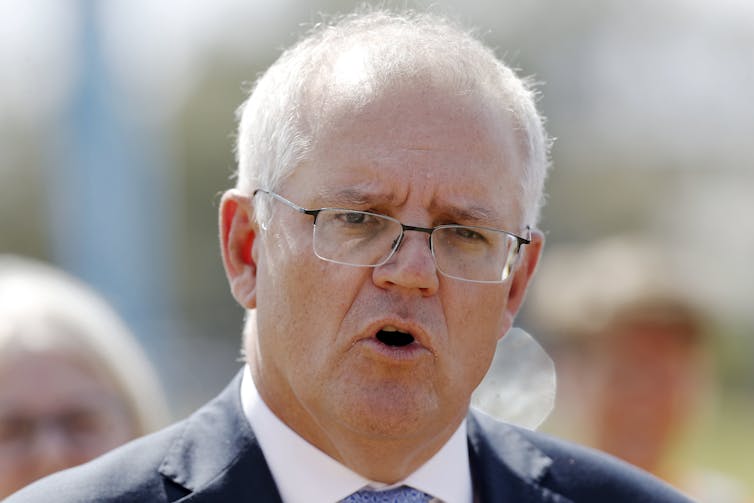 Morrison has dismissed calls for an inquiry into a historical rape allegation against Porter.
Darren Pateman/AAP
Morrison has dismissed calls for an inquiry into a historical rape allegation against Porter.
Darren Pateman/AAP
But those seeking some form of external review can take heart from the words of South Australia Coroner David Whittle on Wednesday[5]:
On the morning of 1 March 2021, an investigation file regarding the death of a woman in June 2020 was delivered to me by South Australia Police. The woman’s death and related matters have been the subject of media reporting in recent days. Whilst SAPOL has provided information to me, I determined that the investigation is incomplete. This was particularly evident having regard to information contained in recent media reports.
The coroner has yet to decide whether to hold an inquest. He awaits further investigation by SA Police. But if he does, his power to draw matters to his attention, including from the statements of witnesses he may call (but not compel), is considerable.
Read more: Women are (rightly) angry. Now they need a plan[6]
It is not the state coroner’s role to establish whether a crime has been committed or to find a person guilty of that crime. But the coroner has considerable power fashioned over the centuries to get behind matters and dig deep. Remember, too, he is not bound by the rules of evidence.
The story has not ended just yet.
If this article has raised issues for you, or if you’re concerned about someone you know, call the 1800 Respect national helpline on 1800 737 732 or Lifeline on 13 11 14.
References
- ^ Has Christian Porter been subjected to a 'trial by media'? No, the media did its job of being a watchdog (theconversation.com)
- ^ View from The Hill: Despite his denial, Christian Porter will struggle with the 'Caesar's wife' test (theconversation.com)
- ^ Kathleen Daly pointed out (core.ac.uk)
- ^ made it very clear (www.theguardian.com)
- ^ Coroner David Whittle on Wednesday (www.courts.sa.gov.au)
- ^ Women are (rightly) angry. Now they need a plan (theconversation.com)