
'Trumpism' in Australia has been overstated -- our problems are mostly our own
- Written by: Frank Bongiorno, Professor of History, ANU College of Arts and Social Sciences, Australian National University
The Trump era might not yet be over. But the Trump presidency – or at least one Trump presidency – certainly is. For the United States, it’s time to clean up the wreckage. For the rest of us, there’s also damage to undo.
Yet, just as Australia managed to emerge from the global financial crisis in better shape than any country had the right to expect, so it emerges from the Trump presidency in surprisingly reasonable shape - especially considering the global calamities still unfolding around us.
Just how much credit Australia’s federal government deserves for that result is worth considering. Australia had two prime ministers during the Trump era, Malcolm Turnbull and Scott Morrison.
Read more: The king, the fires and the fever: a fairytale finish to 2020[1]
Early in Trump’s presidency, Turnbull had a now infamous phone conversation with Trump[2], which was duly leaked to the media. In it, Turnbull tried to persuade a deeply disgruntled president to fulfil the American end of a bargain involving a refugee swap. The US would take asylum-seekers stuck on Manus Island and Nauru, in return for Australia taking refugees from Central America.
Turnbull tried to address Trump as one transactional businessman to another. The effort was probably as effective as it could have been in the circumstances. Turnbull reported in his memoir A Bigger Picture that in dealing with the “narcissistic bully”, it’s advisable to stand up for yourself.
Morrison, who is transactional but no businessman, seemed less worried about appearing close to Trump. The images of the two of them with Australian businessman Anthony Pratt at the opening of an Ohio box factory looked like a Make America Great Again Rally. Morrison scored a state dinner on that visit, in September 2019. It all seemed pretty chummy. As Trump left office, he took time out from fomenting a violent insurrection to award Morrison a legion of merit[3].
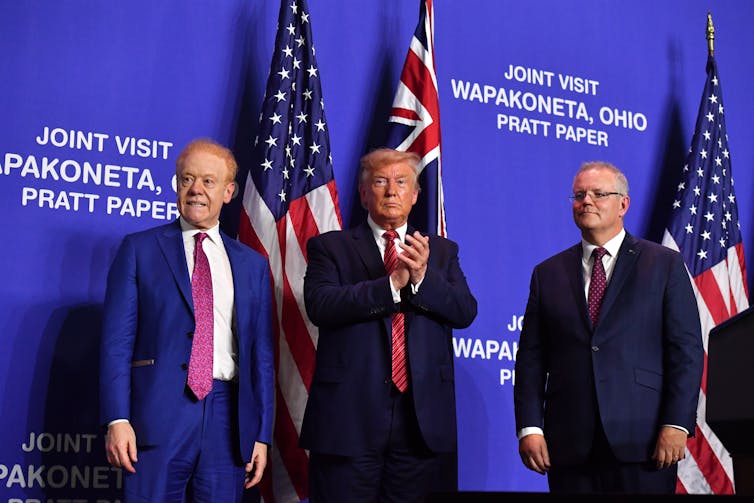 Donald Trump and Scott Morrison made a joint visit to Pratt Paper Factory in Ohio in 2019, looking much like a ‘Make American Great Again’ rally.
AAP/Mick Tsikas
Donald Trump and Scott Morrison made a joint visit to Pratt Paper Factory in Ohio in 2019, looking much like a ‘Make American Great Again’ rally.
AAP/Mick Tsikas
Yet the image of Morrison as Trump-lite has never been fully convincing. Trump delights in revving up his “base”, but Morrison’s political strategy has been to appeal to the “quiet Australians”. He makes a virtue of political disengagement. Morrison is a political entrepreneur if nothing else, always on the hunt for whatever it takes. His brief and mild flirtation with Trumpist populism – in the form of complaints about “negative globalism” in a lecture to the Lowy Institute[4] in October 2019, just after his US visit – needs to be seen in this context.
Trumpism did have its effects on Australian domestic politics. When Turnbull won the prime ministership from Tony Abbott in September 2015, he promised[5] “a style of leadership that respects the people’s intelligence”. But then came the 2016 election, which reduced the Coalition’s margin to a hair’s breadth. It also saw the return of Pauline Hanson’s One Nation to the Senate. The Brexit referendum, signalling the rise of right-wing populism in Britain, occurred during the Australian election campaign. But Trump’s victory later that year did more to embolden Australia’s political right.
That combination of near-defeat and rising right-wing populism in Australia’s two major Anglophone allies was fatal to Turnbull. Never popular among conservatives, the narrative was repeatedly hammered home by the Murdoch media, think tanks, conservative magazines and on the right wing of the Coalition parties both in parliament and out of it. In comparing Turnbull to his Labor counterpart Bill Shorten, conservative legal academic James Allan complained[6]
We have two parties led by men whose core views cannot be separated by a piece of paper.
Trump’s political success managed to convince a large section of the political right that history was on their side. This new confidence had many manifestations.
The timing of Home Affairs Minister Peter Dutton’s criticism[7] of the Fraser Coalition government for allowing the immigration of Lebanese Muslims to Australia in the 1970s – surely one of the most sordid remarks by a senior government minister in decades – came just a fortnight after Trump’s victory. In January 2018, Dutton claimed Melburnians were too frightened[8] to go to restaurants at night because of the danger posed by African street gangs. Two months later, he called for South Africa’s white farmers[9] to be given refugee status, a popular cause on the far right.
After Barnaby Joyce’s career as Nationals leader imploded, he produced a badly written memoir[10] that represented his effort - ham-fisted as it was - to articulate the persona of an angry white man and a populist vision for the “poor whites” of the bush.
Then, in October 2018, a motion from Pauline Hanson that contained the slogan “it’s OK to be white[11]” – one popular among racists – attracted the votes of Coalition senators, before they backtracked and voted against it the following day.
When the move against Turnbull’s leadership came in August 2018, it was predictably over energy policy – attachment to coal and oil remains de rigueur for Australia’s right – and it came from Dutton. The prime minister won a leadership spill by 48 votes to Dutton’s 35 but in the vote for the leadership later in the week, the margin was closer still. In the final round, Morrison defeated Dutton by just five votes. This was Australia’s nearest flirtation with Trumpism.
Morrison seems to have been occasionally tempted by a mild Trumpian populism early in the pandemic, but he quickly recognised that fewer deaths would result from a more consensual approach attuned to scientific advice. Morrison’s stated desire to open up the economy – often well before prudence appeared to dictate – might have been ill-judged, but it was hardly indebted to Trump.
No serious Australian politician has been able to regard the US or UK as worthy of emulation in dealing with COVID-19. The disintegration of the Trump presidency during 2020, and especially its violent denouement, seems to have deterred all but a small core of true believers.
Read more: As Trump exits the White House, he leaves Trumpism behind in Australia[12]
Australia’s harder line toward China in 2020 owes something to US policy and close relations between the countries’ intelligence communities. But it also has other roots – in long-standing Australian anxieties about domination by Asian powers as well as the growing force of a local critique of China’s record on human rights and international relations.
Nor did Australia’s Coalition government need Trump to reinforce its go-slow on climate policy. Australia is quite capable of doing that all on its own. It will find life less congenial under a Biden presidency.
References
- ^ The king, the fires and the fever: a fairytale finish to 2020 (theconversation.com)
- ^ infamous phone conversation with Trump (www.abc.net.au)
- ^ award Morrison a legion of merit (www.theguardian.com)
- ^ lecture to the Lowy Institute (www.lowyinstitute.org)
- ^ he promised (www.theguardian.com)
- ^ complained (www.spectator.com.au)
- ^ criticism (www.abc.net.au)
- ^ claimed Melburnians were too frightened (www.theguardian.com)
- ^ called for South Africa’s white farmers (theconversation.com)
- ^ a badly written memoir (insidestory.org.au)
- ^ it’s OK to be white (www.theguardian.com)
- ^ As Trump exits the White House, he leaves Trumpism behind in Australia (theconversation.com)