The Overlooked Link Between Flat Tennis Balls and Tennis Elbow
- Written by: Times Media
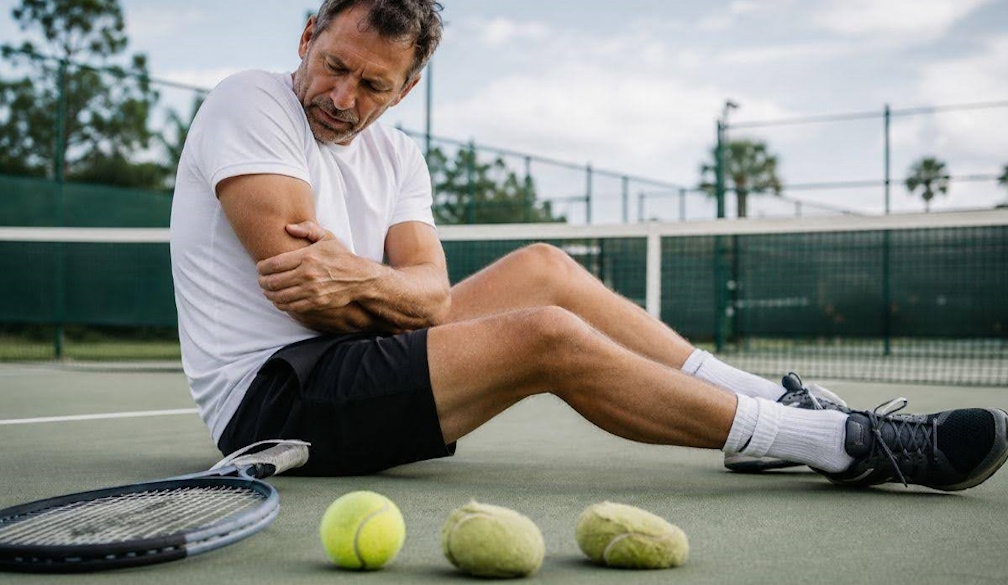
Tennis elbow is the sport's most common injury. Up to 50% of recreational players will experience it at some point in their playing life, and the standard advice is always the same: rest, ice, physio, maybe a new racket, maybe a different string. Check your grip size. Watch your backhand technique.
What almost nobody mentions is the ball in your hand.
Specifically: whether it has enough pressure in it.
This isn't a fringe theory. It follows directly from the physics of impact, the mechanics of how your arm absorbs shock, and what actually happens when a pressurised rubber ball loses its bounce. If you've been nursing a sore elbow, or you play regularly and want to make sure you never do, this is worth understanding properly.
What Tennis Elbow Actually Is
Lateral epicondylitis, commonly known as tennis elbow, is an overuse injury affecting the tendons that attach your forearm extensor muscles to the bony point on the outside of your elbow. Despite the name, only about a third of cases come from tennis. The rest come from repetitive gripping and wrist extension in any context.
In tennis, the injury develops when the tendons are subjected to repeated micro-trauma. Small amounts of stress that individually mean nothing accumulate over thousands of repetitions into inflammation, pain, and eventually degeneration of the tendon tissue itself.
The critical word there is stress. Not all ball strikes are equal in how much stress they send up the kinetic chain toward your elbow. And that's where ball pressure enters the picture.
The Impact Physics of a Flat Ball
When a tennis ball makes contact with your strings, it deforms. It squashes against the stringbed, stores energy, and then springs back, propelling off the racket. The quality of that interaction depends enormously on the internal pressure of the ball.
A properly pressurised ball, sitting at around 12 to 14 psi, deforms in a controlled, predictable way. It has good compliance: it gives a little, stores energy efficiently, and rebounds cleanly. The dwell time on the strings is longer, the energy transfer is smoother, and critically, the shock transmitted to the frame and through to your hand is absorbed progressively rather than all at once.
A flat ball behaves very differently. Under-pressurised, it doesn't deform as cleanly. Instead of compressing and springing back elastically, it tends to sit on the strings. The contact feels heavier, deader, and the rebound is sluggish. What changes most significantly is the shock profile of the impact. The force spike is sharper and shorter, meaning a greater peak load is transmitted into the frame in less time.
Think of the difference between catching a water balloon and catching a cricket ball. The water balloon gives, spreads the impact, and absorbs energy. The cricket ball delivers its force in a hard, concentrated burst. A flat tennis ball moves your racket-ball interaction closer toward the cricket ball end of that spectrum.
That sharp peak force has to go somewhere. It travels up the racket, through the grip, into your hand, wrist, and forearm, directly toward the tendons already under load from your swing.
How You Compensate Without Realising
Here is where it becomes insidious: your body adapts.
When balls are playing heavy and dead, most players don't consciously think "these balls feel flat." They just feel like they're not getting the result they want. The ball isn't coming off the racket with the pace or depth they're expecting. So they do what comes naturally: they swing harder, hit through the ball more, and use more arm.
This is the compensation pattern that really does the damage.
A good tennis stroke is a whole-body movement. Power comes from leg drive, hip rotation, core engagement, and shoulder turn, with the arm acting more as a delivery mechanism than a power source. When you start muscling the ball with your arm because everything feels heavy and unresponsive, you load the forearm extensors disproportionately. You're now generating force from exactly the muscles whose tendons attach at the lateral epicondyle.
Do this over the course of a two-hour session hitting with balls that have been sitting in a bag losing pressure for six weeks, and you've put in two hours of elevated tendon stress on top of your normal training load. Do it week after week, and the micro-trauma accumulates.
This is different from a technique flaw. It's an equipment flaw that creates a technique flaw. Fix the equipment and the compensatory pattern often disappears on its own.
The Vibration Factor
Beyond the direct shock load, there's a secondary mechanism worth understanding: vibration.
When a ball strikes the strings, it creates oscillation. The frame vibrates at characteristic frequencies, and those vibrations travel through the grip into the hand. The amplitude and duration of that vibration depends partly on the racket and strings, and partly on the nature of the impact itself.
A properly pressurised ball produces a cleaner, more damped strike. The ball's own compliance acts as a buffer. A flat ball, hitting harder with less give, tends to produce higher-amplitude vibration, the kind that players describe as a harsh, jarring sensation. Racket manufacturers spend considerable engineering effort trying to damp these vibrations out with frame materials and grip systems, precisely because sustained vibration transmission into the forearm extensors is understood to be a contributing factor in elbow injuries.
String vibration dampeners, which millions of players use, specifically target this problem. Yet most players using dampeners are also hitting with balls that have been slowly deflating since they opened the can three weeks ago, working against themselves without knowing it.
The Numbers That Should Concern You
Consider the typical recreational club player. They play twice a week, two hours per session. A conservative estimate puts the number of ball strikes per session at around 400 to 600. That's 800 to 1,200 impacts on the arm per week.
At a typical club, balls are often shared across multiple sessions before being replaced. A can opened on Monday may still be in use on Saturday. In that time, a pressurised tennis ball can lose anywhere from 1 to 4 psi without any visible sign of wear. It still looks fine. It still bounces if you drop it on the floor. But its performance characteristics have already shifted meaningfully.
Now consider that a course of physiotherapy for lateral epicondylitis typically runs to several weeks of treatment. In Australia and New Zealand, that can mean $80 to $150 per session. A serious case requiring corticosteroid injection, shockwave therapy, or extended rehabilitation can cost well over a thousand dollars, not including time off work if your job involves any repetitive hand use.
The cost of keeping your balls properly pressurised is a rounding error by comparison.
Stopping the Clock on Pressure Loss
A tennis ball starts losing pressure from the moment it is manufactured. The gas molecules inside are small enough to migrate slowly through the rubber wall of the ball over time, and once that pressure is gone, no amount of play can bring it back through normal use. The decline is invisible and gradual, which is exactly what makes it so easy to ignore.
This is where the science of the game meets the reality of the kit bag. PressureBall offers a way to halt, or even reverse, the clock on that decline, providing a pressurised environment that keeps the air inside the ball where it belongs.
It is a simple, elegant correction to the physics of pressure loss, ensuring that when you head to the court, you are bringing proper bounce with you rather than quietly loading your arm to compensate for balls that have already gone soft.
What Proper Pressure Actually Feels Like
If you've only ever played with balls that were losing pressure, you may not have a reference point for how different a properly maintained ball feels. Players who first use a ball pressuriser consistently describe the same experience: the ball feels livelier off the strings, rallies feel faster without more effort, and their arm feels less fatigued after a session.
That last detail is telling. Arm fatigue after tennis is often accepted as normal. In many cases it isn't normal. It's a signal that your equipment is making you work harder than you should be. Correctly pressurised balls are more responsive, require less force to hit with depth, and produce a cleaner, lower-shock impact. The arm does less to achieve the same result.
What You Can Do About It
The simplest change you can make is to stop treating ball pressure as someone else's problem.
Clubs are often slow to replace balls. Coaches run through dozens of balls in drip feeds and rarely retire them until they're visibly bald. Hitting partners fish whatever's in the bag. None of this is negligent. It's just the culture of the sport, and it's worth quietly changing your own standards regardless of what's happening around you.
Keeping your own supply of balls in a proper pressuriser means you control what you hit with. The PressureBall tube holds up to eight balls, maintains them at the correct internal pressure between sessions, and can restore pressure to balls that have already softened. You open a can, play your session, put the balls back in the tube and pump it up. That's the whole protocol, and it costs a fraction of a single physio appointment.
The Conversation Worth Having With Your Coach
If you are currently managing tennis elbow, or have had it before, it's worth raising ball pressure explicitly the next time you talk to your coach or physio. Ask what balls you'll be hitting with. Ask when they were opened. It's not a strange question. It's the kind of detail that separates players who manage their injury risk deliberately from those who just accept that tennis hurts sometimes.
Good coaches will welcome it. The best ones are already thinking about it.
Tennis elbow is rarely one thing. It's usually an accumulation: a technique under strain, a training load slightly too high, a grip slightly too small, recovery slightly too short. Ball pressure is one variable among several, but it's one of the easiest to control completely, at very low cost, with no downside.
If you're doing everything else right and your elbow is still talking to you, it might be time to look at what's actually in your bag.