4 things governments can do to help small business
- Written by: Andrei Alexander Lux, Lecturer in Leadership and Organisational Behaviour, Edith Cowan University
So much for the v-shaped recovery[1].
Australia is set to record its biggest quarterly fall in GDP in history this week. The federal government will extend its JobKeeper wage subsidy program by six months. About 1.75 million workers[2], including about 1 million Victorians, are expected to rely on it till March.
But there’s more to be done, particularly to help the small and medium-sized businesses taking the brunt of the COVID-19 economic impacts.
Small and medium enterprises employ about two-thirds of the workforce[3]. They are crucial to the prosperity of local communities.
A full third are pessimistic about making it through[4] the next three months, according to the Australian Bureau of Statistics’ most recent survey of COVID-19 business impacts[5]. By comparison only 18% of large companies (those employing more than 200 employees) expect difficulties in meeting their financial obligations.
Even at the best of times many small businesses struggle. Yet our research[6] on 223 Australian business owners highlights failure (or success) isn’t just the result of individual entrepreneurs’ personal resources and capabilities. The local business environment plays a significant role.
As Malcolm Gladwell puts it in his book Outliers: The Story of Success[7]:
The tallest oak in the forest is the tallest not just because it grew from the hardiest acorn, it is the tallest also because no other trees blocked its sunlight, the soil around it was deep and rich, no rabbit chewed through its bark as a sapling, and no lumberjack cut it down before it matured.
The same is true for businesses. Even the most resourceful business owners struggle to get ahead when the environment stifles their efforts.
This is a thorny problem for governments as they turn from emergency measures to chart longer-term recovery policies.
There will, no doubt, be much debate over the usual areas – of subsidies and grants, tax breaks, red tape and industrial relations changes. But we suggest four less obvious priorities to create a favourable environment for small business.
1. Government procurement
Small businesses should be given a real advantage in procurement. Procurement policies and processes must be clear, protective and accessible to the small guys, not a maze[8] that ends up helping only the big corporations.
The Australian Small Business and Family Enterprise Ombudsman[9], Kate Carnell, has proposed that federal government contracts worth up to A$10 million go through a small business panel[10] as part of the tender process. “Lowest cost is not always the best value for money,” she said. We agree, with state and local government procurement policies being equally important.
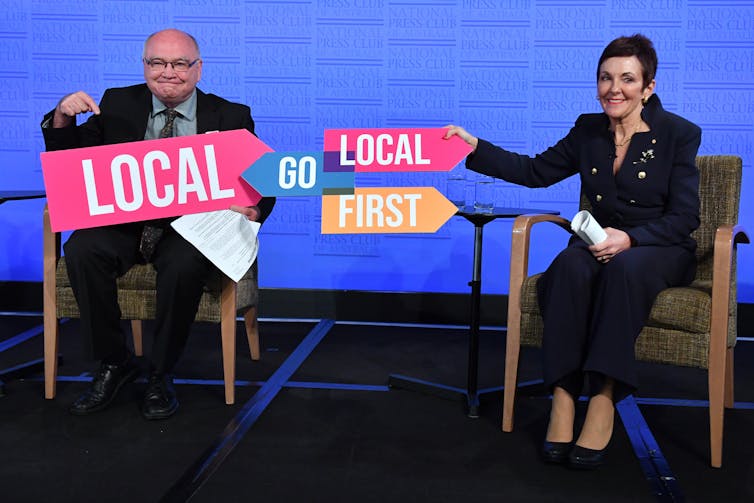 Australian Small Business and Family Enterprise Ombudsman Kate Carnell at the National Press Club with Council of Small Business of Australia head Peter Strong on July 29 2020.
Mick Tsikas/AAP
Australian Small Business and Family Enterprise Ombudsman Kate Carnell at the National Press Club with Council of Small Business of Australia head Peter Strong on July 29 2020.
Mick Tsikas/AAP
2. Ensure they get good advice
One of the biggest decisions many small business owners will face will be whether to borrow money to keep their business going or cut their losses. That’s something for which they should get sound professional advice.
But when small businesses are cash-strapped, cutting back spending on advisers such as lawyers and accountants can be an obvious way to save money.
State and local governments offer some (limited) support to small business advisory services. Western Australia’s Small Business Development Corporation[11], for example, provides free advice to local government for encouraging small business.
What we need now is a national program to ensure all small business owners can get good, free professional advice.
Read more: Melbourne's second lockdown spells death for small businesses. Here are 3 things government can do to save them[12]
3. Encourage localism
Encouraging consumers to “buy local” is a pillar of regional development strategies. “Buy Australian” campaigns have been around since the 1980s with the latest incarnation Buy Australian Made[13] campaign launched in June. Its slogan: “It’s never been more important to buy Australian than right now.”
Australian Made, Australian Grown campaign 2012.The success of these campaigns is open to debate[14], but the general principle appears sound. A 2017 analysis[15] of foodstuffs, for example, found greater localism associated with more resilient and sustainable local economies.
4. Promote mental health
The last measure is more psychological support. This has been a neglected area in the past, but improving business owners’ mental health is as effective as building a stronger network or increasing cash flow.
Our calculations[16] suggest developing hope, optimism, self-efficacy and resilience can improve firm performance by 38%. That’s the same as building a stronger social network (38%), and twice as much as formal entrepreneurial education (15%).
With growing recognition of mental health issues, and the effects of COVID-19 crisis, government policies to promote small business should include a focus on business owners’ mental health.
Read more: As 'lockdown fatigue' sets in, the toll on mental health will require an urgent response[17]
So what does it all mean?
Together, these key factors determine whether business owners can leverage their own resources to drive performance and ride out the recession.
In the words of motivational speaker Alexander Den Heijer in Nothing you don’t already know[18]:
When a flower doesn’t bloom, you fix the environment in which it grows, not the flower.
Hopefully that will be enough.
References
- ^ v-shaped recovery (theconversation.com)
- ^ 1.75 million workers (theconversation.com)
- ^ two-thirds of the workforce (www.abs.gov.au)
- ^ making it through (www.abs.gov.au)
- ^ COVID-19 business impacts (www.abs.gov.au)
- ^ our research (dx.doi.org)
- ^ Outliers: The Story of Success (www.goodreads.com)
- ^ not a maze (www.smh.com.au)
- ^ Australian Small Business and Family Enterprise Ombudsman (www.asbfeo.gov.au)
- ^ go through a small business panel (www.smartcompany.com.au)
- ^ Small Business Development Corporation (www.businessnews.com.au)
- ^ Melbourne's second lockdown spells death for small businesses. Here are 3 things government can do to save them (theconversation.com)
- ^ Buy Australian Made (www.buyaustralianmade.com.au)
- ^ open to debate (theconversation.com)
- ^ 2017 analysis (doi.org)
- ^ Our calculations (dx.doi.org)
- ^ As 'lockdown fatigue' sets in, the toll on mental health will require an urgent response (theconversation.com)
- ^ Nothing you don’t already know (www.goodreads.com)
Authors: Andrei Alexander Lux, Lecturer in Leadership and Organisational Behaviour, Edith Cowan University
Read more https://theconversation.com/4-things-governments-can-do-to-help-small-business-145310