Chalmers' budget delivers modestly to the vulnerable while keeping the inflation ogre in mind
- Written by: Michelle Grattan, Professorial Fellow, University of Canberra
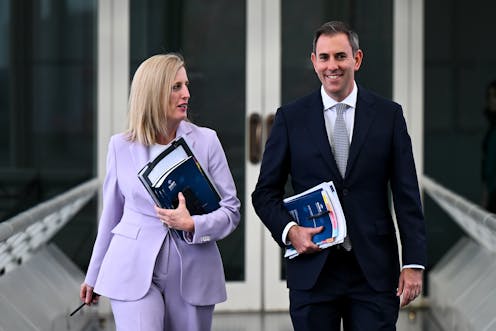
This budget is the culmination of a tug of war between the government’s imperative to fight inflation and the siren call from Labor’s base to help people who are struggling.
The government has delivered measures to ease cost-of-living pressures on the most vulnerable, including on income support and rent assistance. The critics, especially but not only from the left, will say it hasn’t done enough.
Treasurer Jim Chalmers says it’s a balance between “doing what we can for the people doing it tough and keeping the pressure on inflation”. He told his news conference that on cost-of-living relief, “we’ve genuinely put in our best effort”.
But another bunch of critics, loud among them the opposition, will insist the budget wasn’t responsible enough – that it in fact squibs the inflation fight.
The rises in JobSeeker and rent assistance are modest. Indeed $40 a fortnight for JobSeeker is smaller than the Morrison government’s $50 increase.
Read more: Jim Chalmers hands down a budget for Anthony Albanese's battlers[1]
But a big boost would have been inflationary, and so ultimately counter-productive for those it was supposed to help, and many others, too.
While Chalmers insists his cost-of-living measures are restrained, some economists will maintain they’ll in fact add to the inflation problem.
Prime Minister Anthony Albanese’s decision last year to establish the Economic Inclusion Advisory Committee (as part of a deal with crossbencher David Pocock to pass industrial relations legislation) can be seen as crucial in the budget process in the last few weeks.
That committee’s report set a benchmark by which the government could be held to account. The $40 looks punier when compared to the committee’s advice for a $256 increase in JobSeeker.
Read more: Budget 2023: Budgeting for difficult times is hard – just ask Chalmers[2]
When that committee produced its report, Chalmers hosed down expectations of what the government could do. But the welfare lobby had loud voices, and a lot of allies outside its ranks. And Labor backbenchers decided it was time to say their piece.
The campaign for compassion became intense. Minimalism became untenable.
And then the latest revenue upgrades arrived from Treasury. They both increased the pressure to do more, and made it possible.
Meanwhile those revenue numbers (driven by high employment and high commodity prices) imposed another pressure – to deliver a surplus in this financial year.
This served the economic purpose of demonstrating the government’s fiscal credentials. It also sent a powerful political “up yours” to the Coalition, who came to the brink of surplus only to have it snatched away by COVID.
It’s true the projected surplus is followed by the budget plunging back into the red over coming years. And indeed, given the poor economic outlook it outlines, with its forecast of declining economic growth, that might be what happens.
But recent history shows how things can change in a budget’s out years. There is another possible scenario. Chalmers can use the looming deficit numbers in his bid to drive cost savings in expensive programs, notably the National Disability Insurance Scheme. This may (together with some assistance on the revenue side) help contain those deficits in later years.
Some will criticise the budget for a lack of ambition. Why didn’t it get rid of part of those Stage 3 tax cuts? Why did it confine its changes to the Petroleum Resource Rent Tax to tinkering? Couldn’t it have gone further with superannuation tax breaks? Doesn’t the government realise that this was the budget calling for boldness, because the next one will already have the election in mind? Why be the tortoise rather than the hare?
Read more: Budget spends big on support but won't make much difference to poverty[3]
The answers lie in the nature of the Albanese government and its prime minister. Albanese wants to change things, but to minimise the risk in doing so and to maximise the government’s longevity.
While a second term for Labor looks a very good bet, given the government’s popularity and the parlous state of the Liberals, there is never certainty in politics.
Albanese lived at the heart of the disorderly Rudd-Gillard-Rudd era. He puts a high value on process, order, maintaining public confidence and delivering to the base (albeit less than some demand), while not provoking swinging voters.
Those in the centre of the income scale, feeling squeezed by escalating interest rates, may feel left out in this budget. This is despite Chalmers declaring there is “a lot […] for middle Australians”, such as the bulk billing changes for families with children. But if the budget doesn’t deliver much to these people, not does it overtly poke them in the eye.
If this budget has plenty of critics around its edges, they will probably find it hard to deliver a killer blow to its core.
Read more: Budget 2023 at a glance: major measures, cuts and spends[4]
References
- ^ Jim Chalmers hands down a budget for Anthony Albanese's battlers (theconversation.com)
- ^ Budget 2023: Budgeting for difficult times is hard – just ask Chalmers (theconversation.com)
- ^ Budget spends big on support but won't make much difference to poverty (theconversation.com)
- ^ Budget 2023 at a glance: major measures, cuts and spends (theconversation.com)
Authors: Michelle Grattan, Professorial Fellow, University of Canberra