Jim Chalmers hands down a budget for Anthony Albanese's battlers
- Written by: Michelle Grattan, Professorial Fellow, University of Canberra
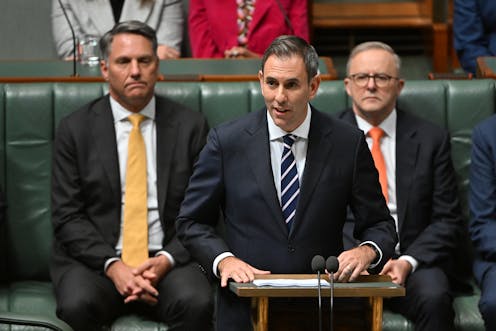
A big incentive for doctors to bulk bill, a modest $40 a fortnight rise in JobSeeker and extra rent assistance are highlights of a Labor budget that juggles targeted cost-of-living relief with containing inflation.
The government will triple the incentive paid to GPs to bulk bill for families with children under 16, pensioners and Commonwealth concession card holders.
The government says this will cover 11.6 million Australians and cost $3.5 billion over the forward estimates. It is part of an injection of $5.7 billion into the problem-ridden Medicare system.
The budget is aimed firmly at the most vulnerable and has a significant focus on women. However, those on middle incomes receive little – although families with children can benefit from the extra bulk billing.
The government has bowed to pressure for an across-the-board rise in JobSeeker. But the $40 a fortnight increase falls far short of the fortnightly $256 recommended by its Economic Inclusion Advisory Committee.
Those 55 and over who have been on the payment nine months will get a slightly larger increase, as people over 60 do now.
Delivering his second budget, Treasurer Jim Chalmers said inflation remained “our primary economic challenge.
"It drives rate rises, it erodes real wages. Which is why this budget is carefully calibrated to alleviate inflationary pressures, not to add to them.”
Read more: View from The Hill: Chalmers' budget delivers modestly to the vulnerable while keeping the inflation ogre in mind[1]
Chalmers said the budget’s suite of measures to ease pressure on households would take 0.75 of a percentage point off inflation in 2023-24.
Inflation is expected to fall from 6% in 2022-23 to 3.25% in 2023-24, before returning to the Reserve Bank target range (between 2% and 3%) in 2024-25.
Unemployment will increase to 4.25% in 2023-24, and 4.5% the following year. Real wages are expected to start rising early next year.
The budget forecasts that this financial year will see the first surplus – $4.2 billion – in 15 years.
This will be followed by a string of deficits: $13.9 billion in 2023-24, $35.1 billion in 2024-25; $36.6 billion in 2025-26, $28.5 billion in 2026-27, with a cumulative total across the budget period of $109.9 billion. The deficits are lower, however, than earlier forecasts.
Revenue next financial year will be 26.4% of GDP while spending will be 26.6%. Net debt will be 22.3% of GDP.
The targeted $14.6 billion cost-of-living package over the forward estimates will see, in a federal-state deal, more than 500,000 households have up to $500 deducted from their power bill in the next financial year. Small businesses will also get relief.
The government is also investing $1 billion in assistance for low-cost loans for double glazing, solar panels and other improvements for homes to contain energy costs.
The increase in JobSeeker, Youth Allowance, Austudy and other income support payments will cost $4.9 billion and go to about 1.1 million people.
Eligibility for the parenting payment (single) is being liberalised, going to parents (overwhelmingly mothers) until their youngest child is aged 14, rather than the present age of eight. This will cost $1.9 billion over the budget period.
Read more: Budget 2023: Budgeting for difficult times is hard – just ask Chalmers[2]
A 15% increase in the maximum rates of Commonwealth rent assistance will mean an extra $31 a fortnight for those renting in the private market and community housing. Chalmers said this was the largest increase in more than 30 years.
Tax increases and measures to improve the budget position include rises in the tobacco excise ($3 billion over the budget period), changes to the Petroleum Resource Rent Tax ($2.4 billion), and a four-year extension of the GST compliance program ($3.8 billion).
As part of a bid to make Australia “a renewable energy superpower”, the budget allocates a further $4 billion. There will be a $2 billion investment in a new Hydrogen Headstart program.
Read more: Budget spends big on support but won't make much difference to poverty[3]
Shadow treasurer Angus Taylor condemned the budget as failing “hard-working Australians right at a time when they needed a plan to address inflation and the cost of living crisis”. He said it was “a typical big-spending, big-taxing Labor budget”.
Greens leader Adam Bandt said the budget “leaves millions behind, leaving people in poverty while billionaires get tax cuts. With a quarter of a trillion dollars in tax cuts for the wealthy, Labor’s budget is a betrayal of renters, young people, and jobseekers”.
Bandt said that when budget legislation came to the parliament, “the Greens will push to make the big corporations pay more tax to fund a freeze on rent increases and lift people out of poverty”.
Innes Willox, chief executive of the employer association Ai Group, said: “The budget does not seek to cure the fundamental problems that Australian businesses and the economy face. While it reduces debt, the focus on short-term household relief will not provide the productivity growth we need now and the jobs we need for the future.”
References
- ^ View from The Hill: Chalmers' budget delivers modestly to the vulnerable while keeping the inflation ogre in mind (theconversation.com)
- ^ Budget 2023: Budgeting for difficult times is hard – just ask Chalmers (theconversation.com)
- ^ Budget spends big on support but won't make much difference to poverty (theconversation.com)
Authors: Michelle Grattan, Professorial Fellow, University of Canberra
Read more https://theconversation.com/jim-chalmers-hands-down-a-budget-for-anthony-albaneses-battlers-205210