2 aspirants who are unlikely to suit the times vie for the Liberal leadership
- Written by: Michelle Grattan, Professorial Fellow, University of Canberra
The Liberal manoeuvrings for an assault on Sussan Ley’s leadership don’t lack transparency.
As members of the Liberal Party gathered in Melbourne on Thursday to attend the memorial service for former colleague Katie Allen, leadership aspirants Andrew Hastie and Angus Taylor met to discuss their rival ambition.
Both the meeting and why it was needed were well publicised. Hastie and Taylor each wants to run against Ley. But the two right-wingers can’t afford to split the conservative vote on which their tilts would rely.
The timing and public nature of the encounter, attended by conservative factional heavyweights James Paterson and Jonno Duniam, would have seemed extraordinary to those unfamiliar with how things go when a party leadership battle is in full flight.
It looked insensitive ahead of the memorial service, and disrespectful to Ley, given that key attendees (but not Hastie) are her supposedly loyal frontbenchers. Anyway, the discussion, over coffee and pastries, came to no resolution. More wrangling will be needed. The Liberals’ leadership agony continues.
The flaws in Ley’s leadership have been canvassed endlessly, especially that she does not come across as standing for much. The qualities and limitations of the wannabe replacements have been less dissected.
There’s something of the old bull-young bull in the Taylor-Hastie face off.
When he entered parliament for the New South Wales regional seat of Hume at the 2013 election, Taylor was hailed as a future leadership prospect. As one pre-election article had said[1], his CV read “as if it’s too good to be true”.
At the University of Sydney he’d won the university medal for economics, before a Rhodes scholarship took him to Oxford. That was followed by a successful business career, including co-founding an agribusiness and working as a director of the management consultancy Port Jackson Partners.
Once on the ministerial ladder, Taylor rose to be minister for industry, energy and emissions reduction in the Morrison government. In opposition under Peter Dutton, he was shadow treasurer. But he had trouble landing blows against treasurer Jim Chalmers; his performance was considered by colleagues as mediocre, which is counting against him now. Taylor and Dutton were privately critical of each other.
Hastie’s earlier career path could not be more different. A captain in the Special Air Service Regiment, he served with distinction in Afghanistan. His entry to parliament at a 2015 byelection was surrounded by drama; the backdrop was the spectacular fall of Tony Abbott, his patron, as prime minister, after a challenge by Malcolm Turnbull.
In government, Hastie was assistant minister for defence. Under Dutton he became defence spokesman, where his performance was considered ordinary. He and Dutton fell out, each blaming the other; the result was the opposition’s defence policy delivered late with no flesh on it.
Since the election, the leadership ambitions of both men have been obvious, but their tactics have starkly contrasted.
Taylor ran against Ley and lost narrowly. In a bizarre move, he encouraged Jacinta Nampijinpa Price to defect from the Nationals to be his potential deputy; the plan imploded when he failed and so Price didn’t run. As shadow defence minister, he has stuck to his knitting, avoiding giving any impression of undermining the leader.
Hastie, on the other hand, has been a firecracker. Aggrieved he wasn’t allocated an economic portfolio, he quit as home affairs spokesman, claiming he wouldn’t have a role in formulating the opposition’s immigration policy (one of his constant topics). He has elevated his profile through social media, with slick, professionally prepared, sometimes provocative posts.
Both Taylor and Hastie are socially conservative, but Hastie much more so (he was denounced for ill-judged remarks about late-term abortions). In economics, there is a big gap. Taylor, with extensive knowledge of economics and business at both a theoretical and practical level, is a conventional economic “dry”. Hastie has shown himself something of a throwback to the past, with one of his videos a sentimental lament for the demise of the Australian car industry.
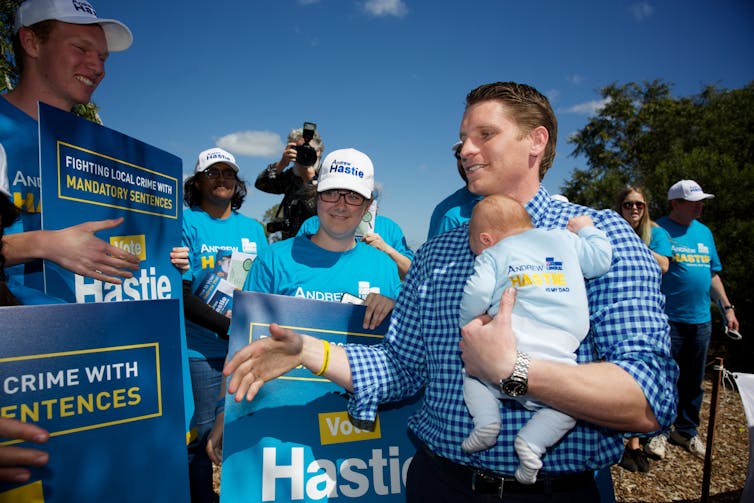
Hastie is attracting the support of impatient younger members of the party, who want generational change. He’s 43 to Taylor’s 59. Taylor’s critics say he has a “born to rule” attitude; those who criticise Hastie find him arrogant.
The reality is neither contender shows much prospect of being a good fit for the opposition’s top job in present circumstances – just as Ley has found herself unable to cut through to today’s voters. This is not just because of the nature of the individuals but because of the political circumstances they face.
These include the challenge of unlocking the women’s vote from Labor, and the public’s current attitude to what “government” should do and provide.
The Liberals can’t regain office without polling much better with female voters. Tackling their gender problem goes well beyond the familiar debate about whether the Liberals should adopt quotas for women candidates, though they might help.
Albanese knows how reliant he is on the female vote and does everything he can to ensure it is cemented in. It’s not just reminding people more than half his caucus are women. It’s serious policy pitched at women, most notably child care, but also improvements in parental leave, superannuation and other measures. It’s leaning often to preferring women for top appointments. It’s support for low-paid workers in feminised industries. The Liberals, whoever leads them, can’t or won’t compete on such fronts and are even conflicted about work-from-home.
Even more fundamental, the Liberals’ natural positioning (whether conservatives or moderates) is to support smaller government, reduce public spending, and tackle debt and deficits. But we’re living in times when voters want big government – for governments to do more, not less, to provide extra services, to help directly with cost-of-living pressures. This has been accentuated since the pandemic. At the macro level, concerns about debt and deficits don’t resonate as they once did.
The times don’t suit the Liberals, and the Liberals don’t have top people to suit the times. Worse for them, there is no sign of either of those things changing.
References
- ^ pre-election article had said (www.theaustralian.com.au)