


I'm fully vaccinated – should I keep wearing a mask for my unvaccinated child?
- Written by: Nancy S. Jecker, Professor of Bioethics and Humanities, School of Medicine, University of Washington
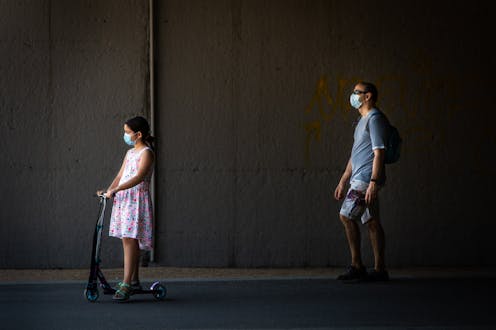
Fully vaccinated adults are celebrating their new freedom[1] and removing their face masks. Yet for parents of children under age 12, the rejoicing might be short-lived.
Since children that age do not yet have access to vaccines, the Centers for Disease Control and Prevention says[2] they are better off staying masked when in public and around people they don’t live with.
Now what? Do “good parents” keep their child’s face shield on at playgrounds, barbecues and play dates, teaching health and safety above all? Or do they “let kids be kids” and tell their child it’s OK to take the mask off? What if a child’s circle includes unvaccinated people at high risk of serious disease? With summer fast approaching, parents of youngsters must face these questions head-on.
As a moral philosopher and bioethicist[3], I analyze ethical dilemmas, and lately I’ve thought a lot about ethical dilemmas raised by the COVID-19 pandemic[4]. I’ve also written about a little-known field – ethics and the family – which asks what parents owe their children, what children owe their parents[5], and what spouses owe each other[6]. There are a few tools in my ethics toolkit that might help with the mask question.
Protecting safety at all costs
There’s an ethical view that holds that people are not just driven to do more for their family members, but have a special moral duty[7] to do more. This special duty arises by virtue of the relationships of love and affection in which families ideally stand.
On some accounts, a special duty might even require doing “everything possible[8]” to keep a loved one safe. Reasoning along these lines, one might hold that parents have a duty to lay down the law when it comes to masking.
Yet a potential snag in this line of thinking is that it is at odds with other decisions people make for their children – like routinely letting kids do risky things such as climb trees or ski down slopes. What’s more, keeping children safe is complicated. Presumably, it includes protecting children’s mental health[9] and social development. A masked summer could frustrate such efforts.
Letting kids be kids
A different way of thinking is that unmasking is justified to let kids be kids. The Swiss enlightenment philosopher Jean-Jacques Rousseau might have supported this view[10]. He held that childhood is valuable for its own sake, and that the best way to bring up children is to let them develop naturally.
Too often, parents bring to parenting their own “life-stage bias[11],” which occurs when ethical concerns – such as safety – that are prominent at one life stage are generalized and assumed to be central for all life stages. While children should, of course, be kept safe to prepare them for adulthood, preparing for adulthood should not crowd out all other values, or keep children from the joys of childhood.
The point here is that childhood is a one-of-a-kind experience[12]. For example, childhood friendships differ from adult ones[13], and childhood play calls upon a child’s ability to become absorbed in make-believe worlds and entertain radically different worlds.
To the extent that children miss out on healthy childhood experiences, they cannot readily make them up. For example, having more adult friends will not compensate for lacking childhood ones, and playing more as an adult will not replace childhood play. The window closes.
Whether masking interferes a lot or only mildly with childhood fun will depend on a number of factors, such as the child’s age (a 2-year-old may have a harder time than a 10-year-old), activity (wearing a mask while playing dolls may be easier than while playing basketball) and aversion to masking (which may vary based on the child’s personality or whether their friends mask).
Civic responsibility
Of course, the other reason for children to mask is that this prevents them from transmitting the coronavirus to others. Especially if a child’s circle includes someone with heightened risk of severe disease and death from the virus, this consideration will be overriding.
For example, if a child’s neighbor is a 5-year-old with Down syndrome, or their best friend has asthma[14], or they have a family member who is vaccinated but whose immune system is suppressed by drugs or disease[15], they should keep their mask on. In these situations, it is important for parents to acknowledge that masking is not what the child wants to do, but that putting others’ health and safety first sometimes matters most.
Masking in solidarity
Parents who choose to keep their unvaccinated child masked might ask the child if it would help them if they masked too. Masking with a child conveys appreciation and recognition that, for some kids, keeping a mask on is a big ask. Such a move throws a wrench in parents’ own unmasking celebrations. But parents can celebrate later, after their child gets vaccinated, and when their child can celebrate too.
While these decisions can be tough for parents and kids alike, the good news is that children ages 2 to 11 will probably have access to vaccines in September[16].
The upshot
Parents and caregivers have made so many sacrifices over the course of the pandemic to keep kids safe. Summertime, typically a period of carefree play, promises long-awaited relief.
For some families with small children, the masks are coming off and they’re headed to Disney World, which no longer requires masks outdoors[17]. For other families, all their prior efforts might feel wasted if they didn’t go the last mile and wait a bit longer.
Whatever parents decide, they should communicate their message in a way that shows love and support for their child.
References
- ^ their new freedom (www.cdc.gov)
- ^ Centers for Disease Control and Prevention says (www.cdc.gov)
- ^ moral philosopher and bioethicist (depts.washington.edu)
- ^ ethical dilemmas raised by the COVID-19 pandemic (dx.doi.org)
- ^ what children owe their parents (www.jstor.org)
- ^ spouses owe each other (www.researchgate.net)
- ^ special moral duty (plato.stanford.edu)
- ^ everything possible (doi.org)
- ^ protecting children’s mental health (www.aappublications.org)
- ^ might have supported this view (oll.libertyfund.org)
- ^ life-stage bias (www.doi.org)
- ^ childhood is a one-of-a-kind experience (doi.org)
- ^ differ from adult ones (www.doi.org)
- ^ a 5-year-old with Down syndrome, or their best friend has asthma (www.cdc.gov)
- ^ immune system is suppressed by drugs or disease (www.sciencemag.org)
- ^ access to vaccines in September (www.aappublications.org)
- ^ no longer requires masks outdoors (www.usatoday.com)










