Dan Andrews’ red carpet walk in Beijing puts Albanese on the spot
- Written by: Michelle Grattan, Professorial Fellow, University of Canberra
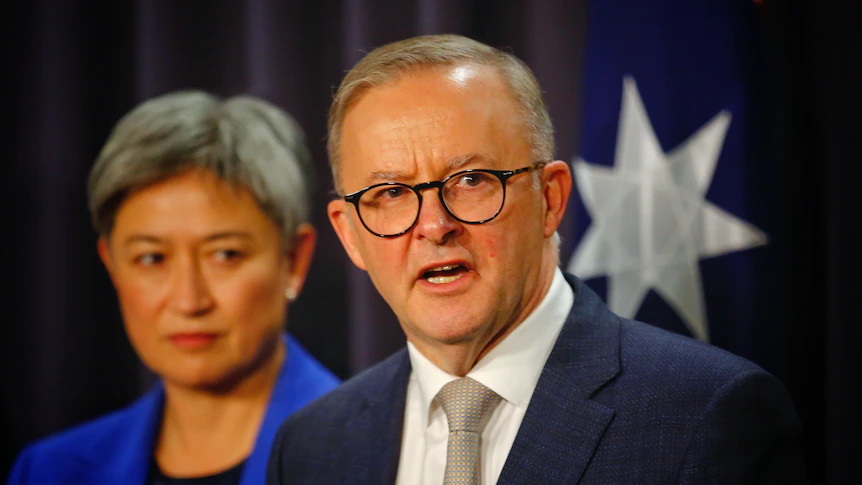
Despite he and his government being in an overwhelmingly dominant position politically, Anthony Albanese sounded quite tetchy at times this week.
He argued the toss on the ABC when pressed, reasonably enough, for detail on the expensive deal for Nauru to take former immigration detainees. Later in the week, a brief Senate inquiry revealed the 30-year agreement could cost up to $2.5 billion.
Albanese dismissed as “not accurate” a story about officials helping the return to Australia of so-called “ISIS brides” and their families, when a fuller response would have been wiser. It emerged that while the government is not facilitating the repatriation, New South Wales and federal police are making arrangements for if and when the people arrive.
Albanese was on the back foot over issues of the government’s lack of transparency, highlighted by aspects of new freedom of information legislation introduced this week. Although some changes are reasonable, the new regime will further restrict public access to information relating to decision-making at senior levels of government. Former crossbench senator Rex Patrick, who constantly runs FOI cases, describes it as an “Albanese counterrevolution” that “strips away citizens’ right to access important information”.
Perhaps the prime ministerial mood was darkened this week by his good political friend, former Victorian premier Dan Andrews, being caught up in a firestorm of criticism for attending China’s enormous military parade in Beijing on Wednesday.
Andrews is a private citizen now, but his presence in the “family photo” with the who’s who of the world’s dictators dismayed many people in Labor.
The parade highlighted the delicate diplomatic dance the Albanese government finds itself in with China. The show of strength sent unmistakable messages to the world. The Australian government kept its distance from the spectacle; embassy officials attended but Australia’s ambassador was in another part of China.
Albanese knew the presence of Andrews was unfortunate, although he held back from robust criticism. On Thursday, he told parliament, “I am not responsible for what every Australian citizen does”. (Andrews said in a Thursday statement the occasion had been a chance to “engage with regional leaders”.)
On the other side of politics, the opposition remains in a world of pain, deeply divided over net zero and with members breaking ranks, in comments or votes, apparently whenever they feel like it. This week several senators, including Nationals frontbenchers Bridget McKenzie and Ross Cadell, crossed the floor to support a motion moved by One Nation’s Pauline Hanson on immigration. So much for the Nationals’ agreement to accept the principle of shadow cabinet solidarity.
Separately, Senator Jacinta Nampijinpa Price damaged the Liberals with an inflammatory comment about Indian immigration.
But amid her deep troubles, Opposition Leader Sussan Ley had a useful win this week. On Monday and Tuesday the opposition in question time targeted the new Minister for Aged Care Sam Rae over the unacceptably long waiting list for home care packages, and the delay of the roll-out of planned aged care reforms, from July to November.
Rae, it will be remembered, owed his elevation to the ministry after the election to being a factional numbers man for Deputy Prime Minister Richard Marles. Labor observers felt he held his own under the attack, but the government found itself in an untenable position.
The opposition had leverage because the government needed to get its latest aged care legislation through the Senate this week. On Wednesday morning, the Senate passed an amendment to bring forward a batch of home packages, when a rare combination of the Coalition, Greens and crossbenchers imposed an equally rare defeat on Labor. Although there was no division, the government registered its opposition.
Then almost immediately, Minister for Ageing Mark Butler announced the government would indeed bring forward the packages.
In the post-election Senate, the government typically only needs either the Greens or the Coalition to pass legislation – and they are usually on different sides of issues. But the unusual alignment this week shows that the Senate, although easier for the government than in its first term, retains the ability to embarrass.
Albanese, like some of his prime ministerial predecessors, tends to find sitting weeks trying. As one Labor man puts it, “Parliament is the home ground for the opposition.” Albanese would prefer to be out and about, dashing around the country – although that does come with a level of exhaustion.
Those around the prime minister would dispute the assessment of his mood as peevish. The alternative interpretation is that he’s showing some second-term arrogance. There was a whiff of this at the end of Thursday’s question time when he advised the opposition, “that they go touch grass during the break and get in touch, and get in touch with what Australians are concerned about”.
Albanese has a strong belief, reinforced by the election, in his own political judgement. He’s irritated by assessments his has been a don’t-rock-the-boat government. We don’t know directly but he must be particularly frustrated by the constant refrain from some commentators that he should be using his large majority to be more radical and reformist.
This week, for example, the respected Nine newspapers’ economics writer Ross Gittins declared that if he “can’t bring himself to govern”, Albanese should retire. “No shame in being past it,” Gittins added, twisting the knife. Galling for a leader who turned a likely minority government into one with a massive majority.
With the pesky parliament now away for a month, Albanese enters international summit season. Next week he’ll be at the Pacific Islands Forum in the Solomon Islands.
Leaders there will be curious for a clue about the government’s proposed level of ambition in its 2035 emissions reduction target under the Paris agreement. This will be announced later this month, before Albanese goes to the United Nations leaders’ week in New York, which starts on September 22. The target is set to be a band, within the broader range of 65-75% reduction on 2005 levels. Energy Minister Chris Bowen indicated this week the government might not legislate the target if there was too much parliamentary opposition.
Summit season includes a clutch of forums, but for Albanese his most important trip is the September one to the United States.
Preparations appear to be on course for a much-anticipated meeting with President Donald Trump then, either in New York or in Washington. The question on the day of that meeting will not be about Albanese’s mood, but what might be the frame of mind of the volatile, unpredictable president.