


Is it wrong to have a romantic type based on race? Yes – it’s a form of racism we rarely speak about
- Written by: Aaron Teo, Lecturer in Curriculum and Pedagogy, University of Southern Queensland
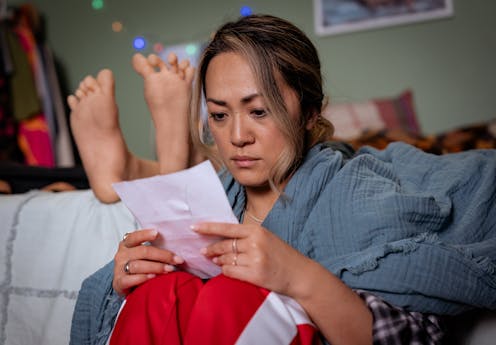
Much has been written and produced about white men’s fetishisation of Asian women[1] (crudely nicknamed “yellow fever”). The ABC’s comedy series White Fever[2] breaks new ground by exploring an Asian woman’s white man fetish in an Australian context.
Across six humorous and heartwarming episodes, protagonist Jane Thomas (Ra Chapman), a Korean adoptee, embarks on a tumultuous journey of coming to terms with her internalised racism.
“Internalised racism” refers to a racial minority’s tacit acceptance of negative understandings or stereotypes about their own racial group. Or as sociologist Karen Pyke explains[3], it’s the “internalisation of racial oppression by the racially subordinated”.
Despite its close links with white supremacy[4] and colonisation[5], it remains an issue that is largely omitted from public discussions about racism.
Jane’s ‘white fetish’
Episode one of White Fever sets the scene for how, despite appearing Asian, Jane is referred to as “whiter than most white people”. She was raised by white parents in a small country town. She enjoys meat pies[6], surrounds herself with white friends and is only sexually attracted to white “manly men” with ample body hair.
However, following an unsuccessful dalliance with a white bartender who has a liking for “petite and gentle” Asian women – and after being accused of not being able to date Asian men – Jane takes on the challenge of trying to land one.

Chaos and hilarity ensue as she unsuccessfully tries to woo a number of Asian men. And when she finds herself involuntarily repulsed by them, she seeks answers from Korean adoptee advocate and influencer Hera (Cassandra Sorrell).
From here, Jane is prompted to learn about the adoption of South Korean children, connect with fellow adoptees and, eventually, reconnect with her heritage by unlearning her internalised racism.
Upholding ideas of white supremacy
Internalised racism involves a minority group’s (conscious or subconscious) endorsement of a racial hierarchy that elevates white people above people of colour[7].
Working alongside other forms of oppression, it has insidious impacts[8] at an individual level, as well as within[9] and between[10] minority groups.
Internalised racism can manifest in many ways. It might involve people of colour fixating on white cultural norms[11], denying racism exists, or even resenting their own culture.
The latter is captured poignantly in White Fever. We see Jane’s refusal to speak her heritage language, which she then ultimately loses. We also see a flashback of her younger self referring to the town’s sole Asian (Cantonese) restaurateur as a “ping pong woman” and “mail-order bride”.
 After Jane (Ra Chapman) sees a video from Hera (Cassandra Sorrell) about how to ‘decolonise your libido’, the two meet in real life.
ABC
After Jane (Ra Chapman) sees a video from Hera (Cassandra Sorrell) about how to ‘decolonise your libido’, the two meet in real life.
ABC
Internalised racism also impacts self-image and beauty standards[12], such as through preferencing whiter skin[13] and shaming non-white-looking hair[14].
Collectively, these attitudes can influence people of colours’ individual racial identities and can result in psychological distress[15] or other adverse health impacts[16] such as maladaptive coping behaviours, depression, anxiety and lower life satisfaction and quality of life, to name a few. Negative stereotypes about one’s racial group can also become self-fulfilling prophecies[17], which may lead to a person of colour distancing themselves from their group.
For Asian populations in particular, internalised racism can fracture communities from within when certain members uphold and reinforce harmful stereotypes on others. This is also shown in my own research[18] on Asian communities in education spaces.
Beyond this, internalised racism has broader harmful effects in the form of anti-Blackness[19], which encompasses negative opinions and unfair treatment of Black people. In an Australian context this manifests as anti-Indigeneity.
What causes it?
Internalised racism is part of a broader system of racism which operates everyday[20] at systemic and institutional levels[21].
But racism can be hard to understand and define[22]. On one hand, it is a social construct that adapts to changing contexts. On the other, it reproduces harmful ideologies and behaviours that are all too familiar.
Racism’s complex, ever-changing and systemic nature helps to entrench internalised racism within minority groups. This makes it difficult to both recognise and work against.
In White Fever, Jane’s internalised racism – manifested in her willingness to egg the town’s Asian restaurant with her white schoolmates – is rewarded with a kiss from her white male crush, and her ongoing “friendship” with a white-dominant group.
Similarly, in real life, people of colour with internalised racism may be rewarded through an illusory sense of racial superiority. This form of “honorary whiteness[23]” is detrimental to their own group and other minorities.
 Jane’s ‘inner white woman’ manifests in the form of her childhood doll, Cindy (Susanna Qian).
ABC
Jane’s ‘inner white woman’ manifests in the form of her childhood doll, Cindy (Susanna Qian).
ABC
Is there a solution?
As Hera quips to Jane, internalised racism is “not your fault, but it is your responsibility”.
For Asian Australians and other racial minorities, challenging[24] internalised racism starts with recognising the way in which white supremacy operates[25].
In an Australian context, it means focusing on First Nations sovereignty[26] as a baseline for addressing broader racial inequity in Australia. This is a crucial first step in disassembling the systems of white supremacy[27] which are responsible for the ongoing displacement and oppression of First Nations peoples and, by extension, of other minorities.
It also means taking an anti-racist stance at home, at work[28], in the classroom[29] and beyond. It means speaking up, even when it feels uncomfortable.
And of course, this responsibility doesn’t just fall on racial minorities. White people can take on ally roles[30] by educating themselves about all forms of racism, understanding their privilege, listening non-defensively and speaking with friends and family about racial injustice.
Racism is everyone’s responsibility, and something we should feverishly work against together.
References
- ^ fetishisation of Asian women (www.smh.com.au)
- ^ White Fever (about.abc.net.au)
- ^ Karen Pyke explains (journals.sagepub.com)
- ^ white supremacy (itstopswithme.humanrights.gov.au)
- ^ colonisation (theconversation.com)
- ^ meat pies (edition.cnn.com)
- ^ above people of colour (theconversation.com)
- ^ insidious impacts (spssi.onlinelibrary.wiley.com)
- ^ within (www.ted.com)
- ^ between (link.springer.com)
- ^ fixating on white cultural norms (journals.sagepub.com)
- ^ beauty standards (projects.iq.harvard.edu)
- ^ preferencing whiter skin (www.theguardian.com)
- ^ shaming non-white-looking hair (www.abc.net.au)
- ^ in psychological distress (journals.sagepub.com)
- ^ other adverse health impacts (compass.onlinelibrary.wiley.com)
- ^ self-fulfilling prophecies (psycnet.apa.org)
- ^ own research (journals.sagepub.com)
- ^ anti-Blackness (centerforhealthprogress.org)
- ^ everyday (theconversation.com)
- ^ systemic and institutional levels (theconversation.com)
- ^ understand and define (theconversation.com)
- ^ honorary whiteness (books.google.com.au)
- ^ challenging (www.sbs.com.au)
- ^ white supremacy operates (theconversation.com)
- ^ First Nations sovereignty (www.sydney.edu.au)
- ^ systems of white supremacy (www.abc.net.au)
- ^ work (theconversation.com)
- ^ classroom (theconversation.com)
- ^ ally roles (itstopswithme.humanrights.gov.au)










