your guide to the 2024 Stella Prize shortlist
- Written by: Julieanne Lamond, Associate Professor of English, Australian National University
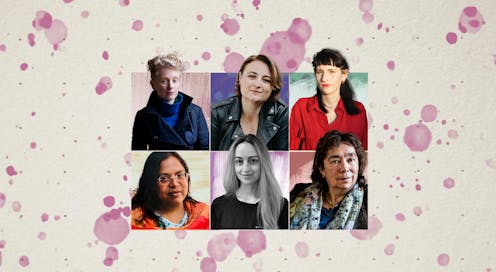
For more than a decade now, the Stella Prize[1], an award celebrating Australian women’s writing, has been changing Australia’s literary landscape. It has taken a monkey wrench to the way literary esteem is bestowed in this country. Its annual whack has shifted the calibration of what kinds of books are valued.
This year’s shortlist is, as we have come to expect, a celebration of unruliness, activism and vivid writing. Reading these books back to back, my overwhelming impression was one of emotional intensity. They are full of pain, shock, desire, anger, grief, horror and joy.
They are also marked by different forms of literary experimentation, particularly in their use of personal experience – whether in fiction, memoir, autofiction or lyric essay. It is not surprising that such experimentation is found in a shortlist published almost entirely by smaller and independent publishers, whose role in Australia’s literary industry has long been to support works that push the boundaries.
This year’s shortlist draws attention to works of literature that don’t offer much in the way of consolation, but might shake up how you see the world and your place in it.
The Swift Dark Tide – Katia Ariel

 Ultimo Press
Katherine Brabon’s Body Friend[3] is a hypnotic, uncomfortable novel about chronic pain and female friendship. The reader meets its protagonist, who lives with an autoimmune condition, as she is about to undergo surgery. The book follows her period of convalescence and pays careful attention to the details of embodied experience. What emerges is a many-sided picture of how pain shapes relationships and selfhood.
The story is based around two friendships that develop in the wake of the protagonist’s surgery. The intensity of these relationships and the forms of identification they allow feel at once surreal and lifelike.
The novel explores the deep pleasure of a friendship with someone who understands your experience and gives you permission to withdraw from the world. But it also looks at the power of friendship to open the door to new ways of being and push you to do more than you thought you could.
In addition to exploring different modes of responding to chronic pain, the relationships at the heart of Body Friend present friendship as sustaining and challenging, marked by the play of identification, attachment and jealousy.
Reading this novel was claustrophobic and compelling. Body Friend explores the difficulty of fitting pain or illness – especially that experienced by women – into available narrative frameworks. It dispenses with the notion of a satisfying plot of recovery. Its structure is cyclical and the pacing is slow, but it is gripping nonetheless.
Feast – Emily O’Grady
Ultimo Press
Katherine Brabon’s Body Friend[3] is a hypnotic, uncomfortable novel about chronic pain and female friendship. The reader meets its protagonist, who lives with an autoimmune condition, as she is about to undergo surgery. The book follows her period of convalescence and pays careful attention to the details of embodied experience. What emerges is a many-sided picture of how pain shapes relationships and selfhood.
The story is based around two friendships that develop in the wake of the protagonist’s surgery. The intensity of these relationships and the forms of identification they allow feel at once surreal and lifelike.
The novel explores the deep pleasure of a friendship with someone who understands your experience and gives you permission to withdraw from the world. But it also looks at the power of friendship to open the door to new ways of being and push you to do more than you thought you could.
In addition to exploring different modes of responding to chronic pain, the relationships at the heart of Body Friend present friendship as sustaining and challenging, marked by the play of identification, attachment and jealousy.
Reading this novel was claustrophobic and compelling. Body Friend explores the difficulty of fitting pain or illness – especially that experienced by women – into available narrative frameworks. It dispenses with the notion of a satisfying plot of recovery. Its structure is cyclical and the pacing is slow, but it is gripping nonetheless.
Feast – Emily O’Grady
 Allen & Unwin
You know when people say in praise of a novel, “I couldn’t put it down”? There were a few times when reading Emily O'Grady’s Feast[4] that I had to put it down because I was so shocked by what it had revealed about its characters.
O’Grady is in full force here. She is doing something quite new with the established genre of the domestic gothic. The novel opens with the scene of a rabbit caught in a trap and goes on to plumb the question: what enables people to wield and abuse power over others?
Feast takes place in an old house in the Scottish countryside, owned by retired actress Alison and her partner, a famous musician. The house is the setting for a birthday party at which multiple pasts are revealed.
The story is triangulated through the perspectives of Alison, her stepdaughter Neve, and Neve’s mother Shannon. These women are differently implicated in a devastating story of cruelty and control. Among the many things that impressed me about Feast is its creation of characters who feel as odd and confusing, appealing and awful, as people are in real life.
Praiseworthy – Alexis Wright
Allen & Unwin
You know when people say in praise of a novel, “I couldn’t put it down”? There were a few times when reading Emily O'Grady’s Feast[4] that I had to put it down because I was so shocked by what it had revealed about its characters.
O’Grady is in full force here. She is doing something quite new with the established genre of the domestic gothic. The novel opens with the scene of a rabbit caught in a trap and goes on to plumb the question: what enables people to wield and abuse power over others?
Feast takes place in an old house in the Scottish countryside, owned by retired actress Alison and her partner, a famous musician. The house is the setting for a birthday party at which multiple pasts are revealed.
The story is triangulated through the perspectives of Alison, her stepdaughter Neve, and Neve’s mother Shannon. These women are differently implicated in a devastating story of cruelty and control. Among the many things that impressed me about Feast is its creation of characters who feel as odd and confusing, appealing and awful, as people are in real life.
Praiseworthy – Alexis Wright
 Giramondo
Praiseworthy[5] is a novel that invites – perhaps requires – its readers to rethink their approach to reading fiction. Character, plot, setting, tone: all are called into question.
Allegory is at work – a central character is named “Aboriginal Sovereignty” – but as Mykaela Saunders has written[6], the literal and the metaphorical are not easily distinguished in the world of the novel.
The remote town of Praiseworthy is covered in an ancestral haze that carries a slippery metaphorical meaning. A kind of hero, Cause Man Steel, is driving the town (and his wife) crazy with his plan to ensure the survival of his people through a scheme to harness the transport energy of the country’s millions of feral donkeys, anticipating a time when the petrol runs out.
Through the madcap antics of Cause and his donkeys, a sharp thread of grief and rage is evident. This focuses on questions of climate emergency and assimilation, and the novel works in complex ways to provide a sense of what it feels like to be living at the pointy end of both. The latter is given unforgettable weight through the perspective of Cause Man Steel’s youngest son, whose inhalation of media hysteria about Indigenous communities has tragic consequences.
Wright does not make it easy to know what to think of all this: the Ancestors are at work, but they might have bigger fish to fry. Written in a register that is expansive and surprising, Alexis Wright’s prose is like nothing you will encounter elsewhere.
Hospital – Sanya Rushdi
Giramondo
Praiseworthy[5] is a novel that invites – perhaps requires – its readers to rethink their approach to reading fiction. Character, plot, setting, tone: all are called into question.
Allegory is at work – a central character is named “Aboriginal Sovereignty” – but as Mykaela Saunders has written[6], the literal and the metaphorical are not easily distinguished in the world of the novel.
The remote town of Praiseworthy is covered in an ancestral haze that carries a slippery metaphorical meaning. A kind of hero, Cause Man Steel, is driving the town (and his wife) crazy with his plan to ensure the survival of his people through a scheme to harness the transport energy of the country’s millions of feral donkeys, anticipating a time when the petrol runs out.
Through the madcap antics of Cause and his donkeys, a sharp thread of grief and rage is evident. This focuses on questions of climate emergency and assimilation, and the novel works in complex ways to provide a sense of what it feels like to be living at the pointy end of both. The latter is given unforgettable weight through the perspective of Cause Man Steel’s youngest son, whose inhalation of media hysteria about Indigenous communities has tragic consequences.
Wright does not make it easy to know what to think of all this: the Ancestors are at work, but they might have bigger fish to fry. Written in a register that is expansive and surprising, Alexis Wright’s prose is like nothing you will encounter elsewhere.
Hospital – Sanya Rushdi
 Giramondo
In Sanya Rushdi’s Hospital[7], the narrator – and thus the reader – is never clear about what is real. This is a work of autofiction, in which the protagonist shares a name and some biographical details with the author.
Hospital explores how Sanya, a student of psychology, navigates experiences of psychosis, medication and forced institutionalisation. She is living with and being treated for psychosis. The experience is one in which time slips, motivations are unclear, and personal agency is obstructed at every turn.
Family members call the Crisis Assessment and Treatment Team to visit Sanya at home, and their perceived role shifts from caring interlocutors to enforcers of a medication regime she actively resists. She is taken, in turn, to a group home and then to a hospital psychiatric ward, where she finds her analysis of her own situation undermined and ignored.
Translated from the Bengali by Arunava Sinha, Hospital is written in an understated tone that does not sensationalise the experiences it portrays. The use of first person is important in keeping the focus on Sanya’s thoughts and feelings, not on how she is diagnosed by others.
Abandon Every Hope: Essays for the Dead – Hayley Singer
Giramondo
In Sanya Rushdi’s Hospital[7], the narrator – and thus the reader – is never clear about what is real. This is a work of autofiction, in which the protagonist shares a name and some biographical details with the author.
Hospital explores how Sanya, a student of psychology, navigates experiences of psychosis, medication and forced institutionalisation. She is living with and being treated for psychosis. The experience is one in which time slips, motivations are unclear, and personal agency is obstructed at every turn.
Family members call the Crisis Assessment and Treatment Team to visit Sanya at home, and their perceived role shifts from caring interlocutors to enforcers of a medication regime she actively resists. She is taken, in turn, to a group home and then to a hospital psychiatric ward, where she finds her analysis of her own situation undermined and ignored.
Translated from the Bengali by Arunava Sinha, Hospital is written in an understated tone that does not sensationalise the experiences it portrays. The use of first person is important in keeping the focus on Sanya’s thoughts and feelings, not on how she is diagnosed by others.
Abandon Every Hope: Essays for the Dead – Hayley Singer
 Upswell
Abandon Every Hope[8] is a collection of lyrical essays that laments the violence meted out by humans against farmed animals. This violence is presented in brutal, shocking detail. The writing is always aware of the entanglement of human and animal lives.
Perhaps the most stunning, and shocking, essay in the collection is Inferno: an account of the effect of COVID on the interface between humans and farm animals in the United States, where restaurant closures and infections in processing plants led to the “inelastic agricultural supply chain” grinding to a halt.
But this is an industry that cannot just “stop” its work of breeding and slaughtering animals. New techniques were developed to euthanise millions of pigs and chickens. Poorly protected workers were infected in high numbers.
Like many of the essays in the collection, Inferno reveals how the farming of animals relies on a disregard for the rights of animals, and the humans who are employed to kill and “process” them.
Singer’s grief and her experiences during COVID are at the forefront of many of these essays. They are not easy reading. They take the reader directly into the slaughterhouse, and they are difficult to forget.
References^ Stella Prize (stella.org.au)^ The Swift Dark Tide (gazebobooks.com.au)^ Body Friend (ultimopress.com.au)^ Feast (www.allenandunwin.com)^ Praiseworthy (giramondopublishing.com)^ Mykaela Saunders has written (sydneyreviewofbooks.com)^ Hospital (giramondopublishing.com)^ Abandon Every Hope (upswellpublishing.com)
Upswell
Abandon Every Hope[8] is a collection of lyrical essays that laments the violence meted out by humans against farmed animals. This violence is presented in brutal, shocking detail. The writing is always aware of the entanglement of human and animal lives.
Perhaps the most stunning, and shocking, essay in the collection is Inferno: an account of the effect of COVID on the interface between humans and farm animals in the United States, where restaurant closures and infections in processing plants led to the “inelastic agricultural supply chain” grinding to a halt.
But this is an industry that cannot just “stop” its work of breeding and slaughtering animals. New techniques were developed to euthanise millions of pigs and chickens. Poorly protected workers were infected in high numbers.
Like many of the essays in the collection, Inferno reveals how the farming of animals relies on a disregard for the rights of animals, and the humans who are employed to kill and “process” them.
Singer’s grief and her experiences during COVID are at the forefront of many of these essays. They are not easy reading. They take the reader directly into the slaughterhouse, and they are difficult to forget.
References^ Stella Prize (stella.org.au)^ The Swift Dark Tide (gazebobooks.com.au)^ Body Friend (ultimopress.com.au)^ Feast (www.allenandunwin.com)^ Praiseworthy (giramondopublishing.com)^ Mykaela Saunders has written (sydneyreviewofbooks.com)^ Hospital (giramondopublishing.com)^ Abandon Every Hope (upswellpublishing.com)