How to look after your mental health while packing up Mum or Dad’s home
- Written by: Erika Penney, Lecturer in Clinical Psychology, University of Technology Sydney
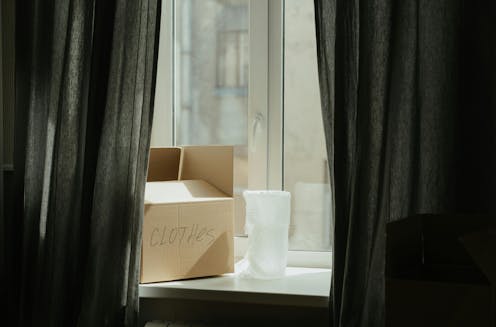
So Mum or Dad has died, or moved to aged care, and now you’ve got to pack up their house. It’s a huge job and you’re dreading it.
It’s normal to feel grief, loss, guilt, exhaustion or even resentment at being left with this job.
So how can you look after your mental health while tackling the task?
Read more: Why is a messy house such an anxiety trigger for me and what can I do about it?[1]
It’s OK to feel a lot of feelings
Research has documented how this task can exert an intense physical and emotional toll[2].
This can be more intense for those who had strained – or even traumatic[3] – relationships with the person whose house they’re packing up.
Decisions around distributing or discarding items can, in some families, bring up painful reminders of the past or end up replaying strained dynamics[4].
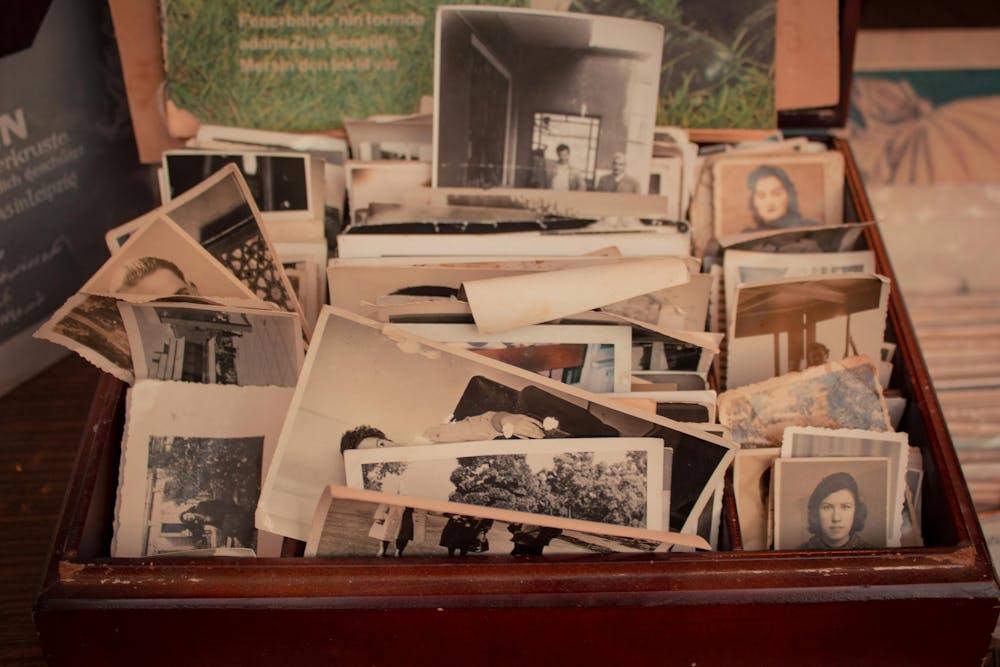
Family members who were carers for the deceased may feel exhaustion, overwhelm, burnout[6] or a sense of injustice they must now continue to be responsible for their loved one’s affairs. Grief can be compounded by the practical challenges of deciding how to store or discard belongings[7], arrange the funeral[8], execute the will, deal with the aged care place or, in some cases, navigate legal disputes.
But packing up the house may also be cathartic or helpful. Research[9] has shown how the task of cleaning out a loved one’s belongings can provide an opportunity for family and friends to talk, share memories, and make sense of what has just happened.
It’s also normal to grieve before someone dies. What psychologists call “anticipatory[10] grief” can happen to relatives packing up the house[11] of a parent who has moved to aged care or palliative care.
What to do with all this stuff?
Some[12] treat their loved one’s items with sanctity, holding onto as many of their belongings as possible and creating “shrines” in their honour.
Others alleviate the weight of grief by clearing out a loved one’s house as soon as possible, giving away, selling or discarding as much as they can.
But if you experience a mix of these – enthusiastically getting rid of some stuff, while desperately wanting to hold onto other things – that’s OK too.
One study[13] identified a process punctuated by four key periods:
numbness and overwhelm at the task of packing the house
yearning to maintain a link to the loved through their belongings
working through grief, anger and guilt regarding the loved one and the task of managing their belongings, and
healing and making sense of the relationship with the deceased and their belongings.
However, it is important to note everyone’s approach is different and there is no “right” way to do the clean out, or “right” way to feel.
 You might learn more about your loved one’s life as you sort through their belongings.
Photo by Tima Miroshnichenko/Pexels[14]
You might learn more about your loved one’s life as you sort through their belongings.
Photo by Tima Miroshnichenko/Pexels[14]
Caring for your mental health during the clean out
To care for your mental health during these difficult times, you might try to:
make space for your feelings, whether it’s sadness, loss, resentment, anger, relief or all the above. There is no right or wrong way to feel. Accepting[15] your emotions is healthier than suppressing them
share the load. Research[16] has shown practical support from close friends and family can help a lot with grief. Accept help with packing, planning, dealing with removalists, selling or donating items and cleaning. Don’t be afraid to reduce your mental load by delegating tasks to friends, who are likely wondering how they can help
take a systematic approach. Break tasks into their smallest component. For example, aim to clean out a drawer instead of an entire bedroom. This can help the mental and physical task feel more manageable
reflect on what’s meaningful to you. Some belongings will have meaning[17], while others will not. What was valuable to the deceased may not be valuable to you. Things they probably saw as pretty worthless (a handwritten shopping list, an old sewing kit) may be very meaningful to you. Ask yourself whether retaining a small number of meaningful possessions would allow you to maintain a connection with your loved one, or if clearing out the space and discarding the items is what you need
share your story. When you feel ready, share your “cleaning out the closet[18]” story with trusted friends and family. Storytelling allows the deceased to live on in memory. Research[19] also suggests we cope better with bereavement when friends and relatives make time to hear our feelings
remember that professional help is available. Just as a solicitor can help with legal disputes, a mental health professional can help you process your feelings.
 Accept help from friends.
Photo by Blue Bird/Pexels[20]
Accept help from friends.
Photo by Blue Bird/Pexels[20]
The home of your loved one is not merely a place where they lived, but a space filled with meaning and stories.
Packing up the house of a loved one can be incredibly daunting and challenging, but it can also be an important part of your grieving process.
Read more: We talked to dozens of people about their experience of grief. Here's what we learned (and how it's different from what you might think)[21]
If this article has raised issues for you, or if you’re concerned about someone you know, call Lifeline on 13 11 14.
References
- ^ Why is a messy house such an anxiety trigger for me and what can I do about it? (theconversation.com)
- ^ physical and emotional toll (www.tandfonline.com)
- ^ traumatic (journals.sagepub.com)
- ^ replaying strained dynamics (journals.sagepub.com)
- ^ Photo by Miray Bostancı/Pexels (www.pexels.com)
- ^ burnout (onlinelibrary.wiley.com)
- ^ store or discard belongings (doi.org)
- ^ arrange the funeral (www.jstor.org)
- ^ Research (www.tandfonline.com)
- ^ anticipatory (pubmed.ncbi.nlm.nih.gov)
- ^ relatives packing up the house (www.ncbi.nlm.nih.gov)
- ^ Some (doi.org)
- ^ study (www.tandfonline.com)
- ^ Photo by Tima Miroshnichenko/Pexels (www.pexels.com)
- ^ Accepting (guilfordjournals.com)
- ^ Research (onlinelibrary.wiley.com)
- ^ meaning (doi.org)
- ^ cleaning out the closet (www.tandfonline.com)
- ^ Research (onlinelibrary.wiley.com)
- ^ Photo by Blue Bird/Pexels (www.pexels.com)
- ^ We talked to dozens of people about their experience of grief. Here's what we learned (and how it's different from what you might think) (theconversation.com)