Changeling warrior Robyn Davidson has never been lost. She’s a seeker with the courage to keep looking
- Written by: Sally Breen, Associate Professor, Griffith University
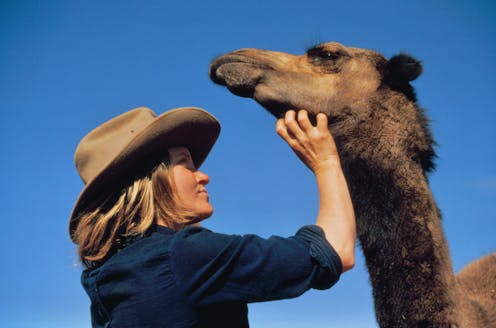
Most people know Robyn Davidson as the camel lady, a young woman of 27 who walked over 2,700 kilometres across Australian deserts to the sea with four camels and a dog. A journey captured in her 1980 memoir Tracks[1].
The vivid images commissioned by National Geographic[2], which beamed around the world at the time or those recalled from the 2014 film version of Tracks (starring Mia Wasikowska): how iridescent blue the ocean was on a deserted beach in Western Australia, how regal and accomplished the camels appeared in their watery playground, but most of all Davidson – brown as a nut and beautiful and something else – unflappable, warrior-like, assured.
I, like millions of others, adored her instantly. The story was compelling, but it was the power captured in those images that made Davidson a global celebrity. Tracks, now in its fortieth edition and published in over 20 languages, has never been out of print. But while interest in the book has never waned, few people know exactly why she spent nine months in the desert. What had drawn or taken her there.
Review: Unfinished Woman – Robyn Davidson (Bloomsbury)
Her motivations are not mentioned in detail or are avoided in Tracks where the focus is on what she is moving within (her developing relationship with country) and toward (an unmapped future). The reasons for the journey were private. But the bullet train of people’s interest in her was already in motion. In a 2015 interview[3] she said,
The more I tried to disappear underneath the radar, the more private I wanted to be, the more people wanted to know about it, to be involved with it somehow. And that has continued.

In Unfinished Woman, Davidson’s first book in over 20 years, we come closer to knowing her. We learn about where this extraordinary self-determination came from and what propelled her into (what was for her, at least initially,) the unknown. We come to know about before. The moment happens a few pages in, when Davidson writes the astonishing line, “My mother hanged herself from the rafters of our garage, using the cord of our electrical kettle.” She then asks, “Where can I go with a sentence like that?” Where indeed.
Davidson, who was 11 at the time her mother died[4], went many places. She moved interstate at 19 and squatted in abandoned terraces in Sydney. She dated a gangster and worked as a croupier in underground, illegal gambling dens. She traversed a continent. Moved to London and lived in dingy flats and wrote Tracks. She was given a cottage to live in by novelist Doris Lessing[5] and spent time with the literary establishment, absorbing words but hating the pretension and the envy.
She followed and documented nomadic peoples in India and Tibet, developing deep connections with many women who were not as free as she was to traverse a wider earth. She “married” a Rajput prince and got to their house in the Himalayas for the first time by way of an elephant. Davidson is a beauty, but it takes a rare kind of person to be able to walk into the different arenas just described and be embraced, confided in, taken on, loved.
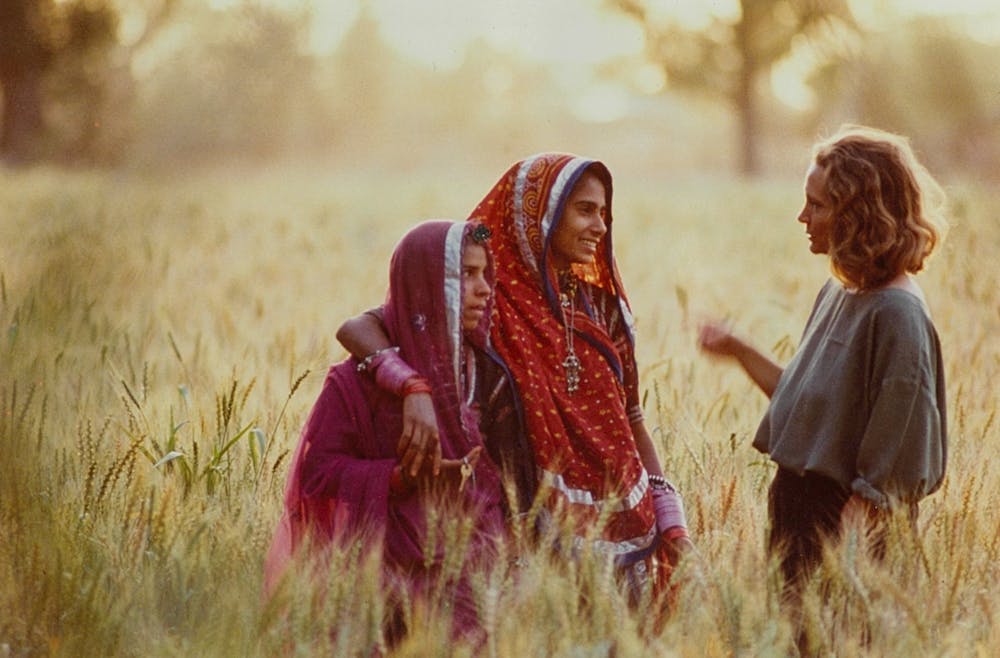 Robyn in Rajastan circa 1990.
Bloomsbury Publishing
Robyn in Rajastan circa 1990.
Bloomsbury Publishing
Read more: Tracks, a film that lets a woman thrive in the outback[6]
The maelstrom
Davidson’s face didn’t get her to where she needed to go – she went anyway, sometimes ill advised. Her unique philosophy and drive was formed in a defining moment she documents in Unfinished Woman a short time after her mother’s suicide where she cleaved from the world into nihilism.
I don’t know why it was on that ordinary afternoon there was a sudden shift, or breach in the appearance of things. Of things as they seem. Not a vision exactly, because nothing changed outwardly. But rather an insight that penetrated the everyday world and caved it in […] I sat down by a tree but it was no longer a tree, a life form one could feel kinship with, it was a whirlwind of energies streaming into a tree-shaped funnel […] The agreed upon world trees, leaves and people was something we draped over the top of the maelstrom to protect ourselves from the truth.
 Robyn and her mother in 1950.
Bloomsbury Publishing
Robyn and her mother in 1950.
Bloomsbury Publishing
From that moment, Davidson would be adrift. Some of that free-fall was monstrous and painful but mostly this understanding provided her with a portal – a connection to infinity she’d tuned into and tried so hard to make sense of, wandering with her “kind, faraway Dad” in big sky spaces in Queensland, especially at their property Malabah – evoked throughout the book like a psalm.
To live conventionally would have betrayed that knowledge she describes as moving inside her “like a huge snake”. Some would say to live unconventionally was a movement against her mother’s fate and the times. But it was more than that. The choice to live unbound was existential.
Continents slammed together, crumpled, melted like cheese. Stars exploded, suns collapsed to the size of fists, oceans froze or boiled away, galaxies collided, ripping each other to wisps, and nothing, nothing at all was solid, nothing held still, reality was this and only this: an apocalypse consuming itself, shitting itself out, eternal, merciless […] and where was ‘I’ in the tumult? What and where?
Davidson’s natural habitat is not singular – it is not a particular place, vocation, or family unit – though all these things have reverberated in her at times, her sense of home could not be contained for long.
I would not remain in any of these worlds: that is, make them my home. Homes were things it was necessary to escape from. If you did not leave them, what happened to future selves. If you did not leave them, you were stuck with remaining who you were.
Davidson’s natural habitat is a way of being. As such, tripping around the intricacies of her mind – the selves she describes as the “different frames” she uses to move between worlds – is at times unsettling. The chaos of thought, a life lived in discontinuous passages can leave you feeling unmoored.
Then there is illumination. The kind of poetic and deeply felt connection to place and sometimes, people, Davidson depicts is breathtaking. She is not looking at landscape, she is sending us missives from the inside.
At eight thousand feet the air had a sharp quality; nothing was out of focus. Sound, particularly thunder, rolled around the slopes unmuffled. Storms could be extreme, horizontal sleet blasting from the north-eastern side, from the line of shattered white peaks along the horizon […] as well there were transformations of monsoon, when oaks grew beards of lichen; fungi fruited from earth, trees, log, dry gullies became waterfalls; leeches longed for you to pass by. Rain came down so heavily on the roof that you ducked instinctively […]
Emotional power and sensory wonder
I’m not sure I agree with critics who say[7] her inability to get at the crux of something, her “loss for words” is linked to her mother’s suicide – that she is trying to pick through and make sense of the subsequent trauma she carried would be only part of the story. For Davidson, her mother is a multitude of visions and contradictions – “under cement” or vividly drawn, never thought about, then thought about all the time. And while she lost her so young and ran from those memories and then struggled to reconstruct them, the writing about her mother is, in a strange convergence, full of emotional power and sensory wonder.
In my memory there are bits of her floating around in a kind of fog – hands, smells, veins, phrases, shoes, a crocodile-skin handbag and its contents, the smell of Helena Rubenstein lipstick, a gold tooth, fine pale hairs on her arms, goosebumps, a crystal stopper being dabbed in the crook of an elbow, nervy fingers twisting rings, fingers twitching as she holds my hand […]
When it comes to representations of selfhood, Davidson is slippery, suggesting being convinced of who we are is a delusion, an exercise in narrative control she doesn’t want to enter into. It does take courage to allow yourself to fragment, and I sense a large part of Davidson has always been ephemeral, drifting, hovering at the high altitude she loved so much in her sky home in the Himalayas. Another frequency. Not really of the man-made world with its straight lines and demarcations, its restrictive real jobs and endless, mind-numbing suburbs.
Read more: How to write about broken trust in a memoir? Janine Mikosza’s Homesickness maps trauma in bold new ways[8]
A struggle
From the outset, Davidson signals she’s never played her cards straight in life and she’s not about to start doing so with her readers, refusing to be neatly categorised by triggering experiences or the expectations of form. In this way Davidson is being true to herself.
Perhaps she resisted the editorial intervention I craved because that would have created an artificial veneer, a sense of refined continuum, her life – indeed any life – does not have. To do so was a risk but Davidson is a changeling. A curlew darting between shadow spaces then suddenly still. Frozen by the notion of being watched, the strange awareness of artificial light.
She struggled for a long time to write this book and at times it shows. Passages written in different moments can overlap or seem incongruous, repetitions and non-linear time frames you must make sense of on your own.
The writing stalled and stalled. A hundred beginnings thrown away, pages and pages of notes stored in boxes, then forgotten. Nothing seemed quite right, or quite true, the memories too scattered, too untrustworthy. Everything I wrote was like debris in a centrifuge, at the core of which, exerting all the power, that purely mathematical point, my imaginary mother.
Is this a frustrating headspace to encounter? Certainly. And maybe this is the point – this is not a Sunday afternoon spent dipping into the juicy gossip of literary celebrity – she did once date Salman Rushdie, after all, a relationship referred to obliquely as “The Catastrophe”.
Unfinished Woman is confounding and moving simultaneously and that’s why this review has also been hard to write. I resisted for months. At first, I was hesitant about wrestling with an idol, but I’ve come to realise Davidson doesn’t want to be fully captured. Even by herself. Though her literary gestures would suggest otherwise.
 Bloomsbury Publishing.
Her beguiling face on the cover of this book has followed me on planes challenging me to know her. Her wry smile suggesting the more I read, the less I’d know – how this probably wouldn’t work out, despite the fact she’d written almost 300 pages telling me it would. Davidson has sat next to me in bars. Stared up at me from ornate chairs in Bali, bedside tables in dim hotel rooms in Melbourne, peeking above menus in my local cafe. I kept turning the book over. Because at least on the back cover she is not looking into my eyes.
I have seen reviews of Unfinished Woman or press materials riddled with throwaway lines like: this is a book about a woman who doesn’t belong anywhere – and it’s hard for me to understand that take. Why people confuse curiosity with restlessness and perpetual movement with being lost. Davidson walked across the middle of Australia and never got lost. She spent months in bed in a mental health crisis and crawled out.
On a ten-day pilgrimage to the peaks in the Himalayas she and her dog Malaki were stalked by a panther and she “came to understand viscerally what it means to be prey.” She built a fire, the dog in her lap and waited out the night. She has belonged profoundly and deeply to many places. Has fallen in and out of love with many people.
Her sense of connection is not parochial, it is not delineated or owned. It is not that Davidson doesn’t fit anywhere it is that she blends into multitudes.
Most people don’t fit where they stay but they stay anyway. Davidson had the courage to keep on looking. She is a seeker. A philosopher but not the ivory tower kind. She has tested her theories in open air cathedrals. In life. Go into this book without a compass and she is more than worth your time.
If this article has raised issues for you, or if you’re concerned about someone you know, call Lifeline on 13 11 14.
References^ Tracks (www.goodreads.com)^ commissioned by National Geographic (www.nationalgeographic.com)^ interview (www.youtube.com)^ who was 11 at the time her mother died (www.smh.com.au)^ Doris Lessing (www.britannica.com)^ Tracks, a film that lets a woman thrive in the outback (theconversation.com)^ who say (www.startribune.com)^ How to write about broken trust in a memoir? Janine Mikosza’s Homesickness maps trauma in bold new ways (theconversation.com)
Bloomsbury Publishing.
Her beguiling face on the cover of this book has followed me on planes challenging me to know her. Her wry smile suggesting the more I read, the less I’d know – how this probably wouldn’t work out, despite the fact she’d written almost 300 pages telling me it would. Davidson has sat next to me in bars. Stared up at me from ornate chairs in Bali, bedside tables in dim hotel rooms in Melbourne, peeking above menus in my local cafe. I kept turning the book over. Because at least on the back cover she is not looking into my eyes.
I have seen reviews of Unfinished Woman or press materials riddled with throwaway lines like: this is a book about a woman who doesn’t belong anywhere – and it’s hard for me to understand that take. Why people confuse curiosity with restlessness and perpetual movement with being lost. Davidson walked across the middle of Australia and never got lost. She spent months in bed in a mental health crisis and crawled out.
On a ten-day pilgrimage to the peaks in the Himalayas she and her dog Malaki were stalked by a panther and she “came to understand viscerally what it means to be prey.” She built a fire, the dog in her lap and waited out the night. She has belonged profoundly and deeply to many places. Has fallen in and out of love with many people.
Her sense of connection is not parochial, it is not delineated or owned. It is not that Davidson doesn’t fit anywhere it is that she blends into multitudes.
Most people don’t fit where they stay but they stay anyway. Davidson had the courage to keep on looking. She is a seeker. A philosopher but not the ivory tower kind. She has tested her theories in open air cathedrals. In life. Go into this book without a compass and she is more than worth your time.
If this article has raised issues for you, or if you’re concerned about someone you know, call Lifeline on 13 11 14.
References^ Tracks (www.goodreads.com)^ commissioned by National Geographic (www.nationalgeographic.com)^ interview (www.youtube.com)^ who was 11 at the time her mother died (www.smh.com.au)^ Doris Lessing (www.britannica.com)^ Tracks, a film that lets a woman thrive in the outback (theconversation.com)^ who say (www.startribune.com)^ How to write about broken trust in a memoir? Janine Mikosza’s Homesickness maps trauma in bold new ways (theconversation.com)