

As the world heats up, solar panels will degrade faster – especially in hot, humid areas. What can we do?
- Written by Shukla Poddar, Postdoctoral Research Fellow, School of Photovoltaics and Renewable Energy Engineering, UNSW Sydney
To reach the goal of 82% renewable energy in Australia’s grid by 2030, we’ll need to build a lot more solar[1].
But even as we accelerate the rate at which we install solar on our rooftops and in grid-scale farms, the world keeps getting hotter and extreme weather arrives more often.
Solar panels have to be outside, exposed to all weather. They’re built to endure heat, snow, rain and wind. But they have limits. Climate change will mean many panels can degrade faster.
Our new research[2] examines which areas of Australia will have the worst conditions for solar degradation out to 2059 – and what it will do to the cost of energy. We found solar in Australia’s hot, humid north will degrade fastest, while solar in the arid interior and more moderate climates down south will fare better.
What makes solar panels degrade?
When you’re looking to install solar on your rooftop, the warranty will likely be a factor in your eventual choice. Most solar manufacturers offer a 25-30 year warranty, where they guarantee power output will drop by less than 20% over that time.
The reason the power output drops at all is that solar panels slowly degrade over time. But different climates, different materials and different manufacturing techniques can lead to faster or slower degradation.
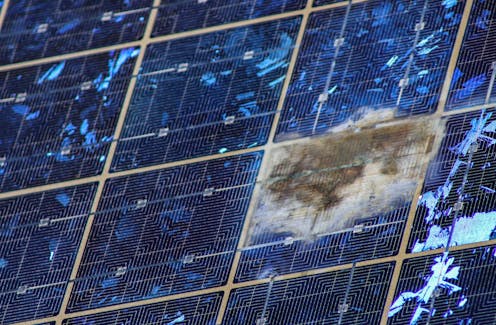
At present, the dominant solar technology is silicon. Silicon modules degrade due to stress from the environment, voltage changes and mechanical stresses, as silicon wafers are quite stiff and brittle. Environmentally, humidity, ultraviolet radiation and temperature are the main causes of damage.
Read more: Climate change will affect solar power and grid stability across Australia – here's how[3]
Hotter, more humid conditions can accelerate degradation in several ways. The map below combines four types of degradation we predict will worsen under climate change. These are:
delamination: heat and humidity can cause the bonds holding the different layers of the cell together to lose adhesion
discoloured encapsulant: intense sunlight and extra moisture can damage or discolour the encapsulant, the polymer used to adhere layers within the solar cell together
ribbon corrosion: if it’s more humid more often, it increases the chances moisture can accumulate and begin corroding the internal ribbon connections of the cell
internal circuit failure: solar cells experience regular temperature fluctuations, daily and seasonally. These temperature changes can over time cause circuits to fail. A hotter world will add extra stress to internal circuits, leading to a higher chance of failure.
What will climate change do?
Our results predict degradation rates will increase across Australia out to 2059 under both high and low emissions scenarios[4] laid out by the Intergovermental Panel on Climate Change.
Under a high emissions scenario, solar would degrade twice as fast as it would under a lower emission scenario due to the extra heat. Solar farms would be able to produce less power and might have to replace panels due to failure more often. On average, this would mean losing about 8.5% of output due solely to extra degradation by 2059. Under a high emissions scenario, this would mean energy could cost 10-12% more.

But the effects wouldn’t be felt equally. Our results show solar built across the hot and humid north of Australia will degrade at especially high rates in the future compared to the arid centre, where conditions are hot but dry.
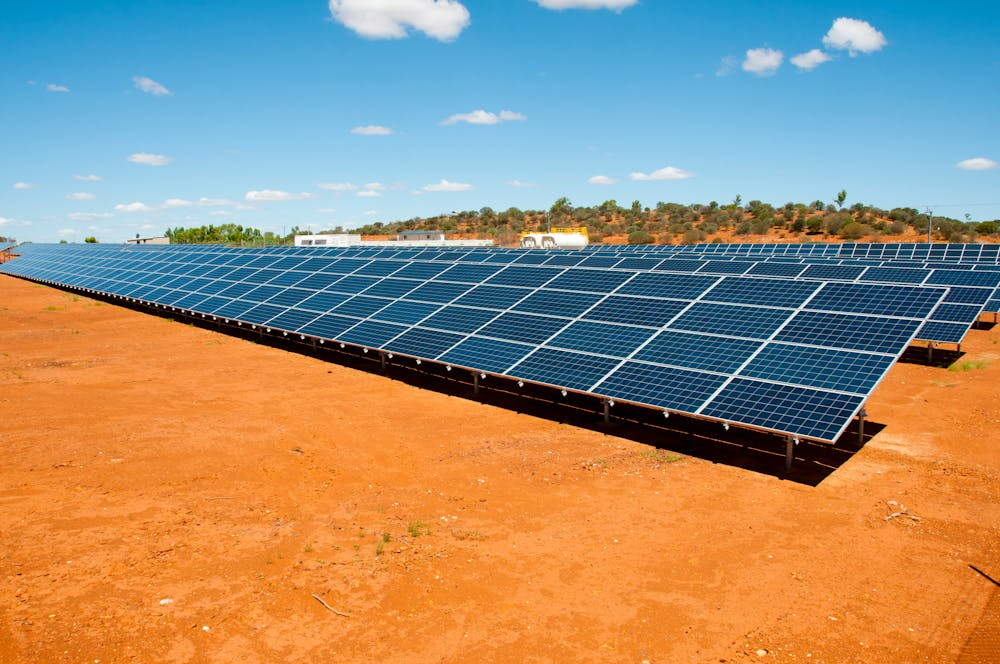 Solar in hot, dry conditions will fare better than hot and humid areas.
Adwo/Shutterstock[5]
Solar in hot, dry conditions will fare better than hot and humid areas.
Adwo/Shutterstock[5]
What should we do?
Heat is the main way solar panels degrade and break in Australia. As the world heats up, it will go from annoyance to very real problem.
At present, very few solar developers are taking climate change into account when they buy their panels. They should, especially those operating in humid areas. They can be more careful while selecting a new solar farm location to ensure their modules have lower chances of failure due to degradation.
To fix the problem, we’ll need to incorporate new ways of cooling panels and improve the materials used. We also need to improve manufacturing processes and materials so we can stop moisture from accumulating inside the panels.
These issues can be fixed. The first step is to understand there is a problem.
Read more: The sunlight that powers solar panels also damages them. 'Gallium doping' is providing a solution[6]
References
- ^ lot more solar (aemo.com.au)
- ^ new research (doi.org)
- ^ Climate change will affect solar power and grid stability across Australia – here's how (theconversation.com)
- ^ high and low emissions scenarios (www.climatechangeinaustralia.gov.au)
- ^ Adwo/Shutterstock (www.shutterstock.com)
- ^ The sunlight that powers solar panels also damages them. 'Gallium doping' is providing a solution (theconversation.com)